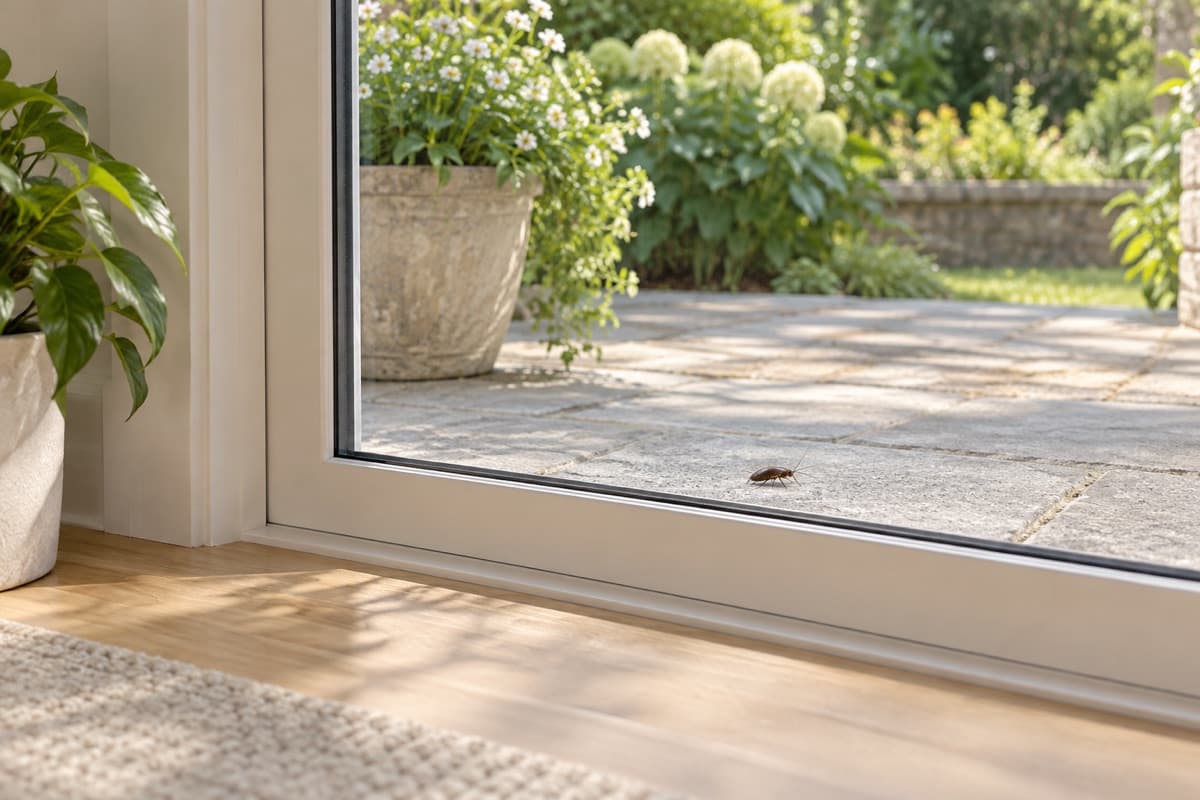
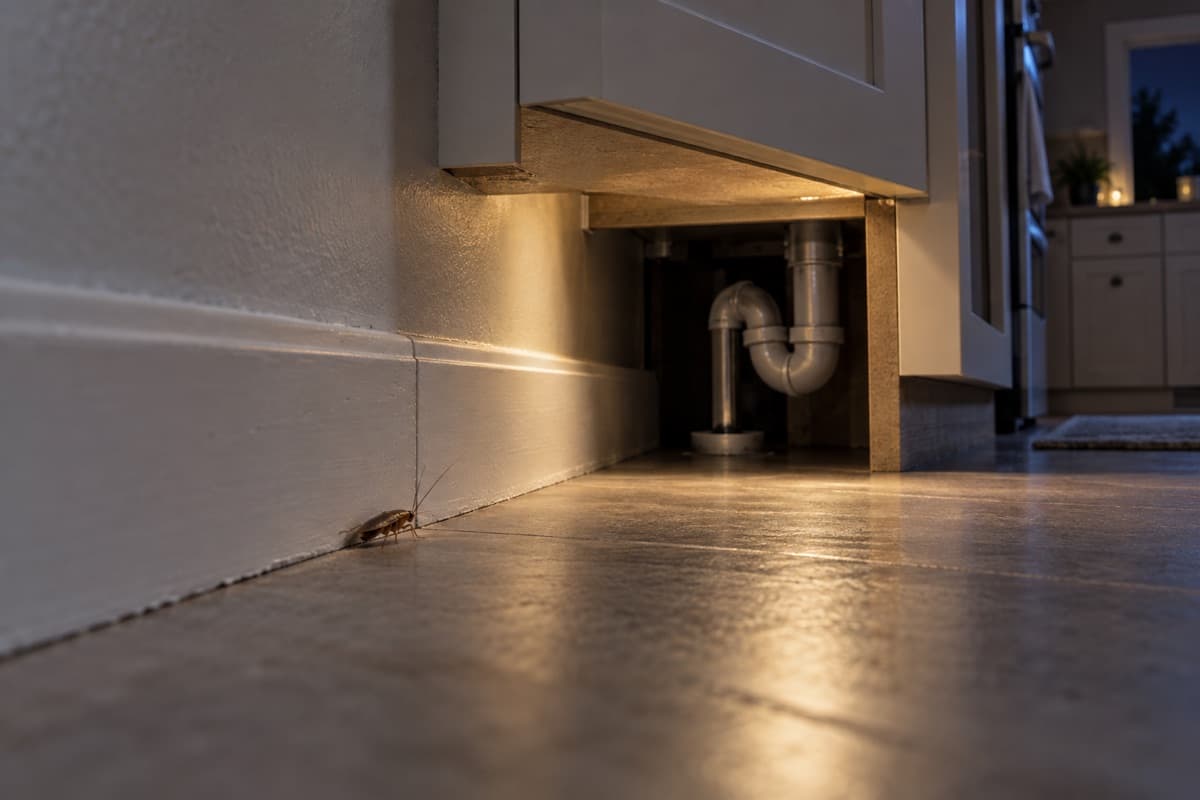
There is nothing you should pour down a drain to kill roaches, and the premise misreads the problem. Large reddish-brown roaches appearing at a drain are almost always American or Oriental cockroaches that live in the sewer system and enter buildings through lower levels and sewers, not a colony breeding inside your pipes. They get in through a dry P-trap, a missing cleanout cap, or a gap where a pipe passes through the floor — the CDC notes that sewer gases enter buildings through dry sanitary sewer drain traps, and anything that lets gas through lets an insect through. The fix is a water seal, a cover, and sealed penetrations. Meanwhile the things people pour are genuinely dangerous: mixing bleach with ammonia produces toxic chloramine gases, caustic drain cleaners cause chemical burns, and consumer insecticide labels flatly prohibit it — Raid's label reads "Do not allow to enter indoor or outdoor drains."
The previous version of this article correctly said not to pour things down the drain, then recommended bay leaves, cucumber slices, and essential oils as roach deterrents. Those are not supported by evidence and have been removed. It also treated all roaches at a drain as one problem. They are not.
First, Work Out Which Roach You Have
This determines everything that follows.
- American cockroach. Large, reddish-brown, 1.5 to 2 inches, with pale banding around the pronotum and functional wings. Texas A&M AgriLife Extension calls it one of the most common cockroaches in sewer systems. Penn State Extension places them "in and around bathtubs, clothes hampers, floor drains, pipe chases, and sewers."
- Oriental cockroach. Large, very dark brown to black, roughly 1.25 inches, cannot fly. EPA's IPM training material describes them as "common in sewers and humid dirty places," entering through lower levels.
- German cockroach. Small, about half an inch, pale brown with two dark stripes behind the head. This one does not come from the sewer. Penn State Extension notes German cockroaches live indoors, in "cracks and crevices and other dark sites," concentrated in kitchens and bathrooms. If you are seeing small striped roaches on your counters, the drain is a red herring and you have a breeding population in the room.
- Drain flies. Small, fuzzy, dark, about an eighth of an inch, moth-like wings held roof-like at rest. Not roaches at all. Their larvae live in the organic film on the inside of the pipe.
If you are not sure, how to figure out where roaches are coming from walks through the inspection that settles it.
What Not To Pour, and Why
Bleach plus ammonia, or bleach plus any acid. This is the one that sends people to the emergency room. Washington State Department of Health is unambiguous: "Don't mix bleach with ammonia, acids, or other cleaners." Bleach and ammonia produce chloramine gases; bleach and acid release chlorine gas. Symptoms include coughing, chest pain, shortness of breath, and in serious exposures pneumonia and fluid in the lungs. Remember that a drain is a confined space you are leaning over, that urine and some cleaners contain ammonia, and that toilet bowl cleaner and rust remover are acidic. You can create this reaction without ever intending to mix anything.
Caustic drain cleaner. Poison Control describes the ingredients plainly — sulfuric and hydrochloric acids, sodium and potassium hydroxide — and warns that exposure causes severe chemical burns. These products are formulated to dissolve hair and grease, not to kill insects. They splash back, they react with whatever is already in the trap, and they do nothing to a roach sitting in a dry line ten feet away.
Boiling water. Popular and mostly harmless in a cast-iron system; less benign in modern plastic. Charlotte Pipe rates PVC systems for operating temperatures not exceeding 140°F, and boiling water is 212°F. Repeated pours stress solvent-welded joints. It also does not solve a drain-fly problem: UC IPM states that "a common misconception is that pouring boiling water and/or bleach down a drain will control these flies. However, these treatments do not remove the organic film within the drain; and they provide at best short-term control."
Insecticide. Consumer insecticide labels prohibit it. The EPA-accepted label for Raid Ant & Roach 26 carries an explicit restriction — "Do not allow to enter indoor or outdoor drains" — and in disposal instructions, "Never place unused product down any indoor or outdoor drain." Because that label also states "It is a violation of Federal law to use this product in a manner inconsistent with its labeling," pouring it down a drain is both prohibited by the label and a FIFRA section 12(a)(2)(G) issue.
Anything else, if you are on septic. The EPA's guidance on caring for a septic system is direct: do not pour "liquid wastes (such as pesticides, drain cleaners, household chemicals, paints, paint thinners)" down the drain, because they harm the bacteria that make the system function and can reach groundwater.
Baking soda and vinegar. Harmless, and briefly satisfying, but the fizz is carbon dioxide from an acid-base reaction. It does not kill insects and it does not strip biofilm.
What Actually Works
1. Restore the water seal in every trap
A P-trap holds a plug of water that blocks the sewer from the room. When a drain goes unused, that water evaporates and the barrier disappears. Texas A&M AgriLife Extension's recommendation is exactly this: keep P-traps "filled with water to create a barrier between the sewer and the home or business," and pour water down every drain weekly when it is not routinely used.
Do this for guest bathrooms, basement floor drains, laundry standpipes, utility sinks, and any shower you have not used in a month. A cup of water takes ten seconds. In a drain that dries out repeatedly, a plumber can install a trap seal primer that feeds it automatically.
2. Cover the openings you cannot keep wet
Fine-mesh drain covers or screens over floor drains and tub overflows physically stop a large roach. Keep sink and tub stoppers closed overnight, when American and Oriental cockroaches forage. These are cheap and they work because sewer species are transient visitors, not residents.
3. Seal around pipe penetrations
This is the entry point people miss. EPA's cockroach module is specific: seal openings where pipes enter under sinks, because cockroaches "will come up from basements and sewers into the facility" through them. Look under every sink, behind the toilet, behind the dishwasher, at the washing machine standpipe, and anywhere a supply or drain line passes through a wall or floor. Copper mesh is a good temporary fill; escutcheon plates or a permanent patch for larger holes. Texas A&M also recommends sealing "openings around plumbing fixtures, furnace flues, electrical outlets, windowsills and walls."
While you are at it, add door sweeps. Sewer species that come up a manhole in the yard get in at the bottom of the door just as readily. How to keep roaches out of your yard covers lowering that outdoor pressure.
4. Clean the drain mechanically, if you have drain flies
If what you actually have is drain flies, the answer is a stiff bristle brush scraped along the inside of the pipe to remove the organic film where eggs are laid and larvae feed — UF/IFAS recommends exactly that, and notes that applying *Bacillus thuringiensis* serotype *israelensis* (Bti) reduced drain fly emergence by 79%. Enzymatic drain products that digest biofilm help maintain it. Chemicals that disinfect but do not strip the film do not.
5. Bait and monitor, in the right places
For sewer species, gel bait can be applied outdoors at entry points — the Advion Cockroach Gel Bait label specifically lists "sewer areas," pest entry sites, and garbage holding areas, and indoors lists "floor drains (to sewers)" among non-food areas. Note the label also prohibits applying residual sprays to baited surfaces and vice versa. Sticky monitors near drains tell you whether the problem is one wanderer a week or a steady stream. How many roach traps you need covers a monitoring plan that gives you an answer rather than a vibe.
If the striped small roaches turn out to be German cockroaches, the plan is different and the drain is irrelevant: gel bait in cracks near harborage plus an insect growth regulator. How to use an IGR for roaches explains where that fits.
6. Fix the moisture
Sewer species need humidity. A dripping trap arm, a sweating cold-water line, a slow toilet leak, and a damp crawl space all sustain them near your foundation. What attracts roaches and how to remove each attractant goes through the list.
When a Sewer Line Inspection Is Warranted
A camera inspection of the sewer lateral is worth the money when:
- Large roaches keep appearing after every trap is sealed, covered, and wet.
- You also get recurring sewer odor with no dry trap to blame.
- Drains are slow, gurgle, or back up.
- The house is old enough for clay, cast iron, or Orangeburg pipe.
- There are mature trees between the house and the street.
A cracked or root-invaded lateral is both a pest highway and a sanitary problem. Note that the homeowner usually owns it: the San Francisco Public Utilities Commission states plainly that "the upper sewer lateral is an extension of your home, even if you can't see it, which means you're fully responsible for it," and asks residents to report suspected structural problems. Rules differ by city, so check with your local utility before assuming the repair is yours or theirs.
In an apartment or condo, the shared stack is management's problem, and a written maintenance request creates the record you will want later. What to do if your neighbors have roaches covers how to escalate that in a multi-unit building.
Frequently Asked Questions
Can roaches actually come up through a drain?
Yes, when the trap is dry. The water seal is the only barrier, and an empty trap is an open tunnel to the sewer. This is why the CDC lists sewer gases entering through dry sanitary sewer drain traps as a hazard when buildings sit unused. Sewer roaches also travel through cracked laterals and unsealed pipe penetrations rather than up through a working trap.
Do roaches live and breed inside my drain pipes?
Sewer species live in the sewer system, in floor drains, manholes, and pipe chases — not inside your sink trap. German cockroaches, the small striped ones, breed in warm cracks near food, such as behind a dishwasher motor or under a refrigerator, not in water.
Will bleach down the drain kill them?
No, and it creates risk. Bleach does not persist in a flowing drain, does not reach where the roaches are, and reacts dangerously with ammonia and acids. UC IPM says outright that bleach poured down a drain does not remove the organic film and provides at best short-term results even against drain flies.
Is boiling water safe for my pipes?
Occasionally, probably. Routinely, no, in a plastic system. PVC drain, waste, and vent systems are specified for operating temperatures not exceeding 140°F. Repeated 212°F pours degrade solvent-welded joints over time.
What about pouring bleach or insecticide into a floor drain in a basement?
Do not put insecticide in a drain — consumer labels prohibit it, and it goes straight to the wastewater plant or your septic field. For a floor drain, the correct maintenance is water to keep the trap sealed and a fitted cover to block entry.
I only see one big roach every few nights. Is that an infestation?
Usually not. A steady trickle of large roaches with no small ones and no droppings in cabinets is the signature of sewer species wandering in. Finding small striped roaches, egg cases, or pepper-like droppings in the kitchen is a different and more urgent problem.
Why do I see them more in summer, or after rain?
Sewer and outdoor populations move when their environment changes. Heavy rain floods harborage and pushes American cockroaches upward and outward; heat and drought drive them toward moisture indoors. Seal the openings before the weather does the recruiting.
Sources
- US EPA, Managing Cockroaches in Child Care Centers, IPM Module 6 — American and Oriental cockroaches entering through lower levels and sewers, and sealing openings where pipes enter under sinks.
- Texas A&M AgriLife Extension: Cockroach Biology and Management — species identification, American cockroaches in sewer systems, floor drains as entry points, and keeping P-traps filled.
- Penn State Extension: American Cockroaches — habitat in bathtubs, hampers, floor drains, pipe chases, and sewers; size and biology; exclusion and baiting.
- Penn State Extension: German Cockroaches — indoor-only habits, and why residual sprays and foggers are of little value.
- CDC: Reopening Buildings Guidance, Control Legionella — sewer gases entering buildings through dry sanitary sewer drain traps.
- Washington State Department of Health: Dangers of Mixing Bleach with Cleaners — chloramine and chlorine gas formation, symptoms, and where ammonia and acids hide.
- Poison Control: What's in drain cleaner and what happens if you drink it? — caustic and acidic ingredients, burn injuries, and handling precautions.
- UC IPM: Moth or Drain Flies — the explicit statement that boiling water and bleach do not remove the organic film and give short-term control at best.
- UF/IFAS EENY-716: Drain Fly, *Psychoda* spp. — larval biology, mechanical removal with a pipe brush, and 79% emergence reduction with Bti.
- US EPA, Pesticide Product Label, Raid Ant & Roach 26 (EPA Reg. No. 4822-596) — the restriction against allowing the product to enter indoor or outdoor drains, and the FIFRA misuse statement.
- US EPA, Pesticide Product Label, Advion Cockroach Gel Bait (EPA Reg. No. 100-1484) — approved placements including sewer areas and floor drains to sewers, and the bait/spray incompatibility restrictions.
- US EPA: How to Care for Your Septic System — pesticides, drain cleaners, and household chemicals that should never go down the drain.
- Charlotte Pipe: PVC Schedule 40 DWV Pipe and Fittings — the 140°F operating temperature specification for PVC systems.
- San Francisco Public Utilities Commission: Sewer Laterals — homeowner responsibility for the upper lateral and how to report structural problems.
- US EPA: Pesticide Labeling Questions and Answers — FIFRA section 12(a)(2)(G) and use inconsistent with labeling.