If your neighbors have German cockroaches, assume some will reach you and act on two tracks at once. Seal and bait your own unit, and report the problem in writing to your landlord or property manager so adjoining units get inspected and treated together. Research backs the urgency: a 1982 study found interapartment movement of up to 30% per week where building construction allowed it, and a 12-month building-wide IPM program in a New Jersey high-rise cut infested units from 49% to 12%, while a comparison building on conventional monthly spraying only went from 47% to 29%. Do not set off foggers, and do not spray insecticide along the shared wall. Both make things worse.
This guide covers what you can do inside your own unit, how to report the problem in a way that produces action, and what the law generally requires. It is general information, not legal advice, and rules vary by state and city.
Why Your Neighbor's Roaches Become Your Roaches
German cockroaches are the small tan species that infests kitchens and bathrooms, and they are built for multi-family buildings. NC State Extension notes that in connected apartments and buildings, German cockroaches can move between units, which makes control difficult in heavy infestations.
Rutgers researchers mapped this directly. In a 188-unit high-rise in Paterson, New Jersey, 49% of surveyed apartments were infested at the start of the study, and infestations were statistically clustered: an apartment was more likely to have roaches if the unit next door, across the hallway, or directly above or below it had them. Shared plumbing chases appear to be part of the reason. After 12 months of building-wide IPM, those correlations mostly disappeared, though vertical spread through shared ceiling and floor spaces was the last pathway to break.
The Owens and Bennett movement study adds an uncomfortable detail. Adult males move more than females, and pyrethrin insecticide applications increased movement between apartments. The authors concluded that cockroach management needs "a more holistic, community-wide perspective."
If you want to confirm the direction roaches are coming from before you act, our guide on figuring out where roaches are coming from walks through monitor placement.
Do This In The First Week
- Put out sticky monitors. Place them tight against edges where walls meet floors, under the kitchen sink, behind and beside the refrigerator and range, in the bathroom vanity, and near any pipe penetration on the wall you share. Date each one. This turns "I think I saw one" into evidence.
- Photograph what you find. Live or dead roaches, shed skins, droppings that look like black specks or smears, and the brown oblong egg cases. HUD's inspection standard describes egg cases as 5 to 9 mm long.
- Report it in writing to your landlord or property manager, even if you already called. Email or a dated letter creates a record.
- Ask specifically for adjacent units to be inspected, including the units above, below, across the hall, and on both sides. This is the request most tenants skip, and it is the one that matters.
- Start gel bait in your own unit while you wait.
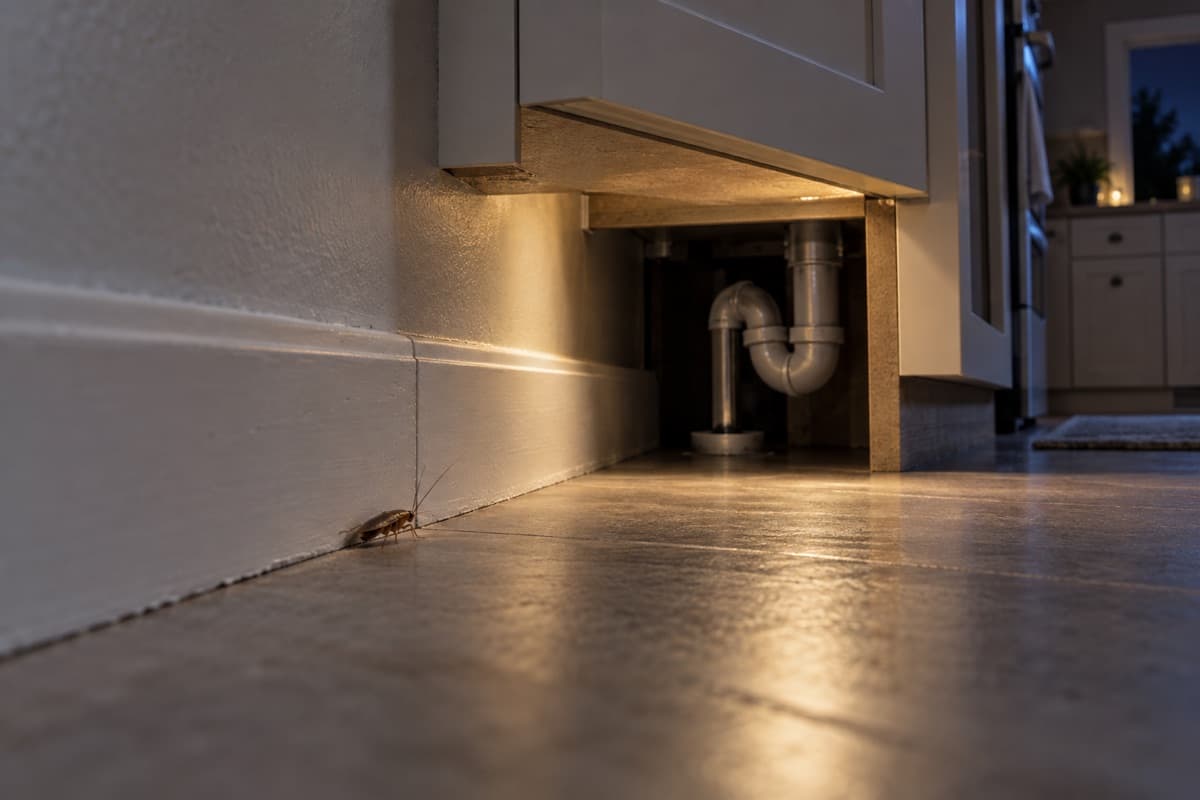
- Fix your own water sources. German cockroaches favor warm, humid areas and cluster near plumbing, according to University of Minnesota Extension. A dripping trap under the sink will keep a small population alive no matter what your neighbor does.
How To Report It So Something Actually Happens
Vague complaints get vague responses. A useful report includes:
- Dates and counts. "Four roaches on sticky monitors under the kitchen sink between March 3 and March 10" is actionable.
- Locations tied to shared structure. Note the pipe chase, outlet, or cabinet gap where you are seeing activity, and which unit is on the other side of it.
- A specific ask. Request inspection and treatment of your unit and the surrounding units, plus sealing of the gaps around pipes and outlets.
- A request for the treatment plan. Ask what product will be used, when, and how follow-up will be scheduled. Baits generally take weeks, not days.
- Copies for yourself. Keep every message.
If you are in public or HUD-assisted housing, you have extra leverage. HUD's National Standards for the Physical Inspection of Real Estate treat "evidence of cockroaches" as a moderate health and safety deficiency with a 30-day correction timeframe, and "extensive cockroach infestation" as a severe deficiency with a 24-hour correction timeframe. Evidence includes a single dead roach, shed skins, droppings, or egg cases. HUD also encourages housing agencies to adopt IPM, noting that cockroaches "can cause asthma in children and can transfer disease-causing organisms to food and surfaces they contaminate."
Seal Your Side Of The Wall
You cannot control the neighboring unit, but you can make your own unit harder to enter and much harder to live in. Purdue Extension's multi-family cockroach guide points out that cockroaches travel from neighboring apartments through holes and cracks, and recommends sealing wall and ceiling cracks, especially where kitchen cabinets meet wall and floor surfaces, and sealing around electrical and plumbing outlets.
New York City's Local Law 55 requires landlords in covered buildings to use IPM, and its list of required steps is a good checklist for any home: repair and seal holes, gaps, and cracks in walls, ceilings, floors, molding, baseboards, around pipes and conduits, and inside cabinets; repair leaking plumbing; and attach door sweeps to doors leading to hallways, basements, or outside.
Focus on:
- The gaps where the supply and drain lines pass through the wall under the kitchen sink and bathroom vanity.
- Gaps behind and inside cabinets, especially at the back corners and the toe kick.
- Electrical outlet and switch boxes on shared walls. Foam gaskets behind the cover plate are cheap and easy.
- The ceiling-wall junction and any penetration for a vent, cable, or conduit.
- The gap under the entry door to a shared hallway.
Use caulk or sealant for small gaps and copper mesh or steel wool packed behind sealant for larger voids. For drains and vent openings specifically, see stopping roaches from coming up the drain.
Sealing is not a force field. Roaches that are already established inside will not be sealed out, and no apartment is airtight. It reduces traffic and, more importantly, removes the hiding places that let a few arrivals become a population.
What Not To Do
- Do not use total release foggers. In a 2019 BMC Public Health study, NC State researchers set off foggers in 20 infested homes following label directions and saw no decline in cockroach populations at two weeks or one month, while gel bait eliminated populations in the 10 comparison homes. Insecticide residue on horizontal kitchen surfaces rose by a median of about 85 times baseline. A follow-up study found that cockroaches from the same apartment complexes were on average about 200-fold resistant to cypermethrin, the pyrethroid in the foggers tested.
- Do not spray repellent insecticide along the shared wall. It can push roaches to move more, which is exactly the Owens and Bennett finding, and repellent residue near bait makes the bait less attractive.
- Do not spray on or near gel bait. UF/IFAS warns that using a product with repellent properties where bait is applied will contaminate the bait and make it repellent.
- Do not stop after one treatment. Bait takes time. Judge it on monitor counts over several weeks, not on how many roaches you see tonight.
- Do not withhold rent on your own reading of the law. Rent withholding and repair-and-deduct exist in many states but have strict procedural requirements, and doing it wrong can put your tenancy at risk. Get advice first.
Talking To Your Neighbor
You are not obligated to, and in many buildings the management company is the right and only channel. If you do talk to them, treat it as a building problem rather than a housekeeping accusation. German cockroaches infest clean homes routinely; they arrive in deliveries, boxes, and used appliances, and they move through walls.
A practical version: "The building has roaches on this floor and I've reported it to management. They may need access to several units to fix it. Have you seen any?" That gives your neighbor a reason to cooperate with an inspection instead of a reason to deny the problem.
If a neighbor refuses access, that is management's problem to solve under the lease, not yours to litigate. Put it in writing that access was refused and let the property handle it.
What The Law Generally Requires
Most U.S. states recognize an implied warranty of habitability, a doctrine that requires landlords to keep residential rentals in a condition fit for human habitation, usually measured against local housing codes. A serious pest infestation is commonly treated as a habitability problem, and tenant remedies can include demanding repairs, withholding rent, or court action, depending on the state.
The details vary enormously:
- Statutory language differs. California's Civil Code section 1941.1, for example, requires that the building and grounds be kept "clean, sanitary, and free from all accumulations of debris, filth, rubbish, garbage, rodents, and vermin."
- Some cities go further. New York City's Local Law 55 requires owners of buildings with three or more units to inspect annually for indoor allergen hazards including cockroaches, respond to complaints, and use IPM.
- Federally assisted housing has its own standards, including the NSPIRE correction timeframes above.
- Responsibility can shift. In many states the landlord's duty is reduced or eliminated where the infestation is traceable to the tenant's own conduct, and tenants are generally expected to report problems promptly.
If your landlord will not act, the usual escalation path is a written demand, then a complaint to the local housing code or health department (311 in New York City, for example), then legal aid or a tenant advocacy organization. If the unit becomes genuinely uninhabitable, see our overview of breaking a lease due to roaches before you give notice. None of this is legal advice, and a local tenants' rights organization or housing attorney is the right source for what applies to your address.
If You Own Your Home
Condo and townhouse owners have the same physics and different paperwork. Check the governing documents for who is responsible for pest control in shared walls, chases, and common areas, and raise it with the association in writing. Most associations can treat common areas and can require owner cooperation, and the case for treating adjoining units at the same time is the same one the research supports.
If the neighbor is in a detached house, the risk profile is lower for German cockroaches and higher for the larger outdoor species. Focus on your exterior envelope, exterior lighting, garbage storage, and yard conditions. Our guide to keeping roaches out of your yard covers that side.
When To Call A Professional
Bring in a licensed pest control professional, or push your landlord to, if:
- You see roaches during the day, or in more than one room.
- Monitor counts are flat or rising after three to four weeks of consistent baiting.
- The infestation is clearly building-wide, or you can see activity at shared penetrations you cannot reach.
- Someone in the home has asthma. Cockroach allergen is an established asthma trigger, and reducing the population is part of reducing exposure.
Ask any company whether they will inspect and treat adjoining units, whether they rotate bait active ingredients, and how they will monitor results. A single spray visit is not a plan. For the broader treatment sequence, see how to get rid of roaches, and for keeping them out afterward, how to keep roaches away for good.
Frequently Asked Questions
Can roaches really travel from another apartment into mine?
Yes. A 1982 study documented interapartment movement of up to 30% per week where building construction permitted it, and a 2019 Rutgers study found that infestations in a high-rise clustered among units that shared walls, shared ceilings and floors, or faced each other across the hallway. Shared plumbing chases, wall voids, and utility penetrations are the usual routes.
Is my landlord legally required to treat the whole building?
Not usually, in those words. Most states require the landlord to keep the unit habitable, and many local codes require the building to be kept free of vermin, but few statutes spell out building-wide treatment. The practical argument is that partial treatment does not work, and the research supports it. Rules vary by state and city, so check with a local legal aid office or tenants' rights group.
Should I treat my apartment if my neighbor is not treating theirs?
Yes, but set expectations. Sealing penetrations, removing food and water, and baiting will reduce what establishes in your unit, and it protects you while the building sorts itself out. It will not stop reinfestation from an untreated neighbor indefinitely, which is why the written report matters as much as the bait.
Will a fogger or bug bomb protect my unit?
No. The 2019 fogger study found no reduction in cockroach populations at two weeks or one month after label-directed use, while depositing insecticide on kitchen floors and counters where people and pets are, and not in the voids where roaches hide. Pyrethroid resistance in apartment-collected German cockroaches is widespread.
Do peppermint oil, bay leaves, or diatomaceous earth keep neighbor roaches out?
Not reliably. Essential oils can kill cockroaches in laboratory tests, but those tests typically apply undiluted oil directly to the insect, which is nothing like misting a baseboard. Diatomaceous earth works only as a dry, undisturbed dust and stops working when it gets damp, which rules out the sink cabinets and pipe chases that matter most here. Use sealing, sanitation, and bait as the core of the plan.
How long should building-wide treatment take to work?
Expect months, not days. In the Rutgers high-rise study, the share of infested units fell from 49% to 24% at six months and 12% at twelve months under an aggressive, researcher-led program. Ask for monitor-based follow-up rather than a set number of spray visits.
What if I share a wall with a restaurant or a commercial kitchen?
The same approach applies, with one addition: commercial food service is usually subject to local health department inspection. If sealing and baiting on your side is not holding, a complaint to the local health department about the commercial space is a legitimate escalation.
Sources
- Wang, Eiden, Cooper, Zha, Wang, and Sanchez, *Journal of Integrated Pest Management* (2019) — building-wide IPM cut infested units from 49% to 12% in 12 months versus 47% to 29% under conventional service.
- Wang, Eiden, Singh, Zha, Wang, and Cooper, *Journal of Economic Entomology* (2019) — spatial clustering of infestations among adjacent, stacked, and across-hall apartments, and how it changed at 6 and 12 months.
- Owens and Bennett, *Journal of Economic Entomology* (1982) — interapartment movement up to 30% per week, and pyrethrin applications increasing that movement.
- DeVries, Santangelo, Crissman, Mick, and Schal, *BMC Public Health* (2019) — total release foggers ineffective against cockroaches and heavy surface residue.
- DeVries, Santangelo, Crissman, Suazo, Kakumanu, and Schal, *Journal of Economic Entomology* (2019) — pyrethroid resistance in apartment-collected German cockroaches.
- HUD: NSPIRE Infestation Standard — cockroach deficiency criteria, evidence, and 30-day and 24-hour correction timeframes.
- HUD PIH Notice 2011-22: Promotion of Integrated Pest Management — IPM components and the asthma and contamination statement.
- NYC HPD: Indoor Allergen Hazards — Local Law 55 owner obligations, IPM work practices, and tenant steps.
- Cornell Legal Information Institute: Implied warranty of habitability — the doctrine, its scope, and tenant remedies.
- California Civil Code section 1941.1 (FindLaw) — statutory habitability language including vermin.
- Purdue Extension: A Practical Guide to Cockroach Control in Multi-Family Housing Units — movement through holes and cracks, sealing, resident and management roles.
- NC State Extension: The German cockroach — movement between connected units, sanitation, monitoring, and baits.
- University of Minnesota Extension: Cockroaches — moisture and harborage preferences, monitoring, and apartment treatment.
- UF/IFAS Extension: Assessment-Based Pest Management of German Cockroaches — bait contamination by repellent products and product rotation.
- EPA: Pest Control Resources for Housing Managers — monitoring, leak repair, sealing conduit penetrations, and vacuuming.
- NPIC: Diatomaceous Earth General Fact Sheet — how it works, the requirement that it stay dry, and label use.