You cannot keep roaches out of your yard, and any guide that promises otherwise is selling something. Several cockroach species are native or long-established outdoor insects that live in mulch, leaf litter, tree holes, woodpiles, sewers, and soil across most of the country — in parts of Florida, one species has been measured at densities of 30,000 to 250,000 per acre. The achievable goal is different and much more useful: lower the pressure at the walls of your house so that far fewer roaches are living in the twenty feet that matter, and far fewer of the ones that fly are being aimed at your doors. That comes down to five things you control — mulch depth and placement, standing water and drainage, harborage like leaf litter and woodpiles, outdoor light color and position, and targeted bait instead of broadcast spray.
This is the landscape reference our other roach guides point to, so it covers the outdoor side in one place. If you are dealing with small tan roaches breeding behind your refrigerator, that is a different problem with a different fix — see how to get rid of roaches. Everything below is about the large outdoor species and the flying ones that come to your porch.
Why "Roach-Free Yard" Is The Wrong Goal
Outdoor cockroaches are decomposers. They eat decaying plant matter and they live in exactly the conditions a landscaped yard creates: shade, organic matter, and retained moisture. A yard with mulch beds, shrubs, a lawn, and irrigation is habitat. You are not going to subtract that habitat from a quarter acre, and you would not want to — most of what makes it habitat is also what makes it a yard.
Texas A&M AgriLife Extension is unusually blunt about this in its cockroach biology and management guide (PDF): perimeter sprays for outdoor cockroaches often fail simply because there are too many infested areas in lawns, mulch, and wooded areas to treat them all. The population is not confined to your property line, and it does not depend on your property to exist.
So reframe the target. You are managing a gradient. The closer a roach is to your foundation, the more likely it ends up under your door. Everything in this guide either pushes the habitat gradient outward from the wall or removes the specific cue — light, water, an open route — that carries an individual roach across the last few feet.
Judge success by how many you find inside, not by whether you ever see one in the mulch again.
Which Roaches Actually Live In Your Landscape
Getting the species right changes what you do. The outdoor roaches fall into a few useful groups.
American cockroach (Periplaneta americana). The big reddish-brown one, an inch and a half to two inches long, with pale banding around the shield behind the head. Both sexes fly. UF/IFAS places it in hollow trees, woodpiles, and mulch outdoors, and notes it also migrates into homes from sewers via the plumbing and from trees and shrubs alongside buildings. It is the species most associated with sanitary sewers and storm drains, and UF/IFAS notes mass migrations are common — in summer, alleyways and yards may be overrun.
Smokybrown cockroach (Periplaneta fuliginosa). Uniformly dark mahogany to nearly black, an inch to an inch and a half, wings past the abdomen in both sexes. UF/IFAS entomology describes it as abundant outdoors in tree holes, woodpiles, and attics, a good flier, and attracted to light. Texas A&M adds ground cover, mulch, palm fronds, soffits, and attic eaves, and stresses that it wants protected, moist, warm sites away from moving air. This is the species where lighting and gutter work pay off most.
Oriental cockroach (Blatta orientalis). Dark brown to nearly black, about an inch and a quarter, and it does not fly. UC IPM notes it prefers cool, dark, damp places — garages, basements, water meter boxes, and drains — and is most common around single-family homes surrounded by vegetation, woodpiles, and ivy. Populations build significantly in masonry enclosures like water meter boxes. It moves indoors at night and generally stays on the ground floor.
Asian cockroach (Blattella asahinai) and the similar field cockroach (Blattella vaga). These are the small ones that look almost exactly like German cockroaches but live outdoors. UF/IFAS reports that the Asian cockroach lives in shaded mulched or composted areas where fresh plant litter accumulates, at densities of 30,000 to 250,000 per acre, is a strong flier, becomes active at sundown, and is attracted to light-colored surfaces and brightly lit areas. Indoor infestations are rare — it comes in through windows and doors and does not establish. Critically, UF/IFAS notes that conventional perimeter treatments do not work well against it, because the infestation is outdoors and enormous.
Wood roaches (Parcoblatta species). Native forest insects, not pests. Penn State Extension describes seven Pennsylvania species living in leaf litter, under bark and fallen logs, in woodpiles, and under stones. Males fly and are attracted to lights at night, mostly in rural areas and mostly in late spring and early summer. The important part: they quickly die within a few days indoors from dehydration, and do not feed or reproduce inside. Penn State says outright that pesticides are unnecessary for them. If you live near woods and get a burst of flying roaches every May, this is very likely what you have, and the fix is lighting and door sweeps, not spraying your lot.
Turkestan cockroach (Blatta lateralis). Increasingly common in the Southwest and California, where UC IPM reports it displacing Oriental cockroaches. It lives in water meter boxes, expansion joints between slabs, compost, leaf litter, potted plants, and sewers.
If you cannot tell what you have, catch one in a jar and get it identified before you spend money — a smokybrown plan and an Asian cockroach plan look nothing alike. Our guide on figuring out where roaches are coming from walks through the tracing process.
Mulch: Depth, Type, And Distance From The Wall
This is the single highest-value change in most yards, and most homeowners have it backwards.
UF/IFAS is specific in Cockroaches and Their Management: cockroaches breed prolifically in pine straw mulch and poorly in gravel or on bare soil. Its recommendation is to use only a thin layer of mulch around the home, extending about one foot out from the foundation, so the material can actually dry out between waterings.
What that means in practice:
- Thin the mulch against the house. Deep mulch holds moisture in the bottom layer indefinitely, and that damp underside is the habitat. Two inches is plenty for weed suppression; four to six inches against a foundation is a roach nursery.
- Pull beds back and leave an inspectable strip. UC IPM recommends maintaining a gravel band roughly 6 to 12 inches wide around the perimeter. A strip of gravel or bare soil does two jobs: it dries fast, and it lets you actually see droppings, shed skins, and entry points along the wall when you walk the house.
- Prefer coarse gravel or stone right at the wall, and keep organic mulch for the beds farther out where it belongs. This is not a case for ripping out all your mulch. It is a case for moving it off the twelve inches that decide whether roaches are living against your siding.
- Do not let mulch bridge the weep holes or cover the siding line. Beyond roaches, mulch piled above the slab edge or against wood siding is a moisture and termite problem.
- Rake beds occasionally instead of only topping them up. Layer after layer of new mulch over old creates a compacted, permanently damp mat underneath.
Ground cover deserves the same scrutiny. UC IPM calls out ivy and dense ground covers near the house as harborage worth eliminating, and UF/IFAS specifically names ivy as a favorite breeding place for outdoor cockroaches. Trimmed, airy plantings with space between the foliage and the wall dry out; a solid mass of ivy against masonry does not.
Water Is The Real Attractant
Cockroaches lose water fast through their cuticle, which is why every outdoor species on the list is tied to damp shelter. The EPA's guidance on whether you really need a pesticide makes the point compactly: roaches can survive roughly a month without food but die in about a week without water. Standing water is the magnet.
Work through these in order:
- Gutters and downspouts. Clogged gutters hold wet leaf debris in a warm, sheltered channel directly against your roofline — a near-perfect smokybrown habitat, with soffit and attic access a few inches away. Clean them, and extend downspouts so they discharge at least several feet from the foundation instead of into the mulch bed.
- Irrigation. Look at your sprinkler heads at run time, not at noon. Heads that spray the foundation, soak a mulch bed daily, or run in the evening keep the perimeter permanently wet. Shift to early-morning watering, deeper and less often, and redirect anything hitting the wall.
- Grading and low spots. Soil should fall away from the foundation. Puddles that persist a day after rain, a settled spot beside a patio slab, or a low corner of the lawn are all worth correcting before you buy a single product.
- The obvious containers. Saucers under pots, birdbaths, wheelbarrows, tarps holding a pocket of water, an unused pet bowl, a leaking hose bib. Individually trivial; together they are why one side of a house has all the activity.
- Crawl space and A/C. A damp crawl space or a condensate line dumping under the house creates exactly the sheltered, moist, still-air conditions smokybrowns prefer.
Drainage work is unglamorous, and it outperforms anything you can buy.
Leaf Litter, Woodpiles, And Other Harborage
Texas A&M's list of where to look outdoors is a good checklist: compost piles, ground cover plants, hollow trees, mulch, old stumps, palm fronds, woodpiles, sewer manholes, and underground water meters.
- Firewood goes off the ground on a rack and well away from the house — the far side of the yard, not against the garage wall. Penn State's advice on wood roaches applies to every species here: bring in only what you will burn within a few hours, because you are carrying the habitat indoors with it.
- Leaf litter against the foundation, in bed corners, behind the AC unit, and in window wells should be cleared. Litter farther out in the yard is fine and ecologically useful; it is the last few feet that matter.
- Tree holes. UF/IFAS recommends filling tree holes with cement to remove what it calls prime harborage. If you have a mature tree with a cavity near the house, that single cavity may be producing more smokybrowns than your entire mulch bed.
- Stumps, old lumber, spare pavers, cardboard, stacked containers. Anything sitting undisturbed on soil for a season is harborage. Get it on a rack, into a bin, or out.
- Palm fronds, dense shrubbery, and branches touching the roof. Trim shrubs and ornamentals off the house — UC IPM frames this as increasing light and air circulation, which is exactly the point — and cut back branches that give smokybrowns a direct route to soffits and attics.
- Compost. Keep it far from the house in a closed bin. Fresh plant litter in shade is precisely the Asian cockroach's preferred habitat.
- Pet food, fallen fruit, and grill drippings. Outdoor food concentrates foraging near the house. Pick up fallen fruit, feed pets indoors or clear bowls at night, and clean the grill's grease tray.
Outdoor Lighting Is A Control Measure
For the flying species — smokybrown, American, Asian, wood roaches — light placement does more than any spray.
The mechanism is wavelength. Insects are most sensitive to ultraviolet and blue light. In a field experiment published in Ecology and Evolution, Wakefield and colleagues compared domestic light types and found LEDs caught roughly four times fewer insects than traditional filament bulbs and about half as many as compact fluorescents, attributing the difference largely to LEDs emitting no UV. Notably, in that study warm-white and cool-white LEDs did not differ significantly from each other, so treat color temperature as a secondary refinement rather than a magic fix. UF/IFAS's own recommendation for Asian cockroaches is to switch porch lighting to yellow bulbs.
What to actually do:
- Move the light, not just the bulb. The most effective change is relocating the bright fixture away from the door — a pole light or a fixture on the far side of a walkway — so insects gather somewhere other than your threshold. A dim fixture at the door plus a brighter one twenty feet out beats a floodlight over the entry.
- Use LED rather than incandescent or CFL, and prefer warm or amber output for entries.
- Shield fixtures so light points down, not out and up. Less scattered light means a smaller attraction radius.
- Put entry and landscape lights on motion sensors or timers rather than dusk-to-dawn. Asian cockroaches are most active right at sundown; a light that is off during that window is not recruiting anything.
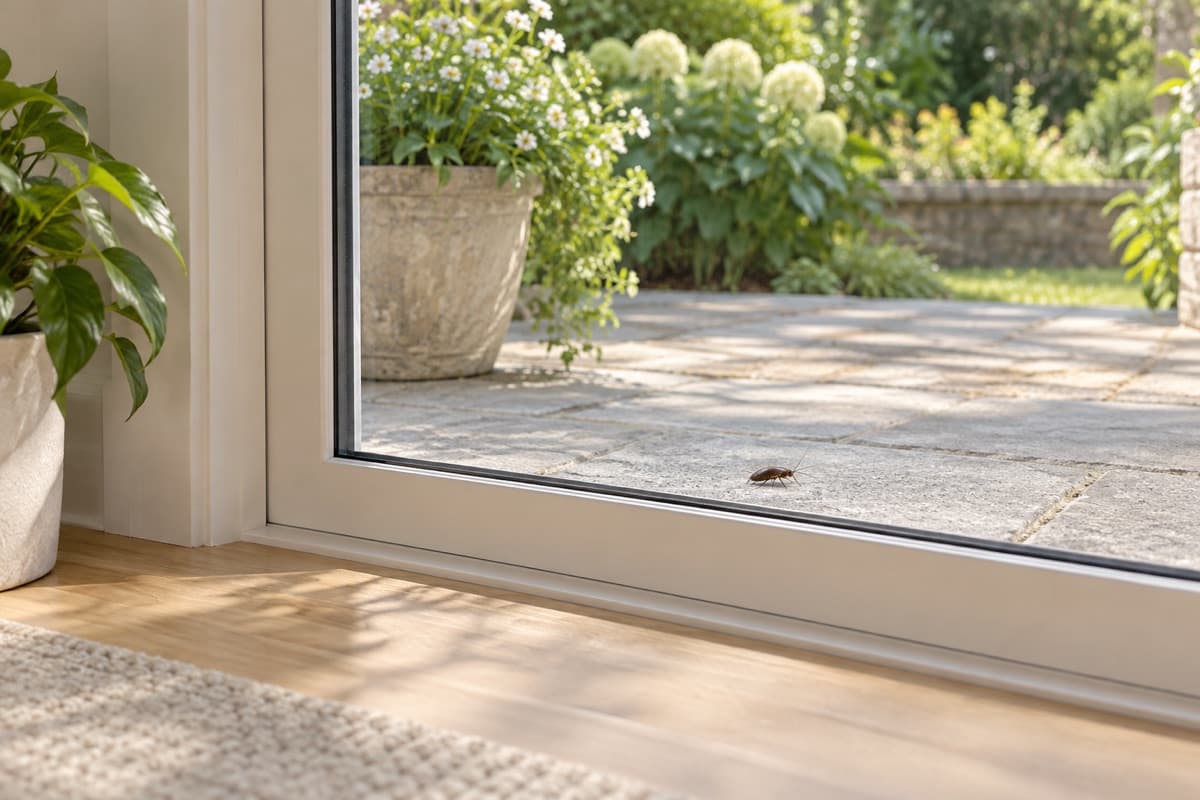
- Close the blinds at dusk on lit rooms, especially sliders and large windows. UF/IFAS specifically notes Asian cockroaches are drawn to light-colored surfaces and brightly lit areas, and a glowing patio door is exactly that.
- Fix the screens. Lighting reduction only helps if the ones that still arrive cannot walk in. Door sweeps, weatherstripping, and intact screens are the other half; our guide on how roaches get into a house covers the envelope work in detail.
Sewers, Storm Drains, And Water Meter Boxes
Some of the roach pressure on your property does not originate on your property.
American cockroaches are among the most common cockroaches in municipal sewer systems, and UF/IFAS notes they migrate into houses and apartments from sewers via the plumbing. UC IPM notes Oriental and Turkestan cockroaches build up in water meter boxes and utility ports. You are not going to treat a city sewer, but you can close the routes:
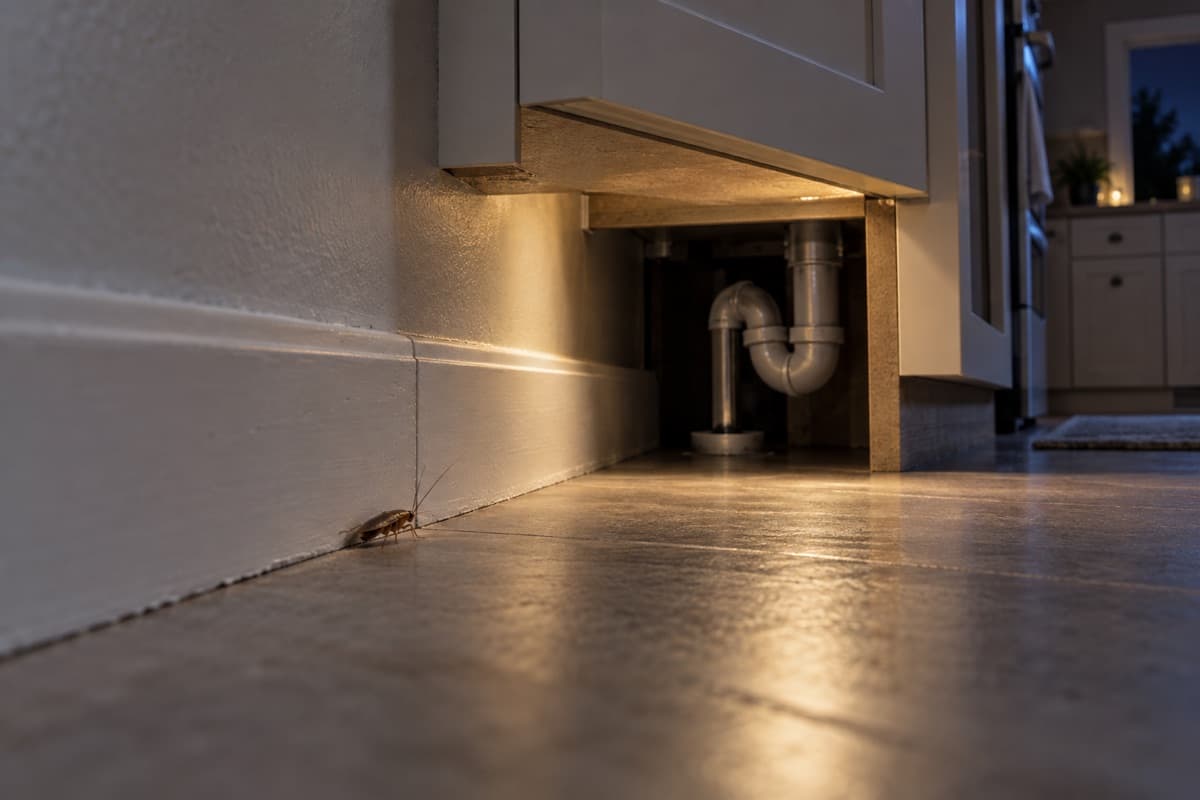
- Keep P-traps full. Texas A&M's recommendation is direct: keeping floor-drain and fixture traps filled with water creates a barrier between the sewer and the house. Run water monthly in the guest bathroom, the basement floor drain, the laundry sink, and any rarely-used fixture. If a trap dries out, the drain becomes an open door. Our guide on stopping roaches from coming up the drain covers traps, screens, and cleanouts.
- Cap or seal sewer cleanouts. A missing or cracked cleanout cap in the yard is a direct sewer connection at ground level.
- Check the water meter box and irrigation valve boxes. These are dark, damp masonry enclosures — prime Oriental and Turkestan cockroach habitat, and they sit in your lawn. They are also one of the places UC IPM specifically recommends placing bait stations.
- Seal wall penetrations at ground level. UF/IFAS recommends caulking wall penetrations near grade. Hose bibs, A/C line sets, electrical and cable entries, and dryer vents are the usual culprits.
- Storm drains and alley manholes. If there is one within a few yards of your house, expect seasonal pressure and prioritize your door sweeps and lighting accordingly. This is a case where a recurring service call may be genuinely worth it.
Outdoor Bait: Realistic Expectations
Bait is the right chemical tool outdoors, and it is worth understanding what it is and is not.
Granular cockroach and cricket baits work reasonably well in ground covers and mulched beds, and Texas A&M recommends sprinkling them lightly per label directions rather than leaving visible mounds that might attract a dog or cat. Containerized bait stations are available for the large species and go against walls, near doors and other suspected entry points. UC IPM likewise recommends bait stations around building perimeters — in valve and water meter boxes, woodpiles, and around planters — and notes that research supports gel baits placed inside stations and in in-ground utility ports for outdoor cockroach management.
A real label makes the constraints concrete. Advion Insect Granule is indoxacarb at 0.22%, labeled for perimeter application in a band up to 10 feet wide around the structure, and for boundary application to soil, fence lines, ornamental gardens, pavement crevices, planter areas, and mulch. The label allows repeat application after seven days if needed, and warns that rainfall or irrigation within two to three days after application may reduce effectiveness. It is also explicit that the product is toxic to fish and aquatic invertebrates, that it must not be applied where conditions favor runoff, and that runoff from treated areas may be hazardous to aquatic organisms nearby.
Take those three lines together and you have the honest picture of outdoor baiting:
- It is consumable and weather-sensitive. Rain and irrigation degrade it. Outdoor bait is a recurring input, not a treatment you do once in April.
- It is placement-sensitive. Bait in the shaded, damp, sheltered spots where roaches actually forage — bed edges, along the foundation, in utility boxes, near woodpiles — not scattered across an open sunny lawn.
- It has a genuine environmental footprint. Do not bait where water will carry it to a storm drain, ditch, or pond, and do not apply before rain.
- It does not solve an indoor problem. The same label notes that granule applications in crawl spaces and basements alone are not intended to give complete control of an indoor cockroach infestation.
Texas A&M's guidance points toward combining tactics rather than relying on one. Bait plus exclusion plus habitat reduction holds far longer than any single measure, and outdoor bait works best when the habitat work has already shrunk the population it is competing with. Read whatever label you buy — the band widths, rates, and restrictions above are specific to that product and do not transfer.
Why Broadcast Perimeter Spraying Is The Wrong Default
The standard offer — a technician walks the house with a wand every month or two — is popular because it is easy to sell, not because it is the most effective thing you can do outdoors.
It often does not work. Texas A&M notes perimeter sprays for outdoor cockroaches may be ineffective because there are simply too many infested areas in lawns, mulch, and wooded areas. UF/IFAS says the same thing more pointedly about Asian cockroaches: conventional perimeter treatment is not effective because the infestation is outdoors. UC IPM adds that sprays may give quick temporary knockdown but not long-term control, and may repel and disperse cockroaches into other areas.
The environmental case against broadcast application is well documented. Most consumer and professional perimeter products are pyrethroids, and pyrethroids wash off hard surfaces into storm drains. A USGS survey of urban streams in the northeastern United States found bifenthrin was the most commonly detected pyrethroid in streambed sediments, present at 76% of the 49 sites surveyed, with about 28% of sediment samples reducing biomass in test organisms and 15% reducing survival. Residential runoff is a documented source. EPA took this seriously enough to revise the environmental hazard and general labeling for non-agricultural outdoor pyrethroid products, with the stated aim of reducing ecological exposure from residential uses; treatments to large structural areas above impervious surfaces remain prohibited specifically to limit runoff and drift to urban surface water. If a sidewalk, driveway, or patio abuts your foundation, a wide banded spray over that surface is not a legitimate application.
Pollinators. Broadcast sprays drift, and drift lands on flowers. UMass Extension's guidance for home gardens and landscapes is straightforward: do not spray open flowers, apply when bees are not foraging if you apply at all, and prevent drift onto adjacent flowering plants, weeds, and ground covers. It also notes cool temperatures can extend how long residues stay toxic to bees. A foundation bed full of blooming perennials is not a place to run a wand.
None of this means a targeted residual application is never appropriate. Crack-and-crevice and spot treatment of specific harborage — porch corners, under ledges, crawl space gratings, under garage doors, around door thresholds and soffits, as UF/IFAS and Texas A&M both describe — is a defensible, label-compliant use. The problem is the reflexive full-perimeter broadcast that substitutes for the habitat work and drains toward a creek. If a company's entire plan is "we spray the outside monthly," ask what else they are doing.
What Does Not Work Outdoors
Being honest about this saves money and time.
"Reduce roach populations by up to 90% within weeks." This claim appears on a lot of pages, including an earlier version of this one. We could not find it in any extension publication, agency document, or peer-reviewed study, and nobody repeating it cites a source. Treat it as invented.
Diatomaceous earth sprinkled around the yard. DE works by abrading and absorbing the waxy layer of an insect's cuticle so it dehydrates, and NPIC notes it remains effective as long as it is kept dry and undisturbed. In a yard it is neither. Rain, dew, irrigation, and wind take it out of service quickly. It has legitimate uses in dry, protected voids — see our guide on using diatomaceous earth for roaches — but broadcasting it over mulch is money into the ground.
Roach-repelling plants. Catnip, lavender, chrysanthemums, and mint are frequently listed as roach deterrents. There is no extension or peer-reviewed support for a planted border reducing cockroach pressure in a yard. Pyrethrins are derived from Chrysanthemum cinerariifolium, but that is an extracted, formulated insecticide, not a living plant in a bed. Plant them because they are nice; we go through the evidence in what plants keep roaches away.
Essential oil and neem sprays on the landscape. Peppermint, cypress, and tea tree oils can produce brief repellency in the lab at concentrations well above what a spray bottle delivers; outdoors they evaporate in hours. Neem is a genuine insecticide, mostly for soft-bodied plant pests, but there is no extension recommendation for it as a yard cockroach treatment and no plausible way a foliar spray reaches a population of that size. Ultrasonic repellers have no credible evidence of effect on cockroaches, indoors or out.
A Realistic Yearly Routine
Habitat management is maintenance, not a project.
Each spring: clean gutters and extend downspouts; thin and pull back mulch, re-establishing the gravel or bare strip at the foundation; trim shrubs and ground cover off the walls and branches off the roof; move the woodpile; reseal ground-level penetrations; replace worn door sweeps; and shift irrigation to early morning.
Monthly in warm weather: clear leaf litter from beds and window wells, run water in rarely-used drains to keep traps full, empty saucers and containers after rain, check meter and valve boxes, and service any outdoor bait stations per label.
At the first spike in sightings: work out which side of the house and what changed. New mulch, a rainy stretch, a clogged gutter, a neighbor's tree removal, and a brighter replacement fixture all produce sudden bursts. Sticky monitors along the garage wall, in the laundry room, and near exterior doors show you where entry is happening — Texas A&M recommends exactly this when the route is unclear.
Every fall: expect migration out of sewers and landscape harborage as nights cool. Door sweeps and sealed penetrations matter most in this window.
When To Call A Professional
The habitat work above is yours regardless of who you hire, and no service substitutes for it. Bring in a licensed pest control professional when:
- You have heavy, recurring pressure from a source you cannot change — an adjacent storm drain or sewer manhole, a wooded lot line, a neighbor's derelict property.
- Roaches are getting into an attic or soffit. Smokybrowns in attic space usually means a roofline, gutter, or vegetation problem plus a gap, and it is worth having someone on a ladder.
- You are considering a residual product and are not confident following a label around children, pets, a vegetable garden, a pond, or a storm drain.
- You want bait stations installed and serviced properly in utility ports and meter boxes rather than granules scattered on a lawn.
- You cannot identify what you have.
When you interview companies, ask which species they identified, what they will apply and precisely where, how they will avoid application over impervious surfaces and near drains, and — most tellingly — what landscape and exclusion repairs they recommend. A company whose whole answer is a monthly perimeter spray is selling a subscription, not a solution.
Frequently Asked Questions
Can I actually get rid of the roaches in my yard?
No. Outdoor cockroach species live in soil, leaf litter, mulch, tree holes, and sewers across entire neighborhoods, and in some regions at densities in the tens of thousands per acre. What you can do is make the perimeter of your house poor habitat and close the routes inside, which is what changes how many you see indoors.
What kind of mulch keeps roaches away?
Gravel or stone, and only because it dries out and holds no organic matter. UF/IFAS notes cockroaches breed prolifically in pine straw and poorly in gravel or bare soil, and recommends only a thin mulch layer extending about a foot from the foundation. Keep organic mulch for beds away from the wall, and keep it shallow.
Will spraying my yard get rid of roaches?
Rarely, and it carries real costs. Extension sources are consistent that perimeter sprays give short-term knockdown at best, can disperse roaches into new areas, and cannot reach the volume of outdoor habitat involved. Pyrethroid runoff from residential surfaces is a documented contributor to toxicity in urban stream sediments, and EPA label restrictions exist specifically to limit it. Targeted crack-and-crevice treatment of specific harborage is reasonable; broadcasting the yard is not.
Do porch lights really attract roaches?
Yes, for the flying species. Smokybrown, American, Asian, and male wood roaches are all attracted to light. Research on domestic bulbs found LEDs attract roughly four times fewer insects than filament bulbs and about half as many as CFLs, largely because LEDs emit no UV. Moving the bright fixture away from the door, shielding it downward, and putting it on a motion sensor usually matters more than the bulb itself.
Why do I get a wave of roaches after it rains, or right after my yard is mulched?
Both events flood or disturb habitat and push roaches to move. Heavy rain saturates mulch, soil, and sewers; fresh mulch disturbs whatever was living in the old layer. Sightings usually settle within a week or two. If they do not, look for a gutter, grading, or irrigation problem keeping the perimeter wet.
Do outdoor bait stations work for big roaches?
Reasonably well, as part of a plan. UC IPM recommends stations around building perimeters, including valve and meter boxes, woodpiles, and planters, and supports gel baits used in stations and in-ground utility ports. Expect to service them — outdoor bait is weather-sensitive and gets consumed — and expect better results once habitat reduction has shrunk the population competing with it.
Are the flying roaches near my woods dangerous?
Wood roaches are not. Penn State Extension describes them as accidental indoor visitors that die within a few days from dehydration and neither feed nor reproduce indoors, and states plainly that pesticides are not needed for them. The seasonal influx of flying males in late spring is a lighting and door-sweep issue.
Should I treat my mulch beds with granular bait?
You can, if the label permits it — the Advion Insect Granule label, for instance, lists mulch, planter, and ornamental garden areas under boundary application. Apply lightly rather than in visible mounds, keep it away from anywhere water runs toward a drain or pond, and do not apply just before rain or irrigation, which can cut effectiveness within two to three days. Follow the specific label in your hand.
My neighbor's yard is a mess. Does my work still help?
Yes, though it caps your ceiling. Habitat in the first few feet of your foundation, plus your own lighting, drainage, and door sweeps, determines most of what reaches your interior. A neighboring source raises the baseline, which means exclusion matters more and results take longer — not that the work is pointless.
Sources
- UF/IFAS ENY-214: Cockroaches and Their Management — pine straw versus gravel and bare soil for breeding, the thin one-foot mulch band, tree holes, firewood placement, ivy as harborage, and treating sheltered cracks rather than broadcasting.
- UF/IFAS EENY-141: American Cockroach — hollow trees, woodpiles and mulch habitat; migration indoors from sewers via plumbing; mass migrations; caulking ground-level penetrations.
- UF/IFAS EENY-120: Asian Cockroach — shaded mulch and plant litter habitat, 30,000 to 250,000 per acre, strong flight, sundown activity, attraction to light, yellow porch bulbs, and the ineffectiveness of conventional perimeter treatment.
- UF/IFAS Entomology: Smokybrown Cockroach — size and color, tree holes, woodpiles and attics, good fliers, attraction to light.
- Texas A&M AgriLife Extension E-359: Cockroach Biology and Management (PDF) — the outdoor habitat checklist (compost, ground cover, hollow trees, mulch, stumps, palm fronds, woodpiles, sewer manholes, water meters); smokybrown preference for protected, moist, still-air sites; keeping P-traps filled; screening soffits; granular baits in ground covers and mulched beds; containerized stations at entry points; and the limits of perimeter spraying.
- UC Statewide IPM Program: Cockroaches — Oriental and Turkestan cockroach habitat in meter boxes, drains, expansion joints, compost and ivy; the 6- to 12-inch gravel perimeter band; bait stations in valve and meter boxes; sprays as temporary knockdown that can disperse cockroaches.
- Penn State Extension: Wood Cockroaches — leaf litter and woodpile habitat, flying males attracted to lights, inability to feed or reproduce indoors, firewood handling, and that pesticides are not recommended.
- Wakefield et al., *Ecology and Evolution* (2016): Experimentally comparing the attractiveness of domestic lights to insects — LEDs attracting roughly four times fewer insects than filament bulbs and about half as many as CFLs, attributed largely to the absence of UV emission.
- Advion Insect Granule label (PDF) — indoxacarb 0.22%; the 10-foot perimeter band; boundary application to mulch, planter and garden areas; repeat after 7 days; reduced effectiveness from rain or irrigation within 2 to 3 days; aquatic toxicity and runoff restrictions; and the note that granule applications alone are not intended to control an indoor infestation.
- EPA: Environmental Hazard and General Labeling for Pyrethroid and Synergized Pyrethrins Non-Agricultural Outdoor Products — label changes intended to reduce ecological exposure from residential pyrethroid use, and the prohibition on treating large structural areas above impervious surfaces.
- USGS: Survey of bioaccessible pyrethroid insecticides and sediment toxicity in urban streams of the northeastern United States — bifenthrin as the most commonly detected pyrethroid in streambed sediments, at 76% of 49 sites, with measured reductions in test organism biomass and survival.
- UMass Extension: Protecting Bees and Pollinators from Pesticides in Home Gardens and Landscapes — not spraying open flowers, applying outside foraging hours, preventing drift, and cool temperatures extending residue toxicity.
- NPIC: Diatomaceous Earth General Fact Sheet — mechanism of action by absorbing cuticular oils and fats, and effectiveness only while kept dry and undisturbed.
- EPA: Do You Really Need to Use a Pesticide? — starve, dry, and exclude as the first line; cockroaches dying in about a week without water while surviving roughly a month without food.