An insect growth regulator (IGR) for roaches is a juvenile hormone mimic that keeps nymphs from becoming reproductive adults. The two you will encounter are (S)-hydroprene and pyriproxyfen. Hydroprene comes as a sealed disc you snap and stick in place, and the EPA-accepted label directs one device per 75 square feet, replaced every 3 months. Liquid IGR concentrates are diluted and sprayed as a spot and crack-and-crevice treatment, typically one gallon of finished spray per 1,500 square feet. None of these products kill adult roaches, so an IGR is something you add to a bait program, not a substitute for one. Follow the label on the product you actually buy; the directions below are the labels' own language, but rates and restrictions differ by product and by state.
The earlier version of this article told readers to mix any IGR with water in a spray bottle and reapply every two to three months, and said some IGRs protect for up to seven months. Those numbers do not match the labels. The seven-month figure belongs to pyriproxyfen's flea claim; the same label lists 180 days for cockroaches. And the most widely sold hydroprene product for homes is not a liquid at all.
What An IGR Actually Does To A Roach
The National Pesticide Information Center describes IGRs as insecticides that "mimic hormones in young insects" and disrupt how they grow and reproduce. NPIC notes the mechanism targets "certain hormones in insects, hormones that humans don't have."
The practical effect on cockroaches is specific and visible. The hydroprene label tells applicators that "one to two weeks after application, you will begin to see roaches with crinkled wings, showing the initial effects of GENTROL. These roaches cannot reproduce." The pyriproxyfen label describes the same thing: "cockroaches with twisted wings and other deformities will begin to appear, indicating that NYLAR 10EC has taken effect — those cockroaches are unable to reproduce."
Deformed wings are the sign the product is working. They are not a sign the infestation is ending. Those roaches are still walking around, still eating, and still shedding allergens.
The Two Active Ingredients Worth Knowing
(S)-hydroprene. Sold as Gentrol and under Zoecon brand names. It is the IGR with the longest track record indoors against German cockroaches, and it is the one packaged as a passive disc that releases vapor into a small area.
Pyriproxyfen. Sold as NyGuard, Nylar, and many private labels. NPIC reports EPA first registered pyriproxyfen in 1995 and it now appears in more than 300 products, most of them flea products. NPIC describes it as "low in toxicity for humans and other mammals" but notes it is moderately to highly toxic to fish, which matters if you have an aquarium in the room you plan to spray.
Neither one is a knockdown product. Both are commonly tank-mixed with an adulticide by professionals, which the labels explicitly permit.
Point Source Discs: The Simplest Option
The hydroprene disc is the format most homeowners should start with, because there is almost nothing to get wrong. The EPA-accepted label directs you to:
- Press the pouch on the side of the device between thumb and forefinger until you hear a snap. That releases the capsule. Do not activate it until you are ready to place it.
- Place one device to treat up to a 75 square foot area. More devices are needed where infestation is heavy.
- Put devices where roach activity has been seen: "in and around cabinets, closets, pantries, drawers, refuse areas, electrical boxes, equipment, and false ceilings," plus around doors, pipe chases, windows, ducts, and refrigerators.
- Wipe the surface clean first so the adhesive holds, then press the device in place. It works in any orientation.
- Replace every 3 months.
Two restrictions matter in a home. The label says "do not place in areas accessible to children," and in food-handling areas it requires keeping the device at least 3 feet from exposed food and off any food preparation surface. A kitchen cabinet that a toddler can open is not a legal placement.
The active ingredient moves out of the device into the surrounding area, so roaches "do not have to come into contact with the device to be affected." That is why it reaches voids that a spray misses. It also means an open, drafty, or oversized space dilutes the effect.
Liquid IGR Concentrate: Rates and Handling
If you use a concentrate, the label is doing real work and you need to read all of it.
Gentrol IGR Concentrate is 9 percent (S)-hydroprene, EPA Reg. No. 2724-351. Its label directs 1 ounce per gallon of diluent, applied at 1 gallon per 1,500 square feet of surface, with the diluted solution used within 48 hours of mixing. It advertises "continuous protection for 4 months." It contains petroleum distillates, is labeled "harmful if swallowed or absorbed through skin," and warns against use on electrical portions of equipment because of shock hazard.
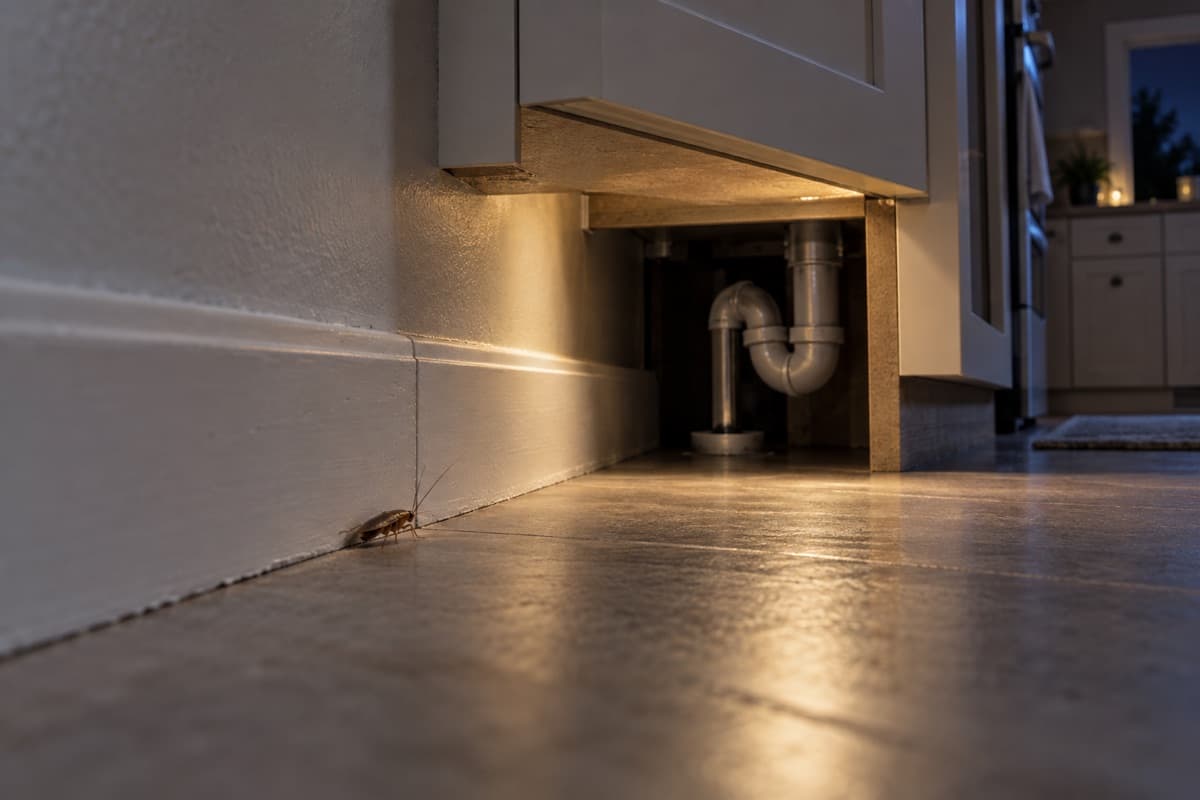
NyGuard IGR Concentrate is 10 percent pyriproxyfen, EPA Reg. No. 1021-1603. Its EPA-accepted label directs 12 ml in one gallon of water to treat 1,500 square feet as a spot, surface, or crack-and-crevice spray, with special attention to "hiding places such as beneath sinks, behind and beneath stoves." It states plainly: "One treatment works for 6 months against cockroach nymphs and crickets."
Both labels require you to remove or cover food and food-contact surfaces before treating a kitchen, and to wash any uncovered food surface afterward. A household trigger sprayer is not adequate equipment for measuring and delivering these rates over 1,500 square feet.
Why An IGR Alone Is Not A Plan
This is the part the old version of this article got wrong by omission. The hydroprene label says the product "by itself, will control cockroach populations over time," then immediately adds: "For faster results, use [it] in conjunction with EPA approved products that kill adult roaches."
The research behind that line is decades old and still holds. A 1986 Purdue study in the Journal of Economic Entomology tested four hydroprene regimes against German cockroaches in low-income public housing. All of them reduced populations, but the best result came from hydroprene combined with a conventional adulticide, with the hydroprene reapplied at three months.
The label even spells out the pairing with bait: place the discs near your bait placements, using 9 devices per 675 square feet, so that "young roaches that do not eat the bait will become affected by the GENTROL Insect Growth Regulator."
In a house, that means gel bait does the killing and the IGR covers the nymphs the bait misses. If you have not set up baiting yet, start with our guide to getting rid of roaches, then read how to use Advion roach gel for placement technique.
What To Expect, Month By Month
- Weeks 1 to 2. Crinkled or twisted wings on adults. No drop in numbers.
- Weeks 2 to 8. If you are also baiting, this is when counts should fall. Track it with sticky monitors rather than by how many roaches you happen to see. Our guide on telling whether roach bait is working explains what to look for.
- Months 2 to 6. The IGR's contribution shows up as an absence: fewer new nymphs maturing. Because German cockroach development takes weeks to months, this lag is unavoidable.
- At the label interval. Replace discs at 3 months. Re-treat liquids at the interval on your specific label, not on a generic schedule.
If you are seeing no decline at all after six to eight weeks of consistent baiting plus an IGR, the problem is usually bait acceptance, bait contamination from sprays or cleaners, or roaches coming back in from an adjacent unit.
Safety Around Children and Pets
Both active ingredients are low-toxicity to mammals compared with conventional insecticides, and both carry only the CAUTION signal word. That is not the same as harmless. The hydroprene disc label warns it "causes moderate eye irritation" and that "prolonged or frequently repeated skin contact may cause allergic reactions in some individuals." The liquid concentrate is harsher: harmful if swallowed or absorbed through skin, with a note to physicians about aspiration pneumonia from its petroleum distillates.
Practical steps:
- Place discs in voids, behind appliances, and inside spaces children and pets cannot open.
- Keep pets, bowls, bedding, and toys out of an area being sprayed and keep them out until the treatment has dried, which is the general guidance in EPA's pesticide safety tips and NPIC's pets and pesticide use fact sheet.
- Remove or cover food and dishes before any liquid application, and wash food-contact surfaces afterward.
- Move or cover aquariums before spraying pyriproxyfen.
- Keep the container. If a child or pet swallows any of it, call Poison Control at 800-222-1222 or the ASPCA Animal Poison Control Center at 888-426-4435 and have the label in hand.
Mistakes That Waste The Product
- Spraying an adulticide over your bait. This is the single most common self-inflicted failure. Contaminated bait gets rejected.
- Treating one room. Roaches harbor along shared walls, in wall voids, and under appliances. Treat the whole infested area, or you are just relocating them. Finding them first helps; see how to figure out where roaches are coming from.
- Using an IGR as the response to a heavy infestation. With hundreds of adults present, sterilizing them does not solve the immediate problem.
- Reaching for a fogger instead. EPA's guidance on total release foggers notes the propellants are typically flammable and that improper use can cause a fire or explosion, and Penn State Extension's IPM guidance is blunter: "Avoid using foggers and sprays. You can't control where the chemicals go, and the risk of exposure is high."
- Assuming the product is legal where you live. Some IGR products are restricted or not registered in certain states, and some professional packs are labeled not for individual resale. Check the label and your state registration before buying.
When To Call a Professional
Hire a licensed pest control company if you see roaches in the open during the day, if numbers have not dropped after six to eight weeks of baiting plus an IGR, if you live in an apartment or multi-unit building where treatment needs to cover neighboring units, or if anyone in the home has asthma. Ask what active ingredients they use, whether they rotate bait products, and whether they include an IGR in the program. Most do, because it is standard practice. Our overview of what pest control companies use for roaches covers what to expect.
Frequently Asked Questions
Do IGRs kill roaches?
No. They prevent nymphs from developing into reproductive adults and render emerging adults sterile, often with visibly deformed wings. Adults already in your home live out their normal lifespan. You need a bait or adulticide to actually reduce the roach count.
How often should I reapply IGR for roaches?
Follow your product's label, not a generic schedule. Hydroprene point-source discs are replaced every 3 months. The Gentrol liquid concentrate claims four months of continuous protection. The NyGuard pyriproxyfen label states one treatment works for 6 months against cockroach nymphs.
Can I mix IGR with my bait or spray?
You can place an IGR near bait; the hydroprene label describes exactly that, using 9 devices per 675 square feet alongside bait placements. Do not spray any liquid onto or beside bait placements, because residues can make bait unpalatable. Tank-mixing an IGR with an adulticide is permitted on both labels, but then the more restrictive of the two labels governs the whole mixture.
Is IGR safe around pets?
Both hydroprene and pyriproxyfen are low in toxicity to mammals, and NPIC calls pyriproxyfen "low in toxicity for humans and other mammals." Treat that as low risk when used per label, not as harmless. Keep pets out until sprays dry, place discs where pets cannot chew them, and move aquariums before spraying, since pyriproxyfen is moderately to highly toxic to fish.
Why am I seeing roaches with twisted wings?
That is the IGR working. Both labels describe crinkled or twisted wings appearing one to two weeks after application on adults that emerged after exposure. Those roaches cannot reproduce, but they are still alive and still need to be killed by bait.
Will an IGR help if roaches are ignoring my bait?
Partly. An IGR does not depend on roaches eating anything, so it still reaches nymphs that refuse bait. But bait refusal usually means something else is wrong: competing food, contaminated or dried-out bait, bad placement, or a population that rejects that bait's sugars. Switch to a bait with a different active ingredient rather than leaning on the IGR alone.
Can I use a flea IGR spray for roaches?
Only if cockroaches are on that product's label. Many pyriproxyfen products are registered for fleas only, and the long "up to seven months" claims you see on packaging are usually flea claims. Using a pesticide in a way inconsistent with its labeling is a violation of federal law.
Sources
- EPA-accepted label, Zoecon (S)-Hydroprene Roach Control Station II / Gentrol Point Source, EPA Reg. No. 2724-469 (2025) — activation, 75 sq ft per device, 3-month replacement, food-area and child-access restrictions, crinkled-wing timing, and bait pairing at 9 devices per 675 sq ft.
- EPA-accepted label, NYLAR 10EC / NyGuard IGR Concentrate, EPA Reg. No. 1021-1603 (2023) — 10 percent pyriproxyfen, 12 ml per gallon per 1,500 sq ft, 180-day cockroach claim, and food-area requirements.
- Gentrol IGR Concentrate label, EPA Reg. No. 2724-351 — 9 percent (S)-hydroprene, 1 oz per gallon, 1,500 sq ft coverage, 48-hour mixed-solution limit, four-month claim, and hazard statements.
- NPIC: Insect Growth Regulators — what IGRs are, how they act on each life stage, and why they are low-toxicity to people.
- NPIC: Pyriproxyfen General Fact Sheet — registration history, mammalian toxicity, and fish toxicity.
- Bennett, Yonker, and Runstrom, *Journal of Economic Entomology* (1986), PubMed record — hydroprene field trial in public housing; best control came from hydroprene plus an adulticide with reapplication at three months.
- Penn State Extension: Got Roaches? Eliminate Roaches with IPM — IPM sequence, bait guidance, and the warning against foggers and broadcast sprays.
- EPA: Safety Precautions for Total Release Foggers — flammability and exposure risks of bug bombs.
- EPA: Pesticide Safety Tips and NPIC: Pets and Pesticide Use — removing pets and their belongings before treatment and waiting for sprays to dry.