Most roach problems are solved by doing five unglamorous things in the right order: identify which species you have, remove food and water, vacuum the harborage, place small dabs of gel bait inside the cracks where roaches actually live, and add an insect growth regulator. Then you monitor with sticky traps until they catch nothing. What derails people is almost never the choice of bait — it is spraying over the bait, fogging the apartment, treating only the rooms where roaches were seen, or quitting at week two. A small German cockroach infestation handled this way is usually gone in four to eight weeks. "Permanent" is real, but it means keeping a breeding population out of your home, not never seeing another insect.
The word "permanently" does a lot of work in roach advice, and it is worth being honest about it up front. You can absolutely eliminate an indoor breeding population and keep it eliminated. You cannot make your home permanently un-enterable by every large outdoor roach that wanders under a door on a hot night. Those are different jobs, and confusing them is why so many people feel like they are losing.
First, Identify What You Are Actually Dealing With
This is the single highest-value ten minutes you will spend, because the species determines the entire plan. The National Pesticide Information Center puts it plainly on its cockroach control page: effective options can differ by species, and identification comes before product selection.
Small roaches that breed indoors. The German cockroach (Blattella germanica) is the one that matters most. Adults are about half an inch, light tan to brown, with two dark stripes running back from the head. UF/IFAS notes it is unable to survive in locations away from humans or human activity — meaning if you have them, they were carried in and they are reproducing inside your walls and cabinets. Nymphs are wingless with the same dark banding. The brownbanded cockroach is the other small indoor species; it tolerates drier conditions and turns up higher in the room, in furniture, electronics, picture frames, and closets rather than only under the sink.
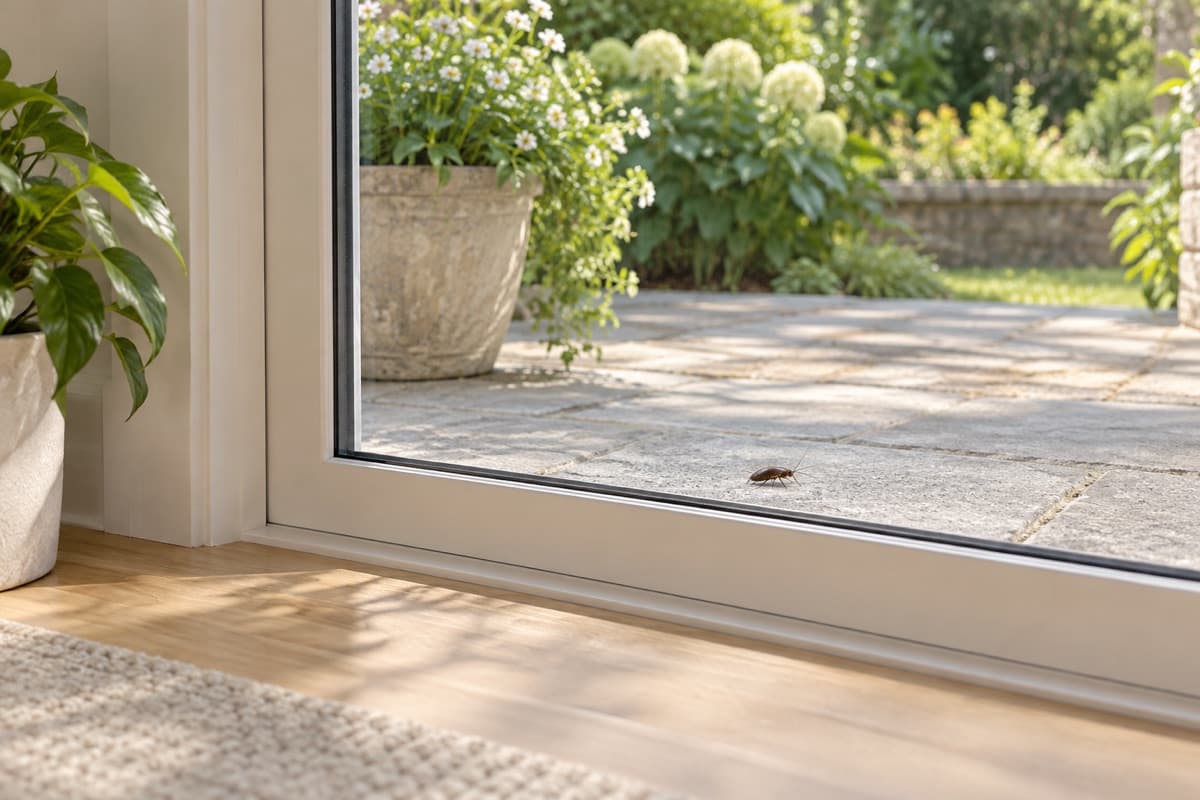
Large roaches that live outdoors and wander in. American, smokybrown, Oriental, Turkestan, Australian, and brown cockroaches run an inch and a quarter to two inches long. The University of California's statewide IPM program on cockroaches puts these in sewers, drains, water meter boxes, woodpiles, and mulch. They come in through gaps and drains, and they do poorly indoors. If this is what you have, gel bait inside your kitchen cabinets is aimed at the wrong place: the fix is exclusion, drainage, and yard work.
How to tell which one you have without a specimen ID. Buy a pack of plain sticky monitors — they are a few dollars — and place them flat against the wall in cabinet corners, under the sink, behind the trash can, beside and under the refrigerator, and along the dishwasher. Number and date each one. Check them daily for a week. UC IPM is direct that sticky traps "offer the best way to detect and monitor cockroach populations," and that you should keep checking until it is apparent where the greatest numbers are being caught.
What the monitors tell you:
- Nothing caught, occasional large roach near a door or bathroom. Outdoor species. Skip to exclusion and moisture.
- Adults only, one or a few. UF/IFAS's assessment-based management guide reads this as most likely a new introduction — the best possible time to act.
- Multiple sizes including tiny nymphs. An established indoor population. Treat now.
- A female carrying an egg case. That guide sets an unambiguous threshold: one gravid female is cause for intervention. Over her life a German cockroach female produces roughly eight egg capsules of 30 to 40 eggs each — on the order of 240 to 320 offspring.
- Roaches visible in the open during daylight. High probability the population is already large.
If you are unsure whether you have roaches at all, our guide on the physical evidence roaches leave behind walks through droppings, smear marks, shed skins, and odor in more detail.
Why The Order Of Operations Decides The Outcome
Nearly every failed DIY roach campaign fails for a structural reason, not a product reason.
Baits work because a foraging roach chooses your bait over everything else available. If the floor under the stove is coated in grease and there are crumbs behind the toaster, you have put a professional-grade insecticide in competition with an all-night buffet. UC IPM is explicit that removing other food sources greatly enhances the effect of baits.
Repellent sprays work against baits directly. The Advion Cockroach Gel Bait label — a mainstream professional product — carries two instructions that people routinely violate: do not apply the gel to surfaces recently treated with residual sprays, and do not apply residual sprays to surfaces treated with the gel. That is not fine print. Spraying a baseboard and then baiting it, or baiting and then spraying later "for good measure," wastes both.
And treatment aimed at the room where you saw a roach misses where roaches live. Roaches spend the overwhelming majority of their time pressed into tight, dark, warm harborage. UF/IFAS notes that adult cockroaches can fit into cracks only about 1/16 inch and prefer spaces of about 3/8 inch — narrower than most people picture when they look at a cabinet corner or a door sweep.
So the order is: reduce competing food and water, physically remove what you can, then bait inside the harborage, then add an IGR, then measure. Doing those steps out of order is what turns a four-week problem into a six-month one.
Step One: Take Away Food, Water, And Harborage
UF/IFAS describes the survival triangle as food, water, and harborage, and water is the tightest constraint. German cockroaches can survive about 12 days with food but no water, and about 42 days with water and no food. A dripping trap is worth more to them than your pantry.
Water first.
- Fix leaks under sinks, at toilet bases and supply lines, at the water heater, and in the refrigerator ice line.
- Dry the sink and tub at night, and don't leave standing water in dish trays or pet bowls overnight.
- Deal with condensation: sweating pipes, the drip pan under the refrigerator, and the A/C condensate line and pan.
- Run a dehumidifier in a damp basement, laundry room, or closet.
Food second.
- Move the stove and refrigerator out and clean underneath and behind them, including the compressor area. This is where the calories are.
- Degrease the range hood, the sides of the stove, and the gap between the counter and the appliance.
- Store dry goods in hard-sided airtight containers. NPIC notes roaches can chew through paper, cardboard, and thin plastic.
- Use a lidded trash can, take trash out at night, and rinse recyclables.
- Pick up pet food overnight.
Harborage third. Cut clutter, especially cardboard and paper bags, which are both food and shelter. Empty and wipe out the cabinets and drawers nearest your monitor hot spots. Seal obvious gaps at cabinet corners, along baseboards, and around plumbing chases once you have treated them.
One cleaning detail matters for health, not just control: UF/IFAS specifies using soapy water with a clean-water rinse to remove cockroach allergens, and warns that no-rinse cleaners only spread allergens rather than removing them.
Step Two: Vacuum The Harborage
Before any product goes down, vacuum. A HEPA vacuum removes live roaches, nymphs, egg cases, droppings, and shed skins at once. UF/IFAS recommends using a HEPA vacuum to knock down heavy infestations before treatment because it reduces the population to a more manageable level and gives immediate results.
Work the crevice tool along cabinet corners and hinges, the toe kick under cabinets, behind and under appliances, the motor compartment of the refrigerator, the sides of the dishwasher, and drawer runners. Empty the canister into a sealed bag and take it outside immediately. Wear an N95 if you are clearing heavy droppings — the cleanup itself aerosolizes allergen.
Step Three: Place Gel Bait Where Roaches Actually Live
Bait is the core of the program. UC IPM calls baits the primary pesticides used to treat cockroach infestations, and the NC State field study described below found gel baits produced significant declines within two to four weeks while foggers did nothing at all.
Amount and spacing. The Advion label specifies spots of about 0.5 grams, roughly a quarter inch in diameter — pea-sized, not a stripe. For light to moderate infestations, 1 to 3 spots per 10 linear feet; for heavy infestations, 3 to 5 spots per 10 linear feet. The label also states that several small applications distributed within an area are more effective than one or two large ones. That is the single most common DIY error after spraying: people put down four huge blobs and call it done.
Where to put it. The label directs the gel to cracks and crevices along walls and floors, behind and under equipment, around sinks, near garbage areas, inside cabinet cracks and crevices, and around plumbing penetrations. Texas A&M's guidance for prebaited stations is a useful rule of thumb generally: get a placement within one to two feet of every suspected harborage. In practice, for a kitchen:
- Inside the upper corners of each cabinet, and at the hinge points.
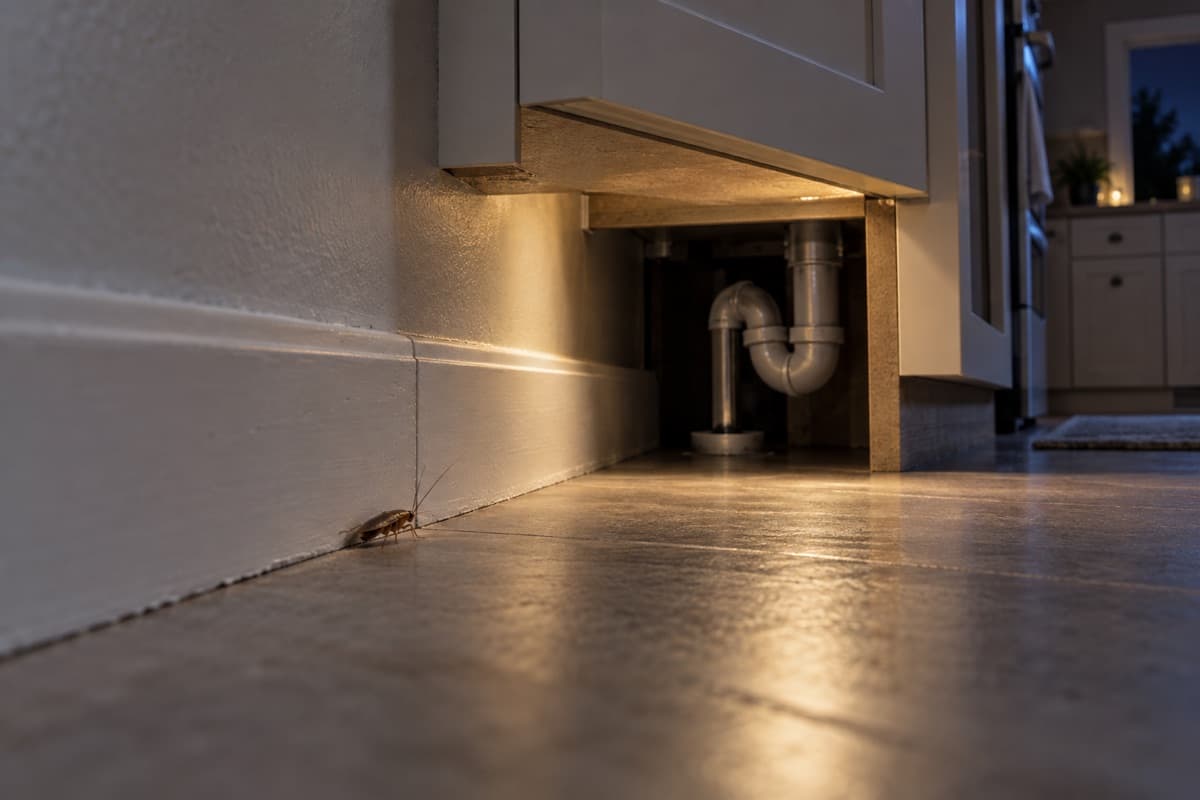
- Under the sink at the pipe penetration, not on the open cabinet floor.
- Along the toe kick, in the gap, not on the face.
- Behind and beneath the refrigerator, near the motor housing.
- Along the dishwasher sides and at the junction between counter and appliance.
- Inside the crack where the stove meets the wall or cabinet.
Where not to put it. The Advion label is specific: do not treat areas easily accessible to children and pets, do not apply to surfaces that food contacts, do not allow open food to contact the gel, and do not apply where temperatures exceed 120–130°F, because the bait liquefies and loses effectiveness — which rules out parts of stoves, ovens, and grills.
Expect a lag. UC IPM notes most bait insecticides are slow acting and may take seven days or longer. That delay is the mechanism, not a defect: the roach needs time to return to harborage, where the toxicant moves through the population secondarily. If you want a deeper walkthrough of placement technique with one common product, see our guide to using Advion roach gel correctly.
Reapply. UF/IFAS advises reapplying bait every one to two weeks depending on infestation level and product, continuing until monitors catch nothing, with no nymphs or egg cases. Inspect placements — bait that has been consumed, dried out, or crusted over is no longer working.
Step Four: Add An Insect Growth Regulator
An IGR does not kill adults. It is a juvenile hormone analog — hydroprene and pyriproxyfen are the common ones — that prevents nymphs from developing into reproductive adults. It closes the back door while bait works on the front.
It does something else that is less well known and genuinely useful. Gravid females carrying an egg case feed and forage very little, which is exactly why they survive baiting campaigns. UF/IFAS notes that IGRs cause the ootheca to be released prematurely, which returns the female to normal foraging and feeding — putting her back in contact with your bait.
Two practical notes. Apply the IGR as a crack-and-crevice treatment to harborage, placed near your bait but not directly on it, so you do not affect bait palatability. And be patient: UF/IFAS states IGRs require four to six weeks for a noticeable decrease in the cockroach population. Our guide on how to use an IGR for roaches covers formulations and placement timing.
Step Five: Monitor So You Are Measuring, Not Guessing
Leave the sticky monitors down through the entire program and keep dating them. UF/IFAS describes monitors as your eyes on the property, working 24/7.
Read them weekly:
- Catch counts falling week over week. The program is working. Keep going.
- Fewer adults but still nymphs. Reproduction is continuing somewhere you have not treated. Widen your inspection — the guide suggests focusing within five to ten feet of a monitor catching early-instar nymphs.
- Flat or rising counts after two to three weeks of correct baiting. Something is wrong: competing food, wrong placement, a sprayed surface, resistance, or bait aversion. Do not simply add more of the same bait.
- Zero catches, no nymphs, no egg cases. That is the endpoint. Baiting can stop; monitoring should continue for a few more weeks.
If you want a checklist for interpreting early results, we cover the signals in how to tell if roach bait is working.
What Not To Do
This section will contradict a lot of what you have read elsewhere, so here is the evidence.
Total-release foggers ("bug bombs") do not work on roaches. This is not opinion. Researchers at NC State ran a controlled field test across five apartment complexes with moderate to severe German cockroach infestations, comparing four commercially available foggers against gel bait. The results, reported by NC State and published in BMC Public Health in January 2019, were that the foggers produced no reduction in cockroach populations at two weeks or four weeks, while gel baits produced significant declines. Meanwhile, insecticide residue on horizontal kitchen surfaces rose to roughly 600 times pre-treatment levels. "The bug-bomb products did absolutely nothing to control cockroach populations in these homes," said study author Zachary DeVries.
The mechanism is simple. UC IPM explains that aerosols and total-release foggers don't reach the crevices where cockroaches harbor and breed, and may also repel and disperse cockroaches to other areas of the building. UF/IFAS puts it as control from foggers being variable because it is limited to the cockroaches that directly contact the fog. So you get the exposure without the control, and you may push the infestation into adjacent rooms or units. Our page on how many roach foggers you would need goes further into why the whole premise is flawed.
Do not spray repellent residuals over or around bait. Beyond the label prohibition, repellent pyrethroid sprays drive roaches deeper into voids and away from the bait you want them eating. If you have already sprayed a surface, wipe it and bait elsewhere.
Do not treat only where you saw one. Treat where the monitors say they live.
Be realistic about DIY dusts. Boric acid and desiccant dusts do work, with real constraints. UC IPM describes boric acid as a contact and stomach poison that clings to the roach's body by electrostatic charge and is ingested during grooming — but only while it stays dry and undisturbed, and a deposit that gets wet, dries, and cakes loses its charge. Apply a barely visible film into voids: under and behind appliances, inside the toe kick, into wall voids at plumbing and electrical penetrations. Visible piles of powder are both ineffective and something roaches will walk around. Keep dusts out of reach of children and pets, and out of living-space air.
Skip the folk remedies as a treatment. Bay leaves, cucumber peels, coffee grounds, and most essential-oil sprays have no credible evidence of eliminating an infestation. At best some produce brief avoidance of a treated spot, which in an active infestation is the opposite of what you want — you want roaches moving toward bait, not dispersing. Peppermint oil and similar products are repellents by design, so using them alongside a baiting program works against the program. If you like the smell, fine; just do not count it as control, and do not let it substitute for fixing the leak under the sink.
When Bait Stops Working: Resistance And Bait Aversion
If you have done everything right and counts are not moving, there are two well-documented biological explanations.
Insecticide resistance, and it develops fast. A Purdue team led by Michael Scharf tested resistance-management strategies in infested multi-unit housing over six months, publishing in Scientific Reports in 2019. As Purdue summarized the work, rotating three insecticide classes monthly held populations flat but could not reduce them; a two-insecticide mixture failed outright and populations grew; and a single insecticide succeeded only where starting resistance to it was low. Where roughly 10% of the population started out resistant, numbers increased. Worse, survivors developed cross-resistance to classes they had never been exposed to — "we would see resistance increase four- or six-fold in just one generation," Scharf noted. UF/IFAS makes the same point from the field side: if resistance genes are present in more than 1% of a population, noticeable declines in product efficacy can appear within a single generation, and a generation takes about 100 days.
The practical lesson is not "chemicals never work." It is that a population that has been sprayed repeatedly by previous tenants, a landlord's contractor, or you is a different problem than a fresh introduction, and it needs a different active ingredient plus far more attention to sanitation, vacuuming, and IGRs.
Bait aversion is a separate thing. Some German cockroach populations have evolved to reject glucose, a common phagostimulant in baits. Work by Ayako Wada-Katsumata and Coby Schal, published in *Science* in May 2013, showed that in glucose-averse roaches, glucose stimulates the bitter-receptor neurons — the insect literally tastes the sugar as bitter and backs away. UF/IFAS notes bait aversion is inherited much like insecticide resistance. If you see roaches approach your bait and refuse it, or bait that never gets consumed while monitors keep filling, switch to a bait with a different matrix and a different active ingredient.
How to rotate sensibly. UF/IFAS recommends rotating among three to six baits with different IRAC classification numbers, roughly monthly, and specifically warns against putting several bait types out simultaneously, which can increase the probability of resistance and cross-resistance developing. The Advion label carries the same logic in manufacturer form: rotate Group 22A products with different groups that control the same pests. Check the IRAC group number on the label, not the brand name — several brands share an active ingredient.
Seal Them Out And Dry The Place Out
Exclusion is what makes results hold, and for the large outdoor species it is essentially the whole job.
At the envelope:
- Install and maintain tight door sweeps and weatherstripping, including garage, laundry, and patio doors. This is usually the highest-value single repair.
- Caulk around hose bibs, electrical and cable penetrations, dryer vents, and A/C line sets.
- Screen or seal attic and soffit vents, and repair torn window and porch screening.
- Seal gaps around plumbing under sinks and behind toilets, and around pipe chases between floors.
- Maintain drains. Large species move through sewer and drainage systems; keep traps full of water in rarely used drains and repair broken or open cleanouts.
At the perimeter: UC IPM recommends a strip of gravel about 6 to 12 inches wide around the building perimeter, plus trimming vegetation off the walls and removing stored lumber and firewood. Pull mulch and dense ground cover back from the foundation, clear leaf-clogged gutters, and fix irrigation heads and grading that keep the foundation wet.
Inside: keep going after moisture. A dry building is an inhospitable one, and it is the part of prevention that does not wear off.
If You Rent Or Live In A Multi-Unit Building
This is where roach control most often becomes a grind, and it is worth knowing why before you blame yourself.
German cockroaches travel between units through shared plumbing chases, wall voids, outlets, and common walls. A UF/IFAS-led national survey of 926 renters across 44 states and Washington, D.C. found more than 70% of respondents seeing cockroaches at least monthly and nearly 30% daily, with about 79% treating on their own using consumer sprays, foggers, and baits. The researchers point at building connectivity through shared utilities and inaccessible areas, compounded by water leaks and disrepair, as the reason infestations persist. More than three-quarters of respondents said they would pay for complex-wide professional treatment.
What that means for you:
- Treating your unit alone rarely holds if adjacent units are untreated. NPIC's advice is blunt: work with your neighbors and the landlord, because isolated efforts prove ineffective.
- Put every request in writing, keep dated photos, and keep copies. A paper trail is what makes a habitability claim or a code complaint credible later.
- Ask specifically whether adjacent and vertically stacked units are being inspected, and push for a building-wide program rather than repeat spraying of your unit.
- Ask what they are applying. If the answer is a perimeter spray or a fogger, you now know why nothing is changing.
- Report leaks and disrepair as pest issues, because they are. A landlord who will not treat may still be obligated to repair.
Landlord obligations for extermination vary by state and by lease, and in many places they differ between apartment buildings and single-family rentals. Check your state's landlord-tenant statute and your local housing code, or contact a local legal aid office — that is a real answer, and it beats a generic claim about "your rights" that may not apply where you live.
How Long This Actually Takes
Honest expectations prevent people from quitting one week before it works.
- Days 1–3: Sanitation, moisture repairs, vacuuming, monitors down, first bait placement and IGR.
- Week 1: Little visible change, and you may see more roaches in the open as they forage. Bait is slow acting by design — UC IPM says seven days or longer.
- Weeks 2–4: Monitor counts should fall clearly. Reapply bait every one to two weeks. Dead roaches in the open are normal.
- Weeks 4–6: The IGR's effect becomes visible as the nymph cohort fails to mature. UF/IFAS gives four to six weeks for a noticeable decrease from IGRs.
- Weeks 6–12: Counts should reach zero with no nymphs or egg cases. That is when baiting can stop.
A new, small introduction can be over in three to four weeks. An established kitchen infestation is usually six to twelve. A resistant population in a connected apartment building can take months and may not be solvable unit-by-unit at all. If you are eight weeks in with flat monitor counts and correct technique, the problem is not your persistence.
DIY Or Hire A Pro?
Reasonable DIY territory: occasional large outdoor roaches; a small German cockroach problem caught early; all sanitation, exclusion, and moisture work, which is yours regardless of who treats.
Call a licensed professional when:
- Monitors show small roaches and nymphs in more than one room, or you are seeing roaches in daylight.
- Four to six weeks of correct sanitation, bait placement, and an IGR have not clearly reduced counts — that pattern points to resistance, bait aversion, or an untreated source.
- You live in an apartment, condo, or duplex and the source may be a neighboring unit or a shared void.
- Someone in the household has asthma or significant allergies. The EPA identifies cockroach droppings and body parts as an asthma trigger, and prolonged exposure is not worth an extended DIY campaign.
- You are not comfortable placing pesticide products safely around children or pets.
- You cannot tell what species you have. Your county extension office can usually help with identification, often free.
When you get quotes, ask what species they identified, what products and IRAC groups they plan to use and where, how often they will return, and what repairs they recommend. A company that sprays a baseboard perimeter and leaves is not running a German cockroach program. Our breakdown of what roach extermination typically costs gives you a baseline for judging a bid. Verify the license through your state's pesticide regulatory agency before you sign anything.
Keeping Them Out For Good
Once monitors are clean, prevention is mostly maintenance, and it is cheap compared to a second infestation.
- Keep two or three monitors down permanently in the highest-risk spots. This is early warning, and it costs nothing.
- Hold the water line. Fix leaks the week they appear. Dry sinks at night. Keep humidity down in basements and laundry rooms.
- Hold the food line. Airtight storage, lidded trash, clean under the appliances a few times a year.
- Re-check the envelope annually. Door sweeps wear out. Caulk cracks. Screens tear.
- Inspect what comes in. German cockroaches move in with groceries, cardboard cases, secondhand appliances, used furniture, and moving boxes. Unpack cardboard outside and break it down immediately, and be especially careful when moving out of a building that had a problem.
- Act on the first sighting, not the fifth. One gravid female is the intervention threshold for a reason.
Frequently Asked Questions
Can you really get rid of roaches permanently?
You can permanently eliminate an indoor breeding population, and that is a realistic goal. German cockroaches only live where people do, so once they are gone and you have closed the food, water, and entry routes, they stay gone unless something new is carried in. What you cannot do is permanently prevent an outdoor roach from ever walking under a door. Judge success by what is breeding inside, not by whether you ever see another insect.
Does seeing one roach mean there are hundreds more?
It depends on the species. One large outdoor roach is often just one, and points at a gap or a drain. One small tan roach in a kitchen is worth acting on immediately, because German cockroaches breed continuously indoors — a female produces roughly eight egg capsules of 30 to 40 eggs. Put monitors down for a week; that answers the question far better than guessing.
What kills roaches the fastest?
Contact sprays kill the individual roach in front of you fastest, and do the least for the infestation. Gel baits are slower — often seven days or more before numbers visibly drop — but they reach the roaches you cannot see, which is where the population actually lives. If you need immediate reduction, a HEPA vacuum removes hundreds at once without contaminating the bait program.
Do bug bombs work on roaches?
No. The NC State field study found no reduction in cockroach populations from four commercially available foggers at either two or four weeks, while raising insecticide residue on horizontal kitchen surfaces to roughly 600 times baseline. The fog does not penetrate the crevices where roaches harbor, and it can push them into adjacent rooms or units. Gel bait at comparable cost worked in the same study.
Should I spray insecticide along with gel bait?
Not on or near the bait. Product labels prohibit it — Advion's label says not to apply residual sprays to baited surfaces or to bait surfaces recently sprayed — and repellent sprays drive roaches away from the bait you need them to eat. If a targeted residual is part of a professional plan, the pro will separate the placements deliberately.
Does boric acid work for roaches?
Yes, within limits. UC IPM describes boric acid as a contact and stomach poison that clings to the roach electrostatically and is ingested during grooming. It has to be a barely visible film in a dry, undisturbed void — piles get avoided, and a deposit that gets wet, dries, and cakes loses its charge. It is a supporting tool for voids, not a replacement for baiting the harborage.
Do bay leaves, peppermint oil, or coffee grounds get rid of roaches?
No. There is no credible evidence that any of them eliminate an infestation. Strongly scented products may cause brief avoidance of a treated surface, which is actually counterproductive during a baiting program, because you want roaches foraging onto bait rather than relocating. Use the time on the leak under the sink instead.
Why do I still have roaches after the exterminator came?
The usual explanations are resistance to the product used, bait aversion, a neighboring unit acting as a reservoir, or a spray-only treatment that never reached harborage. Ask for the species identification and the product names and IRAC group numbers, ask for a bait-and-IGR program rather than a perimeter spray, and put your own monitors down so you have independent data on whether anything is changing.
How do I know when they are actually gone?
Monitors catching zero roaches, with no nymphs and no egg cases, over consecutive weeks. UF/IFAS uses exactly that as the endpoint for stopping bait applications. Absence of sightings is weaker evidence — roaches are nocturnal and reclusive, and you can miss a recovering population for weeks.
Are roaches dangerous, or just unpleasant?
The best-documented risk is allergic and respiratory. The EPA identifies cockroach droppings and body parts as an asthma trigger, and UC IPM notes indoor infestations are important allergen sources and a risk factor for asthma development in children, especially in multi-unit housing. Roaches can also mechanically carry bacteria between drains, garbage, and food surfaces, which is a sound reason to discard exposed food and rewash dishes — treat that as a hygiene problem to manage rather than a guaranteed illness.
Can a clean house still get roaches?
Yes. Cleanliness strongly affects whether German cockroaches can thrive once introduced, but it has almost no bearing on whether they arrive. They come in on groceries, cardboard, appliances, luggage, and moving boxes, and through shared walls in apartments. Blaming yourself delays the part that helps.
Sources
- UF/IFAS ENY-214: Cockroaches and Their Management — species and sizes, crack size roaches can enter (about 1/16 inch) and prefer (about 3/8 inch), survival without food versus water, IGR timelines of four to six weeks, and the variable performance of foggers.
- UF/IFAS ENY-989: Assessment-Based Pest Management of German Cockroaches — monitors as continuous assessment, the gravid-female intervention threshold, offspring counts, rebaiting every one to two weeks until zero catch, IGRs triggering premature ootheca drop, bait rotation by IRAC class, resistance emerging within a generation, and allergen removal with soapy water and rinse.
- UF/IFAS EENY-002: German Cockroach — dependence on human structures, egg capsule size, roughly 100-day life cycle, and six nymphal instars.
- UC Statewide IPM Program: Cockroaches — sticky traps as the best monitoring method, baits as the primary treatment and their seven-day-plus lag, why foggers and aerosols fail and disperse roaches, boric acid mechanism and its dry-and-undisturbed requirement, perimeter gravel strip, and allergen/asthma risk.
- NC State News: "Bug Bombs" Are Ineffective Killing Roaches Indoors — the BMC Public Health (January 2019) field study of four total-release foggers across five apartment complexes: no population reduction at two or four weeks, effective gel bait comparison, and roughly 600-fold increases in surface insecticide residue.
- EPA-accepted Advion Cockroach Gel Bait label (EPA Reg. No. 100-1484) — 0.6% indoxacarb, spot size of about 0.5 g and a quarter inch, 1–3 spots per 10 linear feet for light to moderate and 3–5 for heavy infestations, many small placements over few large ones, prohibitions on spraying over bait and on food-contact surfaces, the 120–130°F limit, and Group 22A rotation guidance.
- Purdue Agriculture: Rapid cross-resistance bringing cockroaches closer to invincibility — the six-month Scientific Reports field trial of rotation, mixture, and single-insecticide strategies, and the four- to six-fold single-generation resistance increases described by Michael Scharf.
- NC State News: Glucose-averse roaches — the 2013 Science finding that glucose stimulates bitter-receptor neurons in bait-averse German cockroaches.
- UF/IFAS: National survey on roach infestations in multi-family housing (2026) — 926 renters in 44 states and D.C., sighting frequency, reliance on consumer products, and shared utilities and disrepair as drivers of persistence.
- National Pesticide Information Center: Cockroach control — identification before treatment, IPM before pesticides, chewing through paper and thin plastic, switching active ingredients when products fail, and coordinating with neighbors and landlords.
- EPA: Asthma triggers — gain control — cockroach droppings and body parts as an asthma trigger and the recommended low-pesticide control actions.