Nothing. The boric acid powder sold for roaches is registered as a dust, and its label tells you to apply it dry, in a thin film, in cracks and voids — not to blend it into food. Mixing it into sugar, flour, peanut butter, or condensed milk works against you three ways: it wets the powder so it cakes and loses the electrostatic charge that makes it stick to a roach, it lands at a concentration cockroaches actively avoid in choice tests, and it puts an edible pesticide ball on your floor when the label says to apply only in areas inaccessible to children and pets. If you want boric acid inside a food matrix, buy one that is already formulated and tested that way — orthoboric acid granular bait or boric acid tablets — and use the dust for voids.
The earlier version of this article said boric acid "works by dehydrating the insects and disrupting their digestive systems," and went on to recommend cucumber slices, bay leaves, garlic, and catnip as repellents, and to describe roaches as sharing bait "with others in their colony." None of that holds up. Desiccation is how diatomaceous earth and silica aerogel work, not boric acid. Cockroaches are not colonial insects with a shared nest. And the kitchen-produce repellents have no support in the pest management literature. This version is rebuilt from the product labels and the entomology.
What Boric Acid Actually Does to a Roach
Boric acid is both a contact and a stomach poison, and the contact route matters more than most people assume. University of California's Integrated Pest Management program explains the mechanism directly: boric acid powder "is not repellent, and if it remains dry and undisturbed, it provides control for a very long time. Because it has a positive electrostatic charge, the dust clings to the body of a cockroach as it walks through a treated area, and the cockroach ingests small amounts when it grooms itself."
The National Pesticide Information Center describes what happens next: boric acid "disrupts their stomach and can affect their nervous system. It can also scratch and damage the exterior of insects." That third mechanism is abrasion, not dehydration.
Two consequences follow from the electrostatic point, and together they are the whole argument against mixing. First, wet boric acid stops working as intended: UC IPM notes that "if a deposit gets wet and then dries and cakes, it loses its electrostatic charge and will not be picked up readily by cockroaches," and a peanut butter ball is permanently wet boric acid. Second, thin beats thick, because "thin films of dust are more effective than thick layers, which may cake and clump together." A visible pile or a paste is something roaches walk around.
Boric acid is also slow on purpose. UC IPM puts the realistic timeline at "7 days or more before it has a significant effect on a cockroach population." We cover how long to leave boric acid down separately.
What the Research Says About Sugar, Flour, and Peanut Butter
There is real science on boric acid baits, and it does not support the recipes that circulate online.
Concentration is the first problem. The typical internet recipe is one part boric acid to three parts powdered sugar, which is 25 percent boric acid. In a 1993 Journal of Economic Entomology study, Strong, Koehler, and Patterson at the University of Florida tested boric acid baits at 1, 4, 6.25, 12.5, 25, and 50 percent in both choice and no-choice designs. With no alternative food, everything killed. Given a choice, which is the real-world condition in any kitchen, the dry-mixed and wet-mixed baits showed clear repellency at higher concentrations, and in the wet-mixed choice test all the cockroaches survived except at the lowest concentration. Roaches ate the weak bait and walked away from the strong one.
The liquid finding points the other direction. Gore and Schal at NC State tested aqueous boric acid and sugar solutions against German cockroaches in 2004 and found that solutions of only 0.5 to 2 percent boric acid with inexpensive sugars (fructose, glucose, maltose, or sucrose) were effective. Strong's group had already found that water-based solutions showed no repellency and that mortality did not increase above 1 percent. The concentration that works in a liquid bait is roughly one-tenth to one-fiftieth of what a 1:3 sugar recipe delivers. People are using far too much boric acid and getting avoidance instead of feeding. That research used laboratory-prepared solutions in controlled settings, and it does not turn a dust label into a liquid-bait label.
Sugar itself can be the wrong choice. In 2013, Wada-Katsumata, Silverman, and Schal published work in Science showing that German cockroach populations under bait pressure have evolved glucose aversion: in these roaches glucose stimulates bitter-taste neurons and suppresses the sugar-taste neurons, so a glucose-sweetened bait registers as something to spit out. A 2023 follow-up in the *Journal of Economic Entomology* found the problem compounds, because glucose-averse nymphs also avoided the feces of adults that had eaten glucose or disaccharide baits, blunting the secondary kill that makes baiting work. If your building has a glucose-averse population, powdered sugar is the worst carrier you could pick, and the only symptom is bait that sits untouched. Commercial manufacturers test palatability and change phagostimulants when this shows up. A kitchen recipe cannot.
Why Roaches Do Not Take Bait "Back to the Colony"
Cockroaches are not social insects. There is no queen, no colony, no forager carrying food home, and the claim changes how people place things, so it is worth correcting. What actually produces secondary kill is less tidy: roaches eat each other's feces, vomit, and corpses, and slow-acting insecticides ride along. Buczkowski, Scherer, and Bennett documented three generations of this with indoxacarb gel bait, where nymphs died after exposure to a dosed adult and then adults died from eating those nymphs. The practical implication is that bait belongs where roaches already congregate, because the transfer happens inside the harborage.
The Label Problem, Stated Plainly
Every registered pesticide label carries the same sentence: "It is a violation of Federal law to use this product in a manner inconsistent with its labeling." That language comes from FIFRA, and the statute's list of exceptions covers things like using less than the labeled rate. It does not cover ignoring a use restriction.
Here is what the actual boric acid roach powder labels say. Harris Famous Roach Powder (EPA Reg. No. 3-10, 99 percent boric acid) carries these use restrictions: "Apply only in areas inaccessible to children and pets. Avoid contamination of feed and foodstuff. Do not use in edible product areas of food handling establishments." Zap-A-Roach (EPA Reg. No. 51311-1, 100 percent boric acid) carries the same restriction, plus "Do not contaminate food and foodstuffs" and "Any powder visible after application must be brushed into cracks and crevices or removed." Both labels were amended in 2020 and 2021 under EPA's Boric Acid Interim Decision, and the children-and-pets language is part of the mitigation EPA required during that review.
A sweetened boric acid ball on a kitchen floor is, by design, accessible to children and pets and mixed with foodstuff. Nobody is going to fine a homeowner for it. But the restriction exists because of a risk assessment, and that is the reason to take it seriously. One more wrinkle: the Harris powder already contains a feeding attractant. Its label states the product "is an insect food and contains the HARRIS ROACH LURE. Because of the 'lure,' ants, palmetto bugs, roaches, silverfish and water bugs will find and eat this powder." Adding sugar to a product that already includes a lure accomplishes nothing.
Child and Pet Safety, Without Exaggerating in Either Direction
Boric acid gets described online as both "completely natural and safe" and as a serious household poison. Neither is right.
Acute toxicity is genuinely low. NPIC's technical summary gives an oral LD50 in rats of roughly 3,450 mg/kg for males and 4,080 mg/kg for females, and notes that boric acid "is absorbed poorly by skin contact unless the skin is damaged." A 1988 review of 784 boric acid ingestions in the American Journal of Emergency Medicine found no patients with severe toxicity and 88.3 percent entirely asymptomatic; where symptoms occurred, they were mostly vomiting, abdominal pain, and diarrhea. A toddler who licks a dusty finger is very unlikely to be seriously hurt.
That is not the same as harmless. The labels above say "Harmful if swallowed or inhaled" and "Avoid breathing dust" for a reason. Ingesting a meaningful quantity causes nausea, vomiting, diarrhea, and in severe cases seizures and kidney injury, and NPIC notes the vomit and diarrhea can look blue-green. The historical minimum lethal dose estimates NPIC cites (roughly 5 to 20 grams for adults, 3 to 6 grams for children, under 5 grams for infants) are widely considered conservative, but a bait ball made from several ounces of pure powder is not a trivial amount of boric acid on the floor.
Repeated low-level exposure is the endpoint EPA cares about. The agency's reference dose for boron compounds is 0.2 mg boron per kilogram of body weight per day, driven by developmental effects seen in animal studies at doses that did not visibly harm the mother. That chronic-exposure standard is why the labels push the material into voids rather than onto floors a crawling child contacts daily.
For pets, dogs are the ones to worry about. NPIC's technical data put the canine oral LD50 above 631 mg/kg, lower than the rodent figures, and note that signs of poisoning in animals can begin within two hours. Dogs will eat a peanut butter ball. That is the entire point of a peanut butter ball. Our guide to choosing a roach product around pets covers the risk-based version of that decision.
If a child swallows boric acid, call Poison Control at 1-800-222-1222. For a pet, call your veterinarian or the ASPCA Animal Poison Control Center at 888-426-4435. Have the container with you; the labels specifically instruct this.
How To Apply Boric Acid Dust Correctly
Dry, thin, and hidden. That is the whole method.
- Use a bulb duster or puffer, not a spoon and not your fingers. The Harris label allows a teaspoon but warns not to reuse food utensils for food afterward.
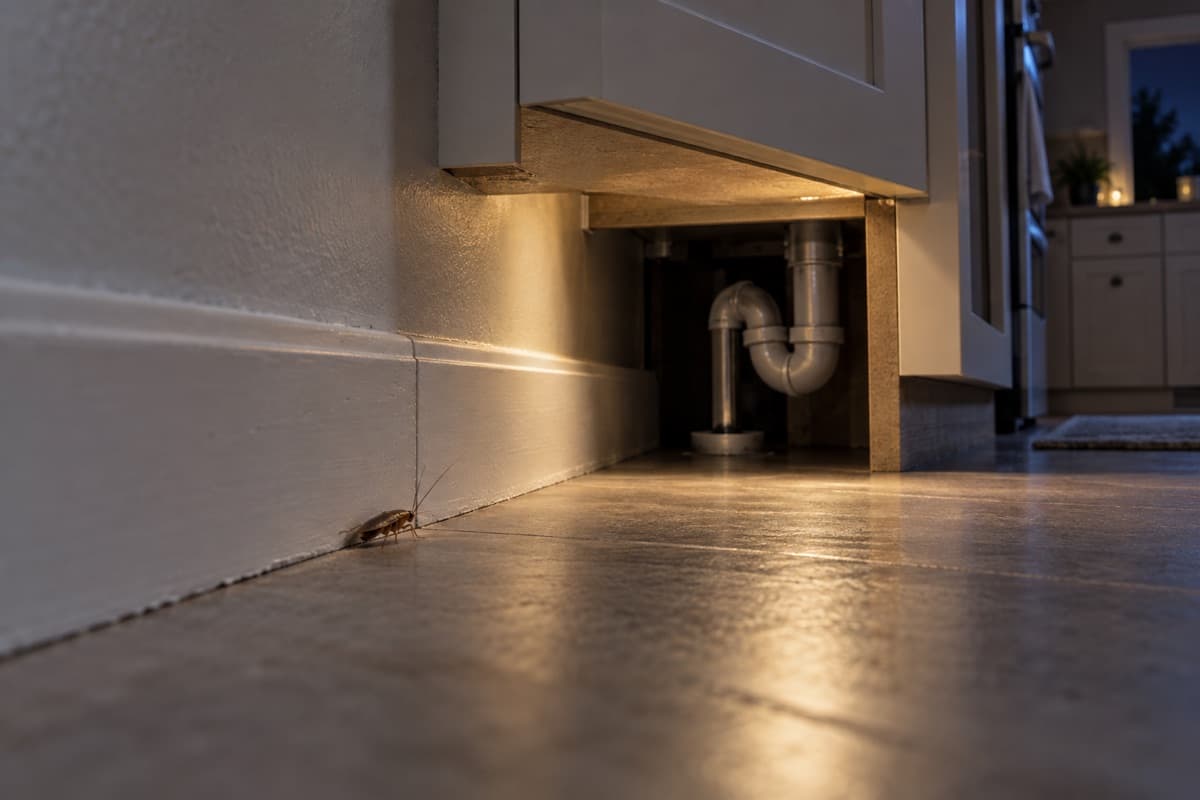
- Pull the kick panel off the refrigerator and range and lay a light film across the entire void underneath. UC IPM specifically recommends this, and it is the highest-value placement in most kitchens.
- Treat inside cabinet and vanity voids. Remove the lower drawers and dust the drawer wells, the back corners of shelves, and the void between the sink cabinet and the wall. Dust around plumbing and conduit penetrations while you are there.
- Brush or vacuum any visible residue into the crack. Both labels require this. If you can see it on an open surface, it is in the wrong place and is not working anyway.
- Keep it out of damp areas and off food-contact surfaces. UF/IFAS puts it simply: boric acid "is most effective indoors in clean, dry areas," and you should "not apply dusts in open areas such as on shelves or counters where food and utensils are kept."
- Leave it alone. Undisturbed and dry, it lasts a very long time. Re-dust only if the area gets wet, cleaned out, or caked.
Boric acid is also not an outdoor material. UC IPM notes it is toxic to plants.
What To Pair It With Instead
The useful version of the original question is: what else should I be doing at the same time? Boric acid dust is one component of a program, and alone it will disappoint you.
- A registered gel bait in cracks and crevices. UC IPM calls baits "the primary pesticides used to treat cockroach infestations," and gels are the most effective consumer format for German cockroaches. Our walkthrough of applying gel bait from the label covers placement density.
- A commercially formulated boric acid bait, if that is the route you want. Harris Famous Roach Tablets are 40 percent boric acid in a lure matrix, and Niban-type granular baits are 5 percent orthoboric acid. That is what "boric acid mixed with food" looks like when someone has tested it.
- An insect growth regulator, which sterilizes adults and keeps nymphs from maturing. It supplies the slow structural pressure boric acid does not.
- Sanitation that removes competing food. UC IPM is blunt: "Removing other food sources will greatly enhance the effects of baits."
- Sticky monitors in the same locations, checked weekly, so you know whether counts are dropping rather than guessing.
Do not combine boric acid with water for spraying, with diatomaceous earth or silica aerogel in the same spot (UC IPM notes desiccant dusts are repellent, which undercuts a non-repellent dust), or with any household cleaner. For the wider DIY picture, we assess what homemade roach mixtures actually accomplish and where diatomaceous earth genuinely fits.
DIY or Call a Pro
Do it yourself when sightings are occasional, you can tell where they are coming from, and monitor counts fall within three to four weeks of starting dust plus gel bait.
Call a professional when you are seeing roaches in daylight or nymphs in more than one room, when you live in an apartment or shared building where treating a single unit rarely holds, when counts have not moved after a month of correct baiting and dusting, when dust needs to go inside wall voids (UC IPM notes this "may require a pest control professional"), or when someone in the home has asthma. Our step-by-step roach elimination plan sequences inspection, baiting, and follow-up in the order that works.
Frequently Asked Questions
Can I mix boric acid with sugar and water to make a liquid bait?
There is published research showing that 0.5 to 2 percent boric acid in sugar water kills German cockroaches effectively, and that low-concentration liquid solutions are not repellent. But the consumer powder you can buy is labeled as a dust, and making a liquid bait from it is not a use the label describes. If you want a liquid or gel boric acid bait, buy a product registered as one.
Is borax the same thing as boric acid?
No. Borax is sodium tetraborate, sold mainly as a laundry booster. Boric acid is a different compound, and the roach powders are 99 to 100 percent boric acid. Some registered ant baits do use sodium tetraborate as the active ingredient, but a box of laundry borax is not registered as an insecticide and using it as one is off-label.
Why do so many websites publish boric acid and peanut butter recipes?
They are old, memorable, and not obviously wrong to a reader. The recipes predate modern gel baits and have been copied forward for decades, while the entomology moved on to formulations that are more palatable, dosed more precisely, and confined to placements that reduce human and pet exposure.
Does boric acid stop working if roaches get used to it?
Resistance to boric acid has not been a practical problem the way it has been for many sprays, likely because the mechanism is physical and metabolic rather than neurotoxic. What does happen is behavioral: if the deposit gets wet, cakes, or sits in an open area roaches avoid, it stops being encountered. That looks like resistance and is not.
How long before I see dead roaches?
Expect a week or more before the population visibly drops, and longer before it is gone. UC IPM describes boric acid powder as having "fairly slow activity," with 7 days or more to a significant population effect. Slow is a feature — it gives dosed roaches time to return to the harborage, where their feces and bodies dose others.
Can I use boric acid in a kitchen at all?
Yes, in the right places: inside the void under the refrigerator and range, inside cabinet voids, in drawer wells, and around pipe penetrations. Not on shelves, counters, or anywhere food or utensils sit, and not in serving areas while food is exposed. The labels prohibit those placements explicitly.
What if my toddler already got into it?
Call Poison Control at 1-800-222-1222 and have the container in hand. The reassuring context is that in a series of 784 boric acid ingestions, no patient developed severe toxicity and 88 percent had no symptoms at all. That is a reason not to panic, not a reason to skip the call.
Sources
- NPIC: Boric Acid General Fact Sheet — how boric acid affects insects, signs of poisoning in people and animals, and poor dermal absorption.
- NPIC: Boric Acid Technical Fact Sheet — rat and dog oral LD50 values, estimated human lethal dose ranges, the 0.2 mg/kg/day boron reference dose, and developmental toxicity findings.
- UC IPM Pest Notes: Cockroaches — the electrostatic mechanism, thin-film application, caking and loss of charge, the 7-day timeline, outdoor plant toxicity, and why baits and sanitation lead the program.
- UF/IFAS: Cockroaches and Their Management — boric acid as the most common labeled cockroach dust, effective in clean dry areas, and not to be applied on open shelves or counters.
- Penn State Extension: Got Roaches? Eliminate Roaches with IPM — boric acid placement in wall voids, behind switches, and along wall edges.
- EPA-accepted label, Harris Famous Roach Powder, EPA Reg. No. 3-10 (2021) — 99 percent boric acid, the built-in lure, "apply only in areas inaccessible to children and pets," and the Boric Acid Interim Decision label mitigation.
- EPA-accepted label, Zap-A-Roach Boric Acid Roach Killer, EPA Reg. No. 51311-1 (2020) — 100 percent boric acid, food-contamination restrictions, and the requirement to brush visible powder into cracks.
- EPA-accepted label, Harris Famous Roach Tablets, EPA Reg. No. 3-1 (2021) — 40 percent boric acid in a formulated lure matrix, twelve tablets per room maximum.
- EPA-accepted label, Redzone Bait / NiBan Granular Bait, EPA Reg. No. 64405-2 (2019) — 5 percent orthoboric acid granular bait, the commercially formulated version of "boric acid mixed with food."
- FIFRA, 7 U.S.C. §136(ee) — the statutory definition of using a pesticide in a manner inconsistent with its labeling, and its limited exceptions.
- Strong, Koehler & Patterson, *Journal of Economic Entomology* 86(5), 1993 — oral toxicity and repellency of borates to German cockroaches across 1 to 50 percent concentrations in choice and no-choice tests.
- Gore & Schal, *Journal of Economic Entomology* 97(2), 2004 — 0.5 to 2 percent boric acid in sugar solutions as effective liquid bait.
- Wada-Katsumata, Silverman & Schal, *Science*, 2013 — glucose aversion as an evolved behavioral resistance to sweetened baits.
- McPherson, Wada-Katsumata, Silverman & Schal, *Journal of Economic Entomology* 116(2), 2023 — glucose- and disaccharide-containing baits impeding secondary mortality in glucose-averse populations.
- Buczkowski, Scherer & Bennett, *Journal of Economic Entomology* 101(3), 2008 — secondary and tertiary mortality from horizontal transfer of indoxacarb bait, the mechanism behind "secondary kill."
- Litovitz et al., *American Journal of Emergency Medicine* 6(3), 1988 — 784 boric acid ingestions, 88.3 percent asymptomatic, no severe toxicity.
</content> </invoke>