TERRO Roach Bait Gel (product T502) is a 0.05% fipronil gel sold under EPA Reg. No. 53883-401-149, a distributor label of Control Solutions' CSI 16-161 Fipronil Roach Bait Gel. The registered label sets the rate by linear footage, not by room: 1 to 3 spots per 10 linear feet (or per square yard) for light to moderate infestations, and 3 to 5 spots per 10 linear feet for heavy ones, with each spot about 0.5 grams, roughly a quarter inch across. A thin line about 1/8 inch wide by 2 inches long is the alternative at any level. Put the gel inside cracks, crevices, and voids near harborage, not on open surfaces. Do not apply it where children or pets can easily reach it, on food-preparation or routinely washed surfaces, over or under residual insecticide sprays, on surfaces hotter than 130°F, or in direct sunlight. Reapply when the bait is no longer visibly present; the label gives no fixed calendar.
The earlier version of this page told readers to apply "pea-sized" drops and to reapply "every 2-3 months." Neither number comes from the label, which specifies a quarter-inch, roughly half-gram spot and ties reapplication to the bait being depleted, with a visual check about one month in. If roaches are eating your bait, two months leaves the placements empty for most of that window. That page also described roaches carrying bait "back to their nest." German cockroaches do not build nests; they aggregate in harborages, and the bait spreads by a different mechanism described below.
Make Sure You Have The Right TERRO Product
TERRO sells several roach products that behave differently. Advice written for one does not transfer to another.
- TERRO Roach Bait Gel (T502) is the gel in a 3-ounce bottle with a dial-adjustable nozzle. Active ingredient: fipronil 0.05%, confirmed on the manufacturer's Safety Data Sheet, which lists Senoret Chemical Co. as the supplier and EPA Reg. No. 53883-401-149. This article is about that product.
- TERRO Multi-Surface Roach Baits (T500) are prefilled plastic stations, and TERRO lists the active ingredient as abamectin B1 0.05%. Different chemistry, different class.
- TERRO Liquid Ant Baits are borax ant baits. They are not roach products and should not be substituted.
If you own a competing gel instead, our walkthrough of Advion roach gel covers the indoxacarb equivalent.
How Fipronil Works, And Why The Delay Matters
Fipronil is a phenylpyrazole insecticide. The National Pesticide Information Center's fipronil fact sheet describes it as killing insects "when they eat it or come in contact with it" by disrupting the central nervous system, and notes it binds more readily to insect nerve receptors than to mammalian ones. Unlike indoxacarb gels, which work only by ingestion, this label permits the claim that it kills by both routes.
The more useful point is what happens after a roach eats it. At bait concentrations fipronil is slow enough that the roach walks away before it dies, and that is what carries the insecticide into the harborage. Buczkowski and Schal documented one route directly in *Pesticide Biochemistry and Physiology* (2001): fipronil-fed German cockroach females regurgitated bait as paralysis set in, about 79% of the excreted fipronil came out in the first 12 hours, more than 74% of the recovered radiolabel was around the mouthparts, and first-instar nymphs preferentially fed on those oral exudates. They called it emetophagy. Coprophagy and necrophagy work the same way. First instars rarely leave harborage to visit your bait dot, which is exactly why this secondary route matters.
Field results are real but not uniform. A 4-week trial in the *Korean Journal of Parasitology* (2006) using a 0.05% fipronil bait in 24 Seoul restaurants and beer halls reported a 93.1% corrected reduction. But a 2026 *Pathogens* study of six gel baits against pyrethroid-resistant German cockroach strains called the fipronil gel "high but variable": 90 to 100% adult mortality, yet nymphal mortality that was complete in one strain and under 40% in two others, roughly 71% overall. It is a good tool with a documented resistance risk, not a guaranteed outcome.
Inspect And Clean Before You Place A Single Dot
Placement accuracy determines most of the result; competing food determines much of the rest.
- Put out plain sticky monitors in cabinet corners, under the sink, behind and beneath the refrigerator, beside the dishwasher, and behind the trash can. Date them, leave them a few nights, and bait where catches concentrate rather than where you happened to see a roach.
- Remove the competing food supply. UC IPM's cockroach guidance is blunt that pesticides alone will not solve a cockroach problem. Degrease under the stove, clean the refrigerator drip pan, stop leaving pet food down overnight, and take trash out nightly. Bait competes with everything else edible in the room.
- Fix water. A dripping trap, a sweating toilet base, or a damp cabinet floor keeps a population going regardless of what you bait with.
- Vacuum the harborage first to remove roaches, droppings, shed skins, and egg cases, then empty the canister outside.
If you are still working out where the population lives, our guide on why there is no single roach nest and where to look instead covers the inspection sequence.
Exactly How Much To Apply
These figures come from the consumer directions on the registered master label.
- Light to moderate infestation: 1 to 3 spots per 10 linear feet, or per square yard of treated area.
- Heavy infestation: 3 to 5 spots per 10 linear feet.
- Spot size: about 0.5 grams, roughly a quarter inch across. The label's bait quantity reference puts a dime-sized spot at 1.0 gram and a quarter-sized spot at 1.5 grams, so anything coin-sized is too much.
- Line option: at any level, a line roughly 1/8 inch wide by 2 inches long may be used instead, which suits long gaps and joints better than round spots.
- By weight: the professional sub-label sets 1.5 grams per square yard for light to moderate German cockroach infestations, up to 3.0 grams for heavy ones, and 1 to 2 grams for large species such as American and Oriental cockroaches.
The label states it plainly: "Numerous smaller bait placements provide faster control than fewer larger placements." German cockroaches forage over a short range, so fifteen small dots reach fifteen harborage clusters while one large blob reaches one.
To dispense from the TERRO bottle, remove the lock tab under the dial, twist the dial to set the flow rate, uncap it, set the tip against the surface, and press the plunger lightly. Recap it afterward so the tip does not crust over.
Where To Put It
The label directs the gel into "openings leading to voids and hollow spaces in floors, walls, ceilings, equipment legs and bases, around plumbing pipes, doors and windows, and behind and under appliances and cabinets." In practice:
- Back upper and lower corners of cabinets and drawers, not on shelf faces.
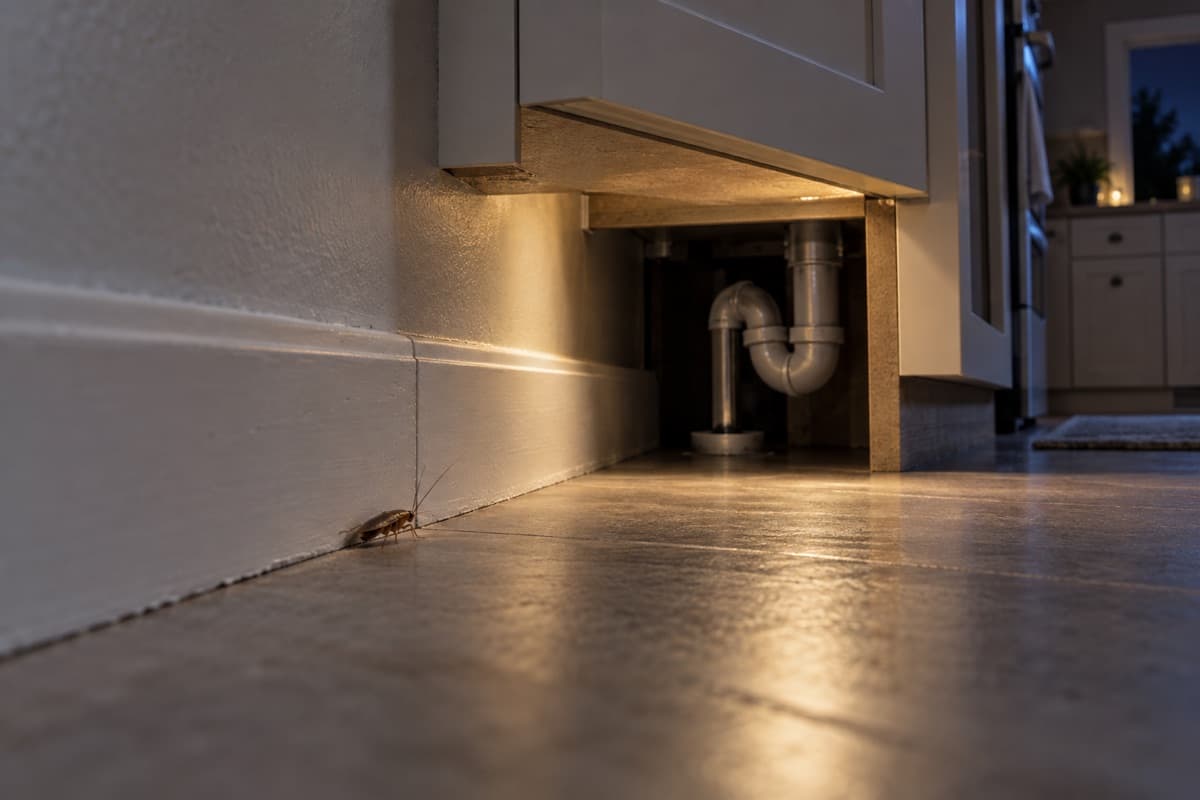
- The underside of the sink cabinet, and where drain and supply lines pass through the cabinet floor.
- Under the countertop overhang and inside the toe kick gap beneath base cabinets.
- Behind and under the refrigerator, near the compressor and drip pan, and along the dishwasher motor housing.
- Where pipes enter walls, along baseboard gaps, and behind loose trim.
- Utility spaces: under the water heater, behind the washer.
Outdoors the label allows spots, beads, or refillable stations at entry sites, in protected locations only, since sun and rain destroy the residual quickly. Stations hold up to 2 grams each and are the right answer wherever an open dot would be reachable or washed away.
What Not To Do
These are use restrictions on the registered label, not suggestions. Under FIFRA, using a pesticide in a manner inconsistent with its labeling is a violation of federal law.
- Do not spray insecticide over the gel, and do not bait onto recently sprayed surfaces. The label says this "may cause the bait to become repellent," and it is the most common way people waste a tube of gel. It is also why a bug bomb is counterproductive here; see our explanation of why foggers are almost never the right tool.
- Do not treat food-preparation surfaces, and keep gel away from food and food-contact surfaces. If gel touches an exposed surface, remove it and wash the surface.
- Do not bait surfaces that get routinely washed. Counter edges and table undersides lose the bait on the next wipe-down.
- Do not apply to surfaces above 130°F. The label names stoves, ovens, grills, heat lamps, coffee urns, toasters, fryers, dishwashers, and hot water pipes. The bait runs.
- Do not apply in direct sunlight, or in or on electrical equipment where a shock hazard exists.
- Expect staining. The label warns it may stain textiles, fabrics, and porous surfaces. Keep it off carpet, upholstery, and unsealed wood.
- Do not place it anywhere easily accessible to children or pets. This is a capitalized restriction on the label, not a footnote.
Dried gel scrapes off with a putty knife; fresh gel wipes up with a damp paper towel.
Safety, Pets, And Children
The FIFRA signal word is CAUTION. The label warns the product is harmful if absorbed through skin and causes moderate eye irritation, and directs applicators to wear long sleeves, long pants, socks, shoes, and waterproof gloves, then wash thoroughly. For a homeowner placing a dozen dots, gloves and handwashing are the operative part. For suspected exposure, the label says to rinse skin or flush eyes for 15 to 20 minutes and call a poison control center; in the United States that is 1-800-222-1222.
Pets deserve more attention than the low signal word suggests.
- Rabbits should not be anywhere near fipronil. It is well documented as toxic to rabbits, and France's food and environmental safety agency ANSES has reported serious adverse reactions and deaths in rabbits exposed to fipronil antiparasitics. If you keep rabbits, choose a different active ingredient.
- Cats that hunt roaches are a specific concern. TERRO's own customer guidance says the product is not recommended if there is a chance your cat could eat a cockroach that has consumed the bait, and lists restlessness, anxiety, and tremors as signs to call a veterinarian about. The Merck Veterinary Manual's entry on phenylpyrazole toxicosis in animals describes the clinical picture.
- Use enclosed stations rather than open dots anywhere an animal or a toddler could reach the placement.
If exposure risk is the deciding factor in your home, our risk-based comparison of pet-safe roach control options walks through which formats keep the pesticide out of reach.
How Long It Takes, And When To Reapply
The registered label states that population reduction should be apparent within 1 day for German cockroaches and 3 to 4 days for American cockroaches; TERRO's marketing says "within 2 days." Both describe the start of the decline, not the end of the infestation. Clearing an established German cockroach population usually takes several weeks, because eggs already in oothecae have to hatch into nymphs that then encounter the bait or the contaminated droppings.
On reapplication, the label gives a condition rather than an interval: bait "will remain pliable and palatable to cockroaches as long as it is visibly present," and you reapply "when bait is no longer visibly present," generally at a lower rate than the initial treatment, with a visual inspection recommended one month in. In a heavy infestation, dots near the hot spots can disappear in days; in a maintenance situation they may sit untouched for weeks and eventually dry out, at which point they should be replaced anyway.
Rapid consumption is a good sign, not a failure. Our guide to reading whether roach bait is working covers what to look for in the first two weeks.
If It Is Not Working
Before concluding the product failed, check the four things that account for most bait failures.
- A spray was used in the same area. Residual pyrethroids, aerosols, and foggers can make gel repellent. Clean the surface and rebait in untreated locations.
- Placement was on open surfaces instead of inside harborage. Roaches spend most of their lives in tight cracks; bait on a shelf face gets less traffic.
- Competing food. Grease behind the range and overnight pet food outcompete a bait dot.
- Bait aversion or resistance. German cockroach populations have evolved behavioral aversion to glucose, a common bait phagostimulant, and a 2023 *Journal of Economic Entomology* study found glucose-averse nymphs also survived better on droppings from adults that ate glucose-, sucrose-, or maltose-based baits, blunting the secondary kill. Add physiological resistance and a particular building's population can genuinely shrug off a particular bait.
The response to the last one is to rotate to a different active ingredient class rather than buying more of the same gel. Indoxacarb, abamectin, dinotefuran, and hydramethylnon are all sold in consumer gels and stations, and rotating chemistry is standard resistance management worth doing before a bait stops working.
DIY Or Call A Pro
Gel baiting is genuinely a homeowner task in a single-family home with a contained problem. Bring in a licensed professional when:
- You live in an apartment, duplex, or condo. Roaches move between units through shared walls, plumbing chases, and trash rooms, so treatment has to be coordinated building-wide, which is your landlord's or association's job.
- The population has been present for months, or you see roaches in daylight, which generally indicates high density.
- Someone in the household has asthma. Cockroach allergens are a recognized asthma trigger, and a heavy infestation warrants faster control and a thorough cleanup.
- You have already run a correct baiting program for six to eight weeks with no meaningful decline.
For the full sequence of inspection, sanitation, baiting, monitoring, and exclusion, see our step-by-step plan for getting rid of roaches.
Frequently Asked Questions
What is the active ingredient in TERRO Roach Bait Gel?
Fipronil at 0.05%. The Safety Data Sheet lists it as the only hazardous component, and EPA Reg. No. 53883-401-149 identifies the product as a distributor version of Control Solutions' CSI 16-161 Fipronil Roach Bait Gel. Do not confuse it with TERRO Multi-Surface Roach Baits, which use abamectin.
How many drops of TERRO gel should I use in a kitchen?
Count linear feet, not rooms. For a light to moderate problem the label allows 1 to 3 quarter-inch spots per 10 linear feet; for a heavy one, 3 to 5. A typical kitchen perimeter easily supports 15 to 25 small placements, all tucked into cracks and voids rather than on open surfaces.
Can I use TERRO roach gel in a kitchen cabinet with food in it?
Yes, but only as a crack and crevice application, away from the food and from any surface food touches. The label prohibits treating food-preparation surfaces and directs you to remove and wash any surface the gel contacts. A dot in the back upper corner of a cabinet, or in the void where plumbing enters, satisfies this; a dot on a shelf next to a cereal box does not.
Is TERRO Roach Bait Gel safe around dogs and cats?
The label restricts it to places not easily accessible to children and pets, which you achieve by keeping every placement inside a crack, void, or enclosed station. The larger question for cats is secondary exposure: TERRO advises against the product if your cat is likely to eat a poisoned roach. Rabbits should not be exposed to fipronil at all. Call your veterinarian immediately if a pet shows restlessness, tremors, or seizures.
How often do I need to reapply it?
When the bait is gone or hardened, not on a schedule. The label ties reapplication to the bait being visibly present and recommends inspecting placements about a month in. Widely repeated advice to reapply "every 2 to 3 months" is not on the label and leaves placements empty during an active infestation.
Can I spray Raid or Ortho around the baited area?
No. The label prohibits both applying gel to recently sprayed areas and spraying over the gel, because it can make the bait repellent. Choose one strategy. Baiting plus sanitation and exclusion outperforms spraying for cockroaches, which is also UC IPM's position.
Does it work on American and Oriental cockroaches, not just German?
Yes, the consumer directions list all three. Expect a slower start with the large species, and remember that American and Oriental cockroaches often breed outdoors, in a crawlspace, or in a sewer line, so indoor bait may only intercept the ones coming in.
Sources
- EPA-accepted master label, CSI 16-161 Fipronil Roach Bait Gel, EPA Reg. No. 53883-401 — the registration TERRO's gel is distributed under. Source for the 0.05% fipronil concentration, the spot and line rates, the bait quantity reference, all use restrictions, PPE, first aid, refillable station limits, and the 1-day and 3-to-4-day speed-of-control statements.
- Safety Data Sheet, TERRO Roach Bait Gel (T502), Senoret Chemical Co., rev. 2021 — confirms fipronil 0.05%, EPA Reg. No. 53883-401-149, CAUTION signal word, and first-aid measures.
- TERRO Multi-Surface Roach Baits (T500) product page — confirms the station product uses abamectin B1 0.05%, a different active ingredient from the gel.
- NPIC fipronil general fact sheet — mode of action, contact and ingestion activity, selectivity for insect nerve receptors, and human exposure symptoms.
- Buczkowski and Schal, *Pesticide Biochemistry and Physiology* 71(3), 2001 — emetophagy: fipronil-induced regurgitation and transfer from adult German cockroaches to first-instar nymphs.
- Field trial of a 0.05% fipronil bait, *Korean Journal of Parasitology*, 2006 — 4-week field trial of a 0.05% fipronil bait in 24 Seoul food establishments, 93.1% corrected reduction.
- Gel bait efficacy against pyrethroid-resistant *Blattella germanica*, *Pathogens*, 2026 — fipronil gel gave 90 to 100% adult mortality but highly variable nymphal mortality across field strains, about 71% overall efficacy.
- Glucose- and disaccharide-containing baits impede secondary mortality in glucose-averse German cockroaches, *Journal of Economic Entomology*, 2023 — behavioral bait aversion reduces the secondary kill that makes baiting work.
- UC IPM Pest Notes: Cockroaches — sanitation and exclusion first, baits over sprays, sticky traps for monitoring, and why sprays and foggers underperform.
- University of Illinois College of Veterinary Medicine: fipronil toxicity in rabbits and ANSES: antiparasitics containing fipronil are toxic to rabbits — why rabbit owners should avoid fipronil products entirely.
- Merck Veterinary Manual: phenylpyrazole (fipronil) toxicosis in animals — clinical signs of fipronil exposure in pets.