Maxforce FC Roach Killer Bait Stations contain 0.05 percent fipronil in a child-resistant plastic disc. The EPA-accepted label directs you to use 4 to 6 stations per 100 square feet of horizontal surface area, place them adjacent to walls and flush in corners where roaches hide, and use no more than 24 stations per residence. Do not spray the stations or set them on freshly sprayed surfaces. The label says roaches begin eating immediately and you "should expect to see fewer roaches within 3 days," and directs you to "inspect all bait stations and replace as needed." For an active German cockroach infestation, gel bait applied into cracks generally outperforms stations, so treat stations as a supplement or a maintenance tool rather than your whole plan. Always follow the label on the package you bought.
The earlier version of this article told readers to use 4 to 6 stations per average-sized room and replace them every three months. The first number is wrong in a way that matters: the label rate is per 100 square feet, and a 12-by-15-foot kitchen is 180 square feet, which calls for roughly 7 to 11 stations. The old article also claimed a rise in roach sightings after baiting is "a good sign" because the bait draws roaches out. We found no support for that. Maxforce stations are not a lure, and the bait's own label describes it as a food roaches eat "even in the presence of other foods," not something that pulls them out of harborage.
What Is Actually In The Station
The active ingredient is fipronil at 0.05 percent, 1.5 grams of bait per station. Fipronil belongs to the phenylpyrazole family and, as the National Pesticide Information Center explains, kills insects when they eat it or contact it by disrupting the nervous system, binding much more readily to insect nerve endings than to those of people or pets.
Two design details on the label are worth knowing. The station has a transparent red top so you can monitor bait consumption while the roaches still experience darkness, "because roaches do not see light in the red spectrum." And the bait is odorless.
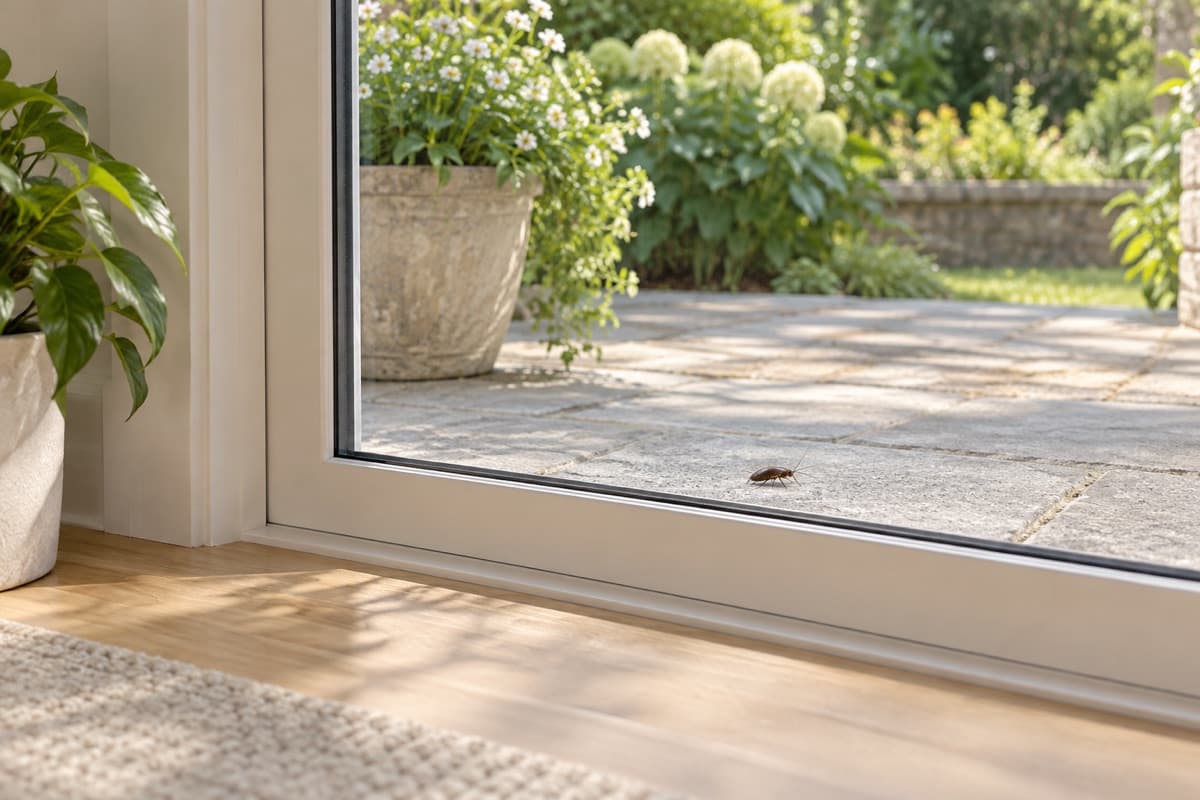
The label covers small cockroaches specifically, "such as German and Brown Banded roaches." If you are dealing with large American or Oriental cockroaches coming in from outside, this is the wrong product.
Note that "Maxforce" is a whole product family from Envu, formerly Bayer Environmental Science. Maxforce FC Magnum Roach Killer Bait Gel is a syringe of 0.05 percent fipronil gel, EPA Reg. No. 432-1460, with entirely different directions. Check which one you actually have before following any instructions, including these.
The Placement Numbers The Label Requires
- 4 to 6 stations per 100 square feet of horizontal surface area. Measure the rooms you are treating. Kitchen at 180 square feet: 7 to 11 stations. Bathroom at 50 square feet: 2 to 3.
- Adjacent to walls and flush in corners. German cockroaches travel along edges, not across open floor.
- No more than 24 stations per residence. This is a hard label limit, not a suggestion. If 24 is not enough coverage for your home, you are past what stations alone can do.
- Peel the strip and stick them to vertical surfaces where floor placement is impractical, such as the inside wall of a cabinet or the back of an appliance panel.
- Outdoors, place stations adjacent to the structure if the label on your package includes outdoor use.
Where To Put Them
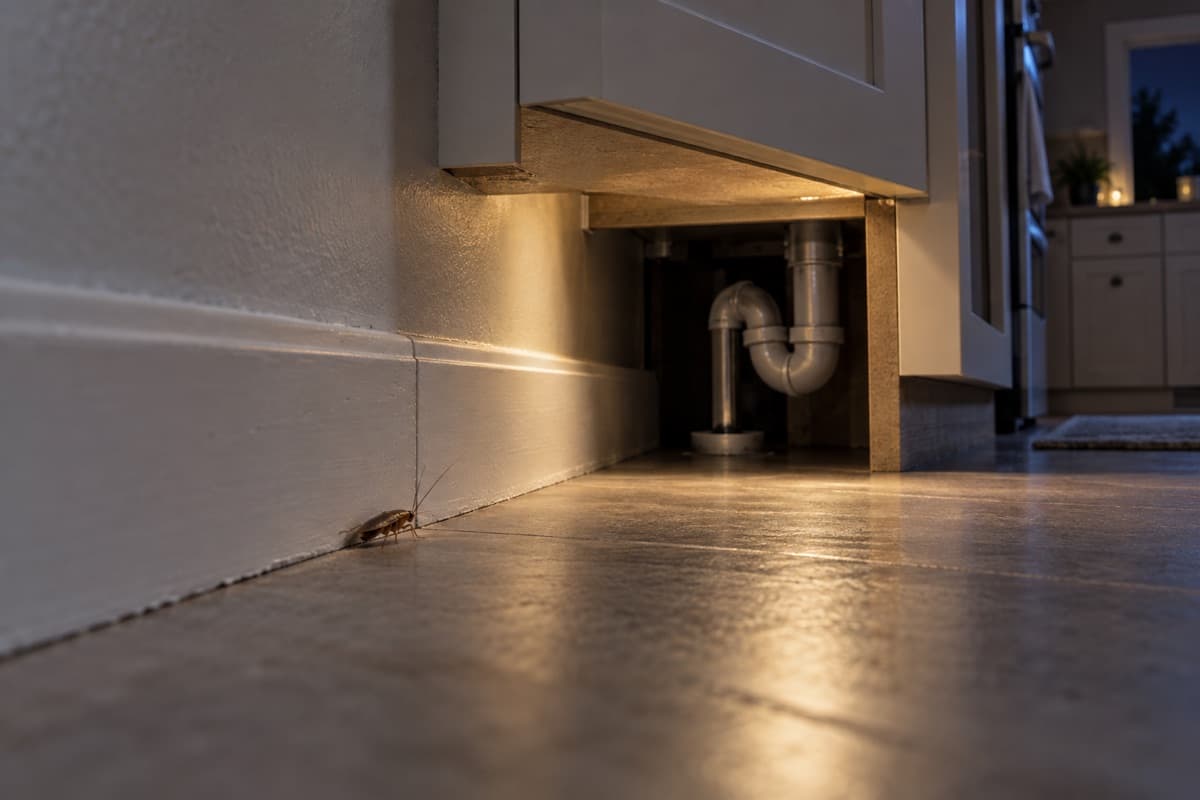
Put stations where roaches actually harbor, which is where warmth, moisture, and darkness meet. The label's own guidance is "dark, warm, damp locations."
- Under the kitchen sink, at the back corners of the cabinet, not in the middle of the floor.
- Behind and beneath the refrigerator, especially near the compressor and drip pan.
- Behind and under the stove and dishwasher.
- Inside the toe kick and back corners of base cabinets.
- Behind the bathroom vanity and near the toilet supply line.
- In the laundry room near the washer connections and the dryer's warm back panel.
- Along the wall behind the trash can.
Droppings that look like coffee grounds or pepper flecks mark active runways. Concentrating stations there is more useful than spreading them evenly. Our guide to finding the roach nest walks through the inspection.
What Not To Do
- Do not spray insecticide on or near the stations. The label is explicit: "Do not spray the bait stations. Avoid placing the bait stations on freshly sprayed surfaces." Residual sprays and cleaners can contaminate bait and make roaches avoid it. This is the most common way people sabotage their own bait program.
- Do not put them in the open middle of a floor or counter. They will be ignored and kicked around.
- Do not exceed 24 per residence.
- Do not scatter them and then keep leaving food out. Bait competes with whatever else is available. Dirty dishes overnight, pet food left down, and grease behind the range all lower bait acceptance.
- Do not combine them with a fogger. EPA's guidance on total release foggers notes the propellants are typically flammable and that the pesticide has to contact the pest to work, which it mostly does not inside cracks. Penn State Extension's cockroach IPM guidance says plainly: "Avoid using foggers and sprays."
How Long They Last And When To Replace
Here the sources genuinely differ, so it is worth being precise.
The label's direction is simply to "inspect all bait stations and replace as needed for continual control of roaches." The EPA-accepted marketing claims attached to the same registration include "kills roaches continuously for 3 months." Envu's current product page says the stations "effectively control pests, then protect your account for up to a year or until the bait is completely consumed."
A workable reading of all three: during an active infestation, check stations every two weeks and replace any that are emptied, greasy, dusty, or dried out. Once you are in maintenance mode with no sightings, inspecting monthly and replacing at roughly three months is reasonable. The transparent top exists so you can make that call by looking rather than by calendar.
Empty stations are a useful signal, not a problem. They mean roaches are feeding. Untouched stations after two weeks mean something is wrong with placement, competing food, or the population's acceptance of that bait.
What To Expect And What Secondary Kill Really Is
The label sets the expectation of "fewer roaches within 3 days." A meaningful drop in the overall population takes longer, usually two to four weeks, and longer still in a heavy infestation. Our guide on how long roach bait takes to work covers the timeline in more detail.
The "domino effect" people describe is real and has been measured. In a 2001 study at NC State, Buczkowski and Schal compared three ways of getting fipronil into adult male German cockroaches. Ingested fipronil bait was "most effectively translocated, and caused high mortality of untreated adults and nymphs," while topical and residual exposure killed far fewer. The authors concluded secondary kill likely comes from nymphs eating the excreted fipronil residues, cannibalism of bait-fed roaches, and contact with contaminated surfaces.
That is why bait beats spray on a roach population: a sprayed roach mostly kills itself, while a baited roach carries the dose back to the harborage. It also means secondary kill only happens if roaches eat the bait. A station nobody visits does nothing.
Stations Versus Gel: The Honest Comparison
Bait stations are clean, contained, child-resistant, and they do not dry out the way an exposed gel dot can. Those are real advantages, particularly in homes with kids or pets.
But gel goes where stations cannot. The Maxforce FC Magnum gel label directs application as pea-size spots and thin beads directly into cracks and crevices, at up to 3.0 grams per square yard to clean out a severe infestation. That puts bait inside the void the roaches live in rather than outside it.
A 2025 study in the Journal of Economic Entomology tested consumer and professional baits in the lab and then in real infested homes. In the lab, everything looked good: all products exceeded 80 percent mortality within 14 days. In homes, the results diverged sharply. Professional products reduced populations within a month, while consumer fipronil bait stations "never showed a decline" in trap catch over the study. The authors' point was that lab performance "might not be indicative of the potential for control" in a real kitchen with competing food and complex harborage.
The practical takeaway: if you have an active German cockroach problem, lead with gel placed into cracks, and use stations to cover surfaces and voids where gel is impractical or where you need containment. Adding an insect growth regulator to the same program covers the nymphs that bait misses; see our guide on how to use an IGR for roaches.
When Maxforce Stops Working
Fipronil resistance in German cockroaches is documented. A 2016 study from NC State collected roaches from a Puerto Rico apartment where Advion, Maxforce FC Magnum, and Maxforce Pro gel baits had all stopped performing. Topical testing revealed moderate resistance to fipronil, extremely high resistance to indoxacarb, and the first documented hydramethylnon resistance in any insect. Worse, residues excreted by field-collected roaches that ate the baits killed susceptible lab nymphs but "failed to kill most nymphs of the field-collected strain," meaning secondary kill collapsed too.
If your stations are being eaten and the population is not falling after a month, do not buy more of the same product. Switch to a bait with a different active ingredient class, such as an indoxacarb, clothianidin, or abamectin gel, and add an IGR. Our explainer on how Combat roach bait works covers the consumer-grade fipronil and hydramethylnon options, which have the same rotation considerations.
Children, Pets, and Food Areas
The stations are child-resistant packaging, which is not the same as childproof. The label's own precaution is minimal, "wash thoroughly with soap and water after handling bait stations," and instructs storage "in a cool, dry area out of reach of children."
If a child or pet gets into one, the bait quantity is small. The ASPCA notes that cats and dogs are attracted to ant and roach baits because the bait is made with peanut butter or sugar, but that "there is such a small amount of bait in these products, that stomach upset is typically the only problem seen." The plastic housing itself, if swallowed whole, is the bigger concern. Call your veterinarian or the ASPCA Animal Poison Control Center at 888-426-4435 with the package in hand, and call Poison Control at 800-222-1222 for a child.
Practical placement: put stations inside voids, behind toe kicks, under appliances, and in cabinets with childproof latches rather than anywhere a crawling child or a chewing dog can reach. The label permits use in food-handling facilities, but keep stations out of drawers and off surfaces where food is prepared, and wash your hands after handling them.
When To Call a Professional
Call a licensed pest control company if you see roaches in the open during the day, if 24 stations is not enough coverage for your home, if bait is being eaten but numbers are not falling after a month, or if you live in an apartment building where roaches move between units and treatment needs to cover neighbors. Someone in the home with asthma is also a reason to escalate, since cockroach allergen is a recognized asthma trigger. For the full DIY sequence before that point, see our guide to getting rid of roaches.
Frequently Asked Questions
How many Maxforce bait stations do I need per room?
Measure the room and apply the label rate of 4 to 6 stations per 100 square feet of horizontal surface. A 180-square-foot kitchen needs roughly 7 to 11. The label also caps total use at 24 stations per residence, so prioritize the rooms with actual roach activity.
How often should I replace Maxforce roach bait stations?
The label says to inspect and replace as needed rather than on a fixed schedule. Check every two weeks during an active infestation and replace any that are empty, dirty, or dried out. Envu says the stations protect for up to a year or until the bait is consumed, and the registration's approved marketing claims include three months of continuous control.
How long do Maxforce bait stations take to work?
The label states you should expect to see fewer roaches within three days. A real reduction in the population usually takes two to four weeks, and longer in a heavy infestation, because the bait has to reach nymphs in the harborage through excreted residues and cannibalism.
Can I use Maxforce stations and spray at the same time?
Not in the same places. The label says do not spray the bait stations and do not place them on freshly sprayed surfaces. Sprays and cleaners can contaminate bait so roaches avoid it. If you need a residual product, keep it well away from bait placements, or skip it and add an insect growth regulator instead.
Are Maxforce roach bait stations safe around dogs and cats?
The stations use child-resistant housings and hold only 1.5 grams of bait each, so the ASPCA's general guidance on roach baits is that stomach upset is the typical outcome of a small ingestion. That is low risk, not zero risk. A swallowed plastic housing can cause an obstruction, so place stations where pets cannot reach them and call your vet or the ASPCA at 888-426-4435 if one is chewed.
Why are roaches ignoring my Maxforce stations?
The usual causes are placement out in the open instead of along walls and in corners, competing food in the kitchen, contamination from sprays or cleaners, and bait that has dried out or crusted. Some German cockroach populations also reject particular bait formulations. Fix placement and sanitation first, then switch active ingredient classes.
Do Maxforce stations work on big roaches?
Not well. The label is written for small cockroaches, specifically German and brown-banded. Large American, Oriental, and smoky brown cockroaches are usually entering from outdoors, sewers, or crawlspaces, and the fix is exclusion and moisture control rather than indoor stations.
Sources
- EPA-accepted label, Maxforce FC Roach Killer Bait Stations, EPA Reg. No. 432-1257 (2014) — 0.05 percent fipronil, 4 to 6 stations per 100 sq ft, 24-station residence cap, no-spray directions, three-day expectation, inspect-and-replace direction, and the approved marketing claims.
- EPA-accepted label, Maxforce FC Roach Killer Bait Gel F.05, EPA Reg. No. 432-1460 (2020) — gel application rates of 0.75 to 3.0 grams per square yard and pea-size spot reference.
- Envu: Maxforce FC Roach Killer Bait Stations — the manufacturer's current claim of up to a year of protection or until bait is consumed.
- Buczkowski and Schal, *Journal of Economic Entomology* (2001) — ingested fipronil bait produced far more secondary kill than topical or residual exposure, via excreted residues and cannibalism.
- Ko, Bieman, Schal, and Silverman, *Pest Management Science* (2016) — fipronil, indoxacarb, and hydramethylnon resistance in a field population where Maxforce FC Magnum and other baits failed, plus reduced secondary kill.
- Gordon et al., *Journal of Economic Entomology* (2025) — lab versus in-home bait performance; consumer fipronil bait stations showed no decline in trap catch in real homes.
- NPIC: Fipronil General Fact Sheet — mode of action and relative toxicity to insects versus mammals.
- ASPCA: Don't Panic, Five Items Pet Parents Shouldn't Worry About — why pets eat roach baits and what typically happens.
- Penn State Extension: Got Roaches? Eliminate Roaches with IPM — sanitation, exclusion, bait guidance, and the warning against foggers and sprays.
- EPA: Safety Precautions for Total Release Foggers — flammability and exposure risks of bug bombs.