Combat bait is roach food mixed with a slow-acting insecticide — fipronil in the Combat Max line, at 0.05% in the bait stations and 0.01% in the gel. A roach eats a small dose, walks back to its harborage, and dies there over hours to days. Because the poison acts slowly, some of it moves on to roaches that never touched the bait, through droppings, regurgitated bait, and cannibalism of the dead. That mechanism is real, but the delivery format matters more than most packaging suggests: in a 2025 field trial, Combat gel bait significantly reduced cockroach counts in homes by month two, while the plastic Combat bait stations produced no significant reduction over four months.
The earlier version of this article said Combat "can eliminate entire colonies within 2-3 weeks." That timeline isn't supported by the in-home research, and it sets people up to give up on a method that does work when they use the right format and enough of it.
What Is Actually In A Combat Bait
Combat is a Henkel brand. The products sold as roach bait are food matrices carrying an insecticide at a very low concentration:
- Combat Max bait stations for small roaches — fipronil 0.05%, sold under EPA Reg. No. 64240-2 as the Combat Roach Killing System.
- Combat Max gel — fipronil 0.01%, applied in pea-sized dots from a syringe.
- Older Combat stations — hydramethylnon, a different slow-acting active with a long track record in roach baits.
Fipronil is a nerve poison. The National Pesticide Information Center explains that it "works by disrupting the normal function of the central nervous system in insects" and is more likely to bind to insect nerve endings than to mammalian ones. That selectivity, plus the tiny amount involved, is why a bait station is a much lower-exposure approach than spraying a room.
The rest of the bait is the part that does the persuading: sugars, fats, and proteins formulated to beat whatever else is available in your kitchen. If the bait can't win that competition, the insecticide never gets eaten.
Why Slow-Acting Poison Is The Whole Point
A fast knockdown insecticide kills the roach standing in front of you. A slow one gets carried home.
Researchers have documented four routes by which a bait's active ingredient moves from a roach that fed to roaches that didn't: direct contact, coprophagy (eating droppings), emetophagy (eating regurgitated bait), and necrophagy and cannibalism (eating the dead). Alexander Ko and colleagues at NC State summarize this in *Insecticide resistance and diminished secondary kill performance of bait formulations against German cockroaches* (Pest Management Science, 2016), noting that insecticide-laden feces deposited inside a harborage make the dose "more accessible to the cockroach population."
This matters most for the roaches you can't reach. Early-instar nymphs stay in cracks and rarely forage. They are the hardest life stage to treat directly and the easiest to reach secondhand. A working bait program is really a delivery system aimed at them.
It also explains something people misread as failure. UC IPM notes that female cockroaches carrying an egg case "do very little feeding and avoid open spaces," so they aren't killed immediately by bait. Their eggs hatch on schedule regardless. You are treating a population with overlapping generations, not a single group.
What The In-Home Research Actually Shows
Two field studies are worth knowing about, because together they explain both why baits are the right tool and why one Combat format disappointed.
Foggers do nothing; Combat gel worked. Zachary DeVries and colleagues at NC State treated 30 low-income homes in Raleigh in *Exposure risks and ineffectiveness of total release foggers (TRFs) used for cockroach control in residential settings* (BMC Public Health, 2019). All four fogger products failed to reduce cockroach trap counts. Both gel baits tested — consumer-grade Combat and professional-grade Maxforce — produced significant declines at two and four weeks. The foggers also left insecticide residues on floors averaging hundreds of times above baseline.
The plastic stations underperformed. Johnalyn Gordon and colleagues at the University of Kentucky ran both lab and in-home trials in *Laboratory and in-home evaluations of consumer- and professional-grade cockroach baits* (Journal of Economic Entomology, 2025). In the lab, every product eventually cleared 80% mortality within 14 days. In real homes the picture separated:
- Professional gels (Advion Evolution, Vendetta Nitro) reduced counts significantly at months one, two, and four.
- Hot Shot liquid stations reduced counts significantly at month one.
- Combat gel reduced counts significantly at months two and four — but not at month one.
- Combat bait stations showed no significant difference at any time point, and averaged 84.8% mortality in the lab only by day 28.
The practical read: the gel is the Combat product with evidence behind it, and even it is a two-month tool, not a two-week one. If you own the plastic stations, treat them as a supplement, not the plan.
How To Place Combat Bait So It Gets Eaten
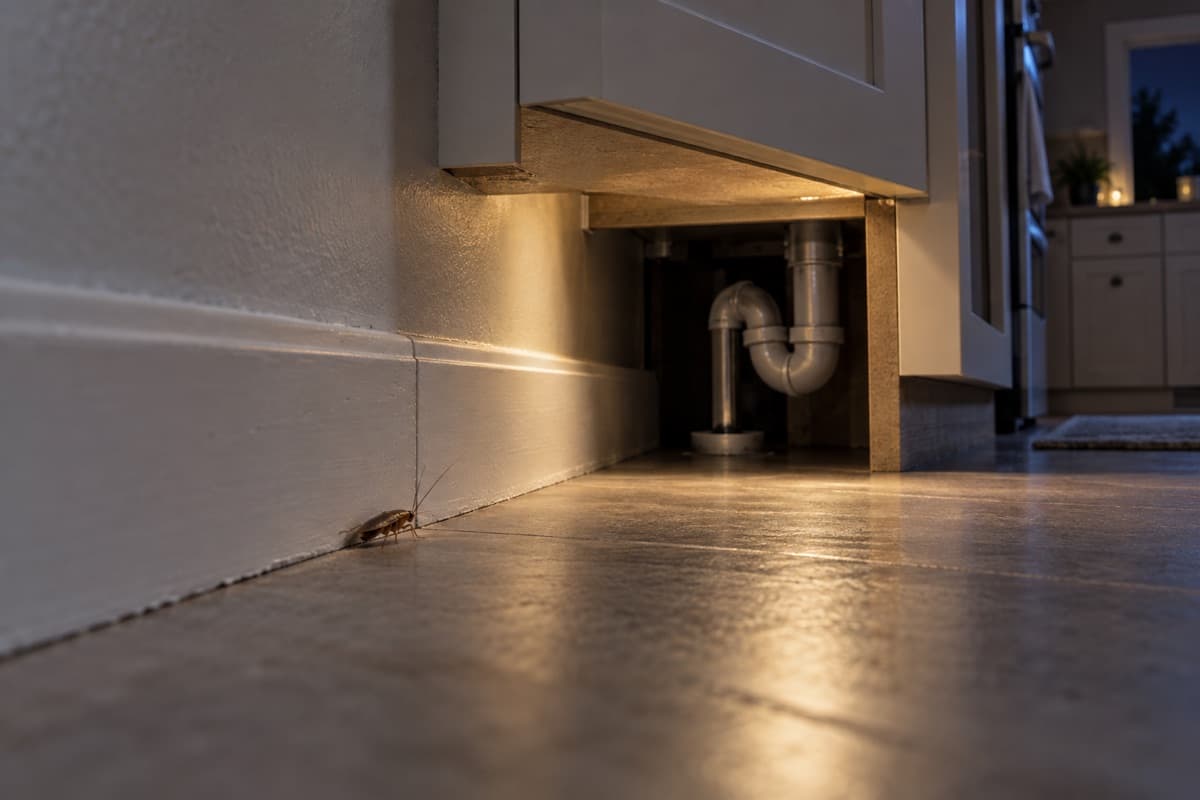
- Put it where roaches already are, not where you walk. Inside cabinet corners, under the sink, behind and under the refrigerator and stove, along the underside of drawers, near plumbing penetrations. If you don't know where they are, run sticky traps for a few nights first — see how to figure out where roaches are coming from.
- Use many small placements, not a few large ones. Rutgers recommends pea-sized dots of gel at harborages and notes that a typical one-bedroom apartment may need 10 to 30 grams of bait to clear an infestation. Most people use a fraction of that.
- Get it close to the crack. Rutgers is direct that gel "is usually more effective than bait stations because gel bait can be applied closer to the cockroach harborages."
- Refresh it. Gel dries out and loses its appeal. Check placements weekly and replace anything that's crusted, dusty, or gone.
- Don't spray anything near it. Pyrethroid sprays are repellent to cockroaches and will steer them away from your bait. Rutgers warns that they can even push roaches into neighboring units.
- Clean up the competition. Grease film, crumbs, pet food left out, and wet sponges all compete with the bait. Contrary to the old advice in this article, leaving grease around does not help — it gives roaches a reason to skip your bait. See what attracts roaches.
What Makes Combat Bait Stop Working
Resistance. This is the real ceiling. The Ko study found the first documented case of hydramethylnon resistance in any insect, moderate fipronil resistance, and extremely high indoxacarb resistance in a single Puerto Rico apartment population where commercial baits had stopped working. Worse, residues excreted by resistant roaches killed susceptible lab nymphs but failed to kill most nymphs from the same resistant strain — so resistance takes the secondary kill down with it.
Competing food. Covered above, and the most common fixable cause.
Too little bait, in too few places. A handful of stations in a heavily infested kitchen will not reach the harborages.
Sprays and foggers in the same space. Both repel, and neither reliably works on their own.
Reinfestation from outside your unit. In an apartment building, your kitchen is one room in a much larger habitat. If neighbors are infested, see what to do if your neighbors have roaches.
Is Combat Bait Safe Around Kids And Pets?
The bait stations are child-resistant and the active ingredient is present at 0.05% or less, which is why baiting is generally the lower-exposure option compared with spraying surfaces a child crawls on. That is not the same as harmless. NPIC lists sweating, nausea, vomiting, headache, stomach pain, dizziness, weakness, and seizures among reported symptoms of fipronil ingestion in people, and notes that signs from a brief exposure generally clear up without treatment.
Practical handling: place stations and gel where a crawling child or a dog cannot reach — inside cabinets, behind appliances, under the sink with a childproof latch on the door. Wash your hands after handling gel. Keep the package so you have the EPA registration number if you need to call Poison Control (1-800-222-1222). If you'd rather avoid insecticides entirely, read the best pet-safe roach killer options before assuming a "natural" product is more effective.
When Bait Isn't Enough
Bait plus sanitation plus exclusion handles most kitchen-scale German cockroach problems, but not all of them. Consider professional help when:
- You've used gel bait properly for two months with no downward trend in trap counts.
- You're seeing roaches in daylight, which usually indicates a large population.
- The infestation spans multiple rooms or you're finding them in bedrooms and bathrooms.
- You live in multifamily housing where treatment needs to cover adjacent units.
For what to expect and what it costs, see how much an exterminator costs for roaches and how to tell if roach bait is working.
Frequently Asked Questions
How long does Combat roach bait take to work?
Individual roaches that feed die within hours to a few days. Population-level results take much longer. In the 2025 Kentucky field trial, Combat gel produced a significant reduction in home trap counts at month two, not month one, and the plastic stations never produced one. Plan on eight weeks of maintained bait before judging it.
Is Combat gel better than Combat bait stations?
Based on the available in-home evidence, yes. The gel can be placed directly at harborages and was the Combat format that reduced populations in the field trial. The stations showed no significant reduction over four months in that study.
Should I see more roaches after putting out bait?
You may, briefly, as roaches leave harborages to feed and as dying ones move into the open. Sustained high counts after several weeks mean something is wrong with placement, quantity, competing food, or resistance — not that the bait is "flushing them out."
Can I use Combat bait and roach spray together?
Not in the same areas. Pyrethroid sprays repel roaches away from bait and can push them into adjacent rooms or units. If you use a spray at all, keep it to the building exterior, well away from indoor bait placements.
Does Combat kill roach eggs?
No bait kills eggs inside an ootheca directly. Egg cases are sealed and the female carrying one barely feeds. Baits work through the generations by killing the nymphs after they hatch, which is why the timeline runs in months rather than weeks. See how long it takes for roach eggs to hatch.
Why did the bait work at first and then stop?
The two usual causes are bait that dried out and was never refreshed, and a population with resistance to the active ingredient. If refreshing the gel doesn't restart the decline, switch to a bait with a different active ingredient class rather than buying more of the same one.
Sources
- EPA pesticide label, Combat Roach Killing System, EPA Reg. No. 64240-2 — active ingredient and registrant.
- National Pesticide Information Center: Fipronil — mode of action and exposure symptoms.
- UC IPM: Cockroaches Pest Notes — bait timelines, bait active ingredients, gravid females, and why aerosols and foggers are often ineffective.
- Rutgers NJAES FS1322: German Cockroach — gel versus stations, bait quantity per apartment, and pyrethroid repellency.
- Ko AE, Bieman DN, Schal C, Silverman J. Insecticide resistance and diminished secondary kill performance of bait formulations against German cockroaches. Pest Management Science 2016;72:1778–1784 — horizontal transfer mechanisms and bait resistance.
- DeVries ZC, Santangelo RG, Crissman J, Mick R, Schal C. Exposure risks and ineffectiveness of total release foggers (TRFs) used for cockroach control in residential settings. BMC Public Health 2019;19:96 — Combat gel versus foggers in 30 homes.
- Gordon JM, Sierras AJ, Jackson DV, Principato S, DeVries ZC. Laboratory and in-home evaluations of consumer- and professional-grade cockroach baits. Journal of Economic Entomology 2025;118(2):826–837 — Combat gel versus Combat bait stations in homes.