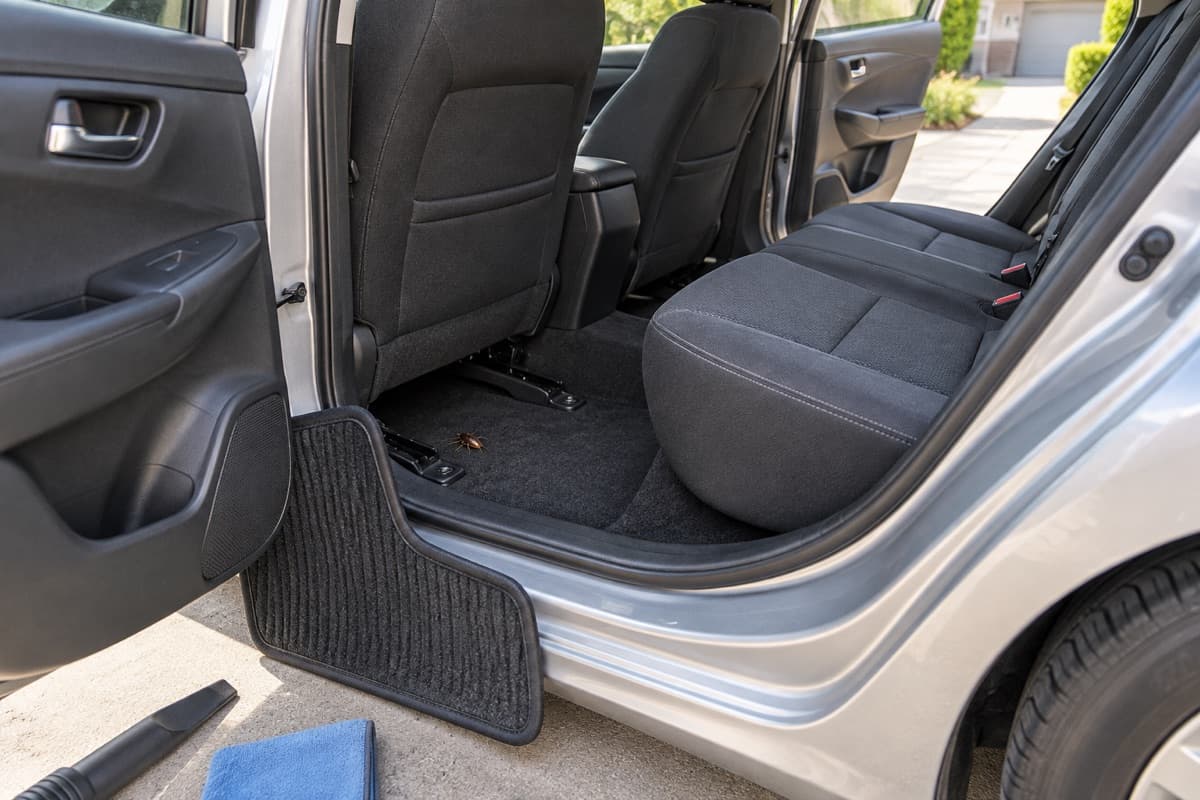
Get roaches out of a car by completely emptying it, vacuuming every seam and crevice with a HEPA vacuum, removing every food and moisture source, and then placing small dabs of cockroach gel bait deep in the cracks where they harbor — not on open surfaces. Do not set off a total-release fogger in a vehicle. Fogger labels explicitly prohibit use in small enclosed spaces because the product can explode, a car cabin is smaller than the minimum space those labels allow, and the fog cannot reach the voids where roaches actually live. Most importantly, find out whether you have German cockroaches breeding in the car or occasional strays wandering in from a parking area, because the answer changes the entire plan.
There is almost no university extension literature written specifically about cockroaches in passenger vehicles. What follows applies the same integrated pest management principles those agencies publish for buildings, adapted to a space that is smaller, hotter, harder to seal, and full of surfaces you press your hands and children against every day. That last part is why several popular internet suggestions for cars are genuinely bad advice rather than merely ineffective.
First, Figure Out Which Roach Problem You Have
This is the diagnostic step almost every car-roach article skips, and it determines whether you are looking at a weekend of cleaning or a four-to-six-week program.
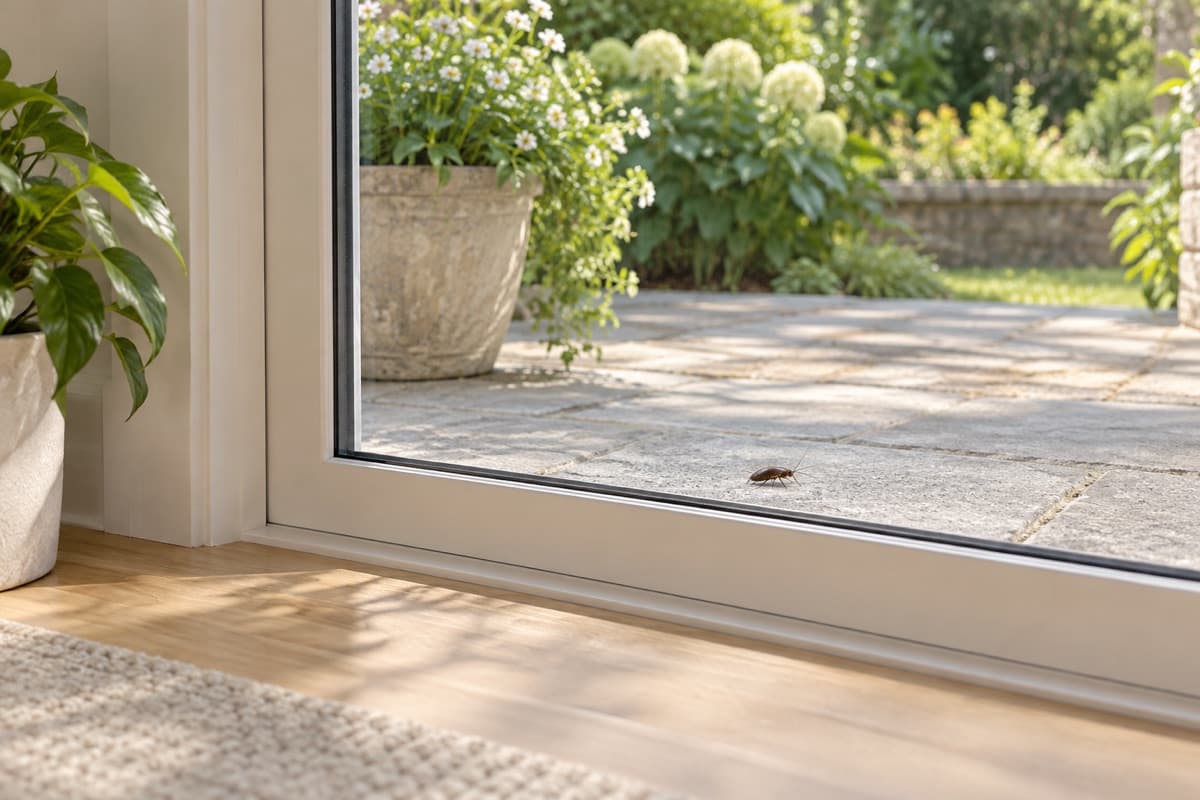
Strays from outside. If you are finding large roaches — an inch or more, reddish-brown or dark mahogany — in ones and twos, especially after parking near a dumpster, a mulch bed, a storm drain, or under a tree, these are almost certainly outdoor species that wandered or flew in through an open door or window. They do not establish populations inside a car. Clean the car, stop parking there, and the problem generally ends.
A breeding population. If you are finding small roaches — adults roughly 3/8 to 9/16 inch, light tan to brown with two dark stripes behind the head — and especially if you are seeing multiple sizes including tiny nymphs, you are dealing with German cockroaches. UF/IFAS notes that this species cannot survive in locations away from humans or human activity, which means they did not fly in from the parking lot. They were carried in, and they are reproducing in the vehicle. Each egg capsule holds 30 to 40 eggs, and the full life cycle runs roughly 100 days, so a car with a handful of German cockroaches in March can have a serious problem by summer.
How to confirm it. Buy a pack of plain sticky monitors, number and date them, and press them flat under the seats, in the footwells against the transmission tunnel, in the trunk against the wheel wells, and in the console and glovebox. Check them for a week. Empty monitors plus occasional large roaches means strays. Monitors catching small roaches and nymphs means a resident population. Our guide to the physical evidence that you actually have roaches covers droppings, shed skins, and egg cases in more detail.
Where they came from. German cockroaches move on objects, not under their own power over distance. Penn State Extension is direct about the mechanism: it is difficult to keep cockroaches out of a space when they arrive via boxes, grocery bags, suitcases, and similar items. In a car that usually means a cardboard box from an infested apartment or workplace, a gym bag, a grocery haul, a used child seat, a backpack that sits in an infested break room, or moving boxes. If you cannot think of a plausible carrier, look harder — because if the source is still loading roaches into the car every week, treating the car alone will not hold.
Do This Now: Strip The Car And Vacuum It
Nothing else works until this is done. Baits, monitors, and any professional treatment all depend on the car being empty and dry first.
- Take everything out. Every bag, box, floor mat, blanket, phone mount, toy, napkin stash, seat cover, cargo organizer, and item in the trunk, glovebox, console, and door pockets. Do this in a driveway or parking lot, not inside a garage attached to your house — you do not want to move the problem indoors.
- Triage what comes out. Cardboard and paper go straight into a bag and into an outdoor trash can. Fabric items go directly into a sealed bag and then into a hot wash and a hot dryer cycle. Anything you cannot wash and cannot inspect thoroughly is a judgment call, and cardboard is almost never worth keeping.
- Remove the seats if you reasonably can. Most front seats come out with four bolts. This is the single biggest upgrade to a car cleanout, because seat rails, the carpet under the seat, and the seat foam are prime harborage and you cannot properly reach them otherwise. If you are not comfortable doing this — and if your vehicle has side airbags in the seats, you should not be — slide the seats fully forward and fully back and work each position.
- Vacuum with a HEPA vacuum and a crevice tool. UC IPM recommends using a vacuum with a high-efficiency particulate air filter or triple filters when cleaning up cockroaches, because the droppings and shed skins are a potent allergen and a standard shop vac will blow them back into the air. Work slowly through every seam: seat rails, seat back seams, under the carpet edges, the sill plates, the spare tire well, the trunk liner.
- Empty the canister outdoors, immediately, into a sealed bag. Vacuuming physically removes live roaches, nymphs, and egg cases — but only if they do not crawl back out.
- Fix the moisture. Cockroaches lose water fast and will not stay where there is none. Check for a clogged sunroof or cowl drain, a leaking windshield or door seal, a plugged A/C evaporator drain dripping into the passenger footwell, or wet carpet padding. A damp car is a survivable car. Dry it fully, with the windows down in the sun or a dehumidifier in a closed garage.
- Pull the cabin air filter and inspect it. It is a paper accordion in a dark plastic box behind the glovebox on most vehicles, and it is a favorite harborage. Replace it rather than cleaning it.
Expect the full strip-and-vacuum to take two to four hours on a family car. It is tedious, and it does more than any product you can buy.
Where Roaches Actually Hide In A Car
German cockroaches want tight contact on multiple sides, warmth, and darkness. Almost every one of those conditions is easier to find in a car than in a kitchen. Work through this list deliberately:
- Seat rails and seat frames. Hollow tubing, welded seams, and the carpet crushed underneath them.
- Under the carpet and padding. The jute or foam padding under the carpet is the largest single harborage in most vehicles, and it holds moisture.
- Door cards. The interior door panel is a hollow shell over the door structure, reachable through speaker openings, the window slot, and the map pocket.
- Dash vents and HVAC ducting. Dark, ducted, and connected to the cabin filter box.
- Center console and glovebox. Especially the void behind and under them.
- Trunk liner, spare tire well, and jack storage. Often carpeted, often damp, rarely opened.
- Headliner edges and pillar trim. Less common, but it happens in heavy infestations.
- Child seats. Deep foam, fabric channels, and crumbs. Treat these as their own project.
- Under-hood cavities near the firewall and cowl. Warm after driving, and connected to the cabin through wiring grommets.
On child seats, follow the seat manufacturer's manual, not a pest-control instinct. Do not apply any pesticide to harness webbing or to the shell, and do not use solvents, degreasers, or bleach on the harness — those can weaken webbing and strip flame-resistant treatment. Most manufacturers allow the cover to be removed and washed per the manual while the harness gets mild soap and water and air drying. If a child seat is heavily infested and the manual's approved cleaning will not clear it, replacing the seat is the safe answer.
Using Gel Bait Correctly In A Vehicle
Baits are the right chemical tool here, because they work the way a car's geometry demands: the roach goes to the product, deep in a crack, rather than the product being sprayed across surfaces people touch. UC IPM describes baits as "the primary pesticides used to treat cockroach infestations" and notes they "can be quite effective for long-term control," while sprays "may also repel and disperse cockroaches to other areas of the building from which they may return later."
Read the label on the product you actually buy, because use sites differ. The Syngenta Advion Cockroach Gel Bait label lists residential homes, offices, warehouses, hotels, "buses, trains, aircraft," and elsewhere "aircraft, buses, boats/ships, trains." Private automobiles are not named. That is worth being honest about: applying it inside your personal car is a use the label does not specifically describe, and it is your responsibility to follow the label you hold. If your label limits use to structures, use it in the garage and driveway rather than the cabin, and handle the car with cleaning, vacuuming, and enclosed bait stations.
Where a labeled gel bait is appropriate, the label's own application guidance translates well to a car:
- Use small spots, not lines of gel. Advion specifies about 0.5 grams per spot, roughly 1/4 inch in diameter, with one to three spots per 10 linear feet for light to moderate infestations and three to five for heavy ones. Several small placements beat one or two large ones.
- Place it in cracks and crevices, out of reach. The label instruction is to apply "to areas not able to be contacted by children or pets," and to treat between construction elements, into voids, and behind equipment. In a car that means under the seat frame, inside the seat rail channel, up behind the console side panels, inside the trunk's jack storage, and under the sill trim — never on the dash, the door armrest, the cup holders, or the seat surface.
- Never spray over bait. The label is explicit in both directions: do not apply the gel to surfaces recently treated with residual sprays, and do not apply residual sprays to surfaces treated with the gel. A repellent aerosol drives roaches away from the bait you want them eating. Our walkthrough on using Advion roach gel correctly covers placement technique in more detail.
- Watch the heat. The Advion label warns not to apply where surface temperatures exceed 120 to 130°F, because the bait liquefies and loses effectiveness. In a parked car, that is not a corner case. A 2005 study in Pediatrics measured interior temperatures in a dark sedan and found an average 40°F rise over an hour, with even the coolest 72°F ambient day producing a 117°F interior. A dashboard or a sun-facing seat rail will run well past the gel's limit. Keep placements low, shaded, and inside voids, and inspect them weekly — the label also tells you to check placements and apply fresh bait as needed.
- Add an insect growth regulator. Bait kills foraging adults; an IGR disrupts development so the next generation never matures. Used together they are what actually break the cycle, and our guide to how IGRs work for roaches explains the timing.
- Keep monitoring. Leave the sticky monitors down. They are how you know whether numbers are dropping rather than guessing from how many you happen to see.
Expect four to six weeks, not one. Anyone promising a one-day fix for a German cockroach population in a vehicle is selling something.
Why Foggers Do Not Belong In A Car
This is the most common piece of car-roach advice online, and it is the one to reject outright. There are four separate reasons, and any one of them would be enough.
The label prohibits it. A representative EPA-registered total-release fogger label states plainly: "Do not use in small, enclosed spaces such as closets, cabinets or under counters or tables. Use of a fogger in an enclosed space may cause the product to explode, resulting in injury to people or damage to property." The same label sets a floor on room size — "Do not use in a room 5 ft. x 5 ft. or smaller" — and a sealed car cabin is smaller than that minimum. Using a pesticide in a manner inconsistent with its labeling is a violation of federal law, and that sentence appears on the label itself.
The dose math is absurd. That label rates its smallest 2-ounce canister for a room up to 10 by 25 feet with an 8-foot ceiling — about 2,000 cubic feet. The passenger cabin of a midsize sedan is roughly 100 cubic feet. You would be releasing a charge intended for a space around twenty times larger into a sealed box lined with fabric and foam.
The fire and explosion risk is real, not theoretical. EPA's safety precautions for total release foggers note that "the aerosol propellants in these foggers typically are flammable, improper use may cause a fire or explosion," and direct users to keep foggers six feet or farther from ignition sources including running electrical appliances that cycle on and off. A car is full of those: dome lights on door switches, relays, blower motors, and the central locking system. The same label warns that "exposure to temperatures above 130°F may cause bursting" — and a parked car in the sun routinely exceeds that, which is also why you should never store an unused fogger canister in a vehicle.
It does not even work. NPIC notes that foggers spray a mist that falls onto exposed surfaces and "do not reach into unexposed voids, cracks and crevices, where pests may hide," and that some fogger ingredients repel pests deeper into hiding. UC IPM says applications of aerosols and total-release foggers "are often ineffective since they don't reach the crevices where cockroaches harbor and breed and can be hazardous." Penn State Extension goes further, calling aerosol foggers "of little value in controlling German cockroaches" and warning that such applications "may disperse the cockroaches, making control difficult." Every harborage listed earlier in this guide — under the carpet, inside the door card, in the seat rail — is exactly where the fog does not go.
There is also the residue problem, which matters more in a car than in a house. A fogger deposits pesticide on every exposed surface: the steering wheel, the shift knob, the seat belt webbing, the seat fabric your children sit on, the child seat harness. NPIC recommends cleaning after fogging, particularly surfaces children or food might contact, and wearing gloves and long sleeves to do it. In a vehicle you cannot wash a steering wheel the way you can wipe a countertop, and you cannot properly ventilate a car the way a label's "open windows and doors for two hours" instruction assumes.
The health data backs up the caution. A 2018 CDC report in MMWR identified 3,222 acute illnesses and injuries related to total-release foggers across 10 states from 2007 through 2015, including four deaths, with failure to vacate during application and early reentry the two most common causes. People with preexisting asthma had roughly 2.5 times the odds of moderate-to-high severity illness. Notably, the study found no statistically significant reduction in incidence after EPA's improved fogger labels took effect in 2012. If you are weighing this specific approach, our detailed look at what happens when you bomb a car for roaches goes through the scenario step by step.
Heat And Cold: What The Research Actually Shows
Two DIY ideas circulate constantly: park the car in the sun with the windows up and cook them, or leave it out in a hard freeze. Both contain a grain of truth and both fail for the same reason.
On heat. Cockroaches do die at sustained high temperatures, and professional thermal remediation is a real technique. But the field data shows how hard it is to do properly. A U.S. Army study presented at the International Conference on Urban Pests treated chronically infested food service facilities with direct-fired propane heaters, targeting 46°C (115°F) held for 45 minutes and running heat for four to six hours. Even then, "temperatures frequently reached 65°C (150°F) at the ceiling while some areas at floor level remained below 46°C (115°F)," and cockroaches "congregated in relatively cool spots" and had to be vacuumed up during the process. Heat alone produced a 91 percent trap-index reduction at one week — good, but not elimination, and the team still followed with an IGR and a residual insecticide.
A car in the sun reproduces the bad half of that experiment. Cabin air gets hot fast — the Pediatrics data shows 80 percent of the total rise happening in the first 30 minutes — but the padding under the carpet, the inside of a door card, and the void behind the console are insulated and lag well behind. Those are precisely the cool spots the roaches will move to, and unlike the Army crew, you have no way to vacuum them mid-treatment. Meanwhile, the heat degrades your gel bait, can warp adhesives and trim, and makes the car genuinely dangerous to enter.
On cold. There is no clean answer here either. Laboratory work by Hoffmann tested five German cockroach strains at 0, 5, and 10°C and found cold tolerance varied sharply by strain — an outdoor strain from a refuse tip was tolerant enough to be observed overwintering in the field, while strains from a bakery and from subtropical Turkey were considerably less tolerant. The same outdoor strain lost most of that hardiness after eight years at warm laboratory temperatures. Practically, that means you cannot predict how the population in your car will respond, a residential freeze rarely holds long enough at a low enough temperature inside insulated harborage, and the eggs are the most protected stage of all.
Neither heat nor cold is a substitute for stripping, vacuuming, and baiting. Treat both as folk remedies with a real mechanism and no practical way to deliver it.
Cleaning Up Droppings And Allergens
Cockroach allergen is the best-documented health consequence of an infestation, and a car concentrates it — you spend a long time in a small volume with recirculated air.
- Use a HEPA vacuum rather than brushing or compressed air, which aerosolizes the debris.
- Damp-wipe hard surfaces instead of dry-dusting them. Droppings look like coarse black pepper or ink smears and are often deposited in corners and along seams.
- Replace the cabin air filter after the population is under control, not before, and run the HVAC with fresh air rather than recirculation for a few drives.
- Wear a mask if you are clearing heavy droppings, especially if anyone in the household has asthma. EPA identifies cockroaches and their droppings as an asthma trigger and recommends removing food and water sources, sealing crevices, and using bait stations and gels as part of an integrated approach.
- Shampoo or extract the carpets and upholstery only after the vacuuming is complete, and dry the car thoroughly afterward. A wet car is a hospitable car.
Our guide on cleaning up roach droppings safely covers surfaces and products in more depth.
Keeping Them From Coming Back
A car is rarely the origin of a German cockroach problem. It is usually a downstream symptom of an infested home, apartment building, workplace, or a single contaminated item. If you clear the car and skip this part, you will be doing it again in two months.
- Find the source. Think about where the car's contents spend time. A break room, a storage unit, a relative's apartment, a moving load, a secondhand appliance or car seat. If the source is your own home, treat the home, not just the car.
- Stop transporting cardboard. Cardboard is both a harborage and an egg-case carrier. Break down boxes outside and carry the contents in, or use hard-sided totes.
- Inspect what comes into the car, especially groceries, secondhand items, and anything from a building with a known problem. Our guide on not bringing roaches with you when you move applies directly to anything you load into a vehicle.
- Stop eating in the car, or at least stop leaving food, wrappers, and open drink containers in it. Crumbs in seat seams are a real food supply at this scale.
- Vacuum monthly and keep a small trash bag you actually empty.
- Park away from pressure. Dumpsters, storm drains, heavy mulch beds, and stacked pallets are where large outdoor roaches live.
- Keep windows and sunroof closed when parked, and repair torn door seals — those are also what keep the car dry.
- Leave a couple of monitors in place for a month or two after you think it is over. They cost almost nothing and they tell you the truth.
When To Call A Professional
Reasonable DIY territory: occasional large strays, and a small, newly discovered German cockroach population in a car you can fully empty and vacuum.
Call a licensed pest control professional when:
- You are still catching nymphs on monitors after four to six weeks of consistent cleaning, correct bait placement, and an IGR.
- The infestation extends into areas you cannot reach — under the dash, inside the HVAC ducting, behind the headliner, or into the wiring harness grommets at the firewall.
- The car came to you already infested, such as a used vehicle purchase, and you do not know the extent.
- Someone who rides in the car has asthma or significant allergies. The exposure is not worth an extended DIY campaign.
- You are not comfortable placing pesticide products in a space children and pets occupy.
Ask specifically whether the company treats vehicles, what product and use site they intend to apply under, and whether they will also assess the home or workplace that is feeding the problem. A company that only fogs the cabin and leaves is not solving a German cockroach problem. For a used-car purchase, a professional detailer who will remove the seats and carpet often accomplishes more than a pest treatment does.
Frequently Asked Questions
Can I just bug bomb my car?
No. Total-release fogger labels prohibit use in small enclosed spaces because the product can explode, and a car cabin is smaller than the minimum room size those labels allow — while the smallest canister is rated for a space roughly twenty times a sedan's interior volume. Separately, foggers cannot reach the voids where roaches harbor, and they leave residue on the steering wheel, seat belts, and seats you and your passengers touch. There is no version of this that is both legal and effective.
How long does it take to get roaches out of a car?
For occasional outdoor strays, a thorough cleanout usually ends it within days. For a German cockroach population, plan on four to six weeks of baiting plus an insect growth regulator, with monitors down the whole time. The old advice that it takes one to two weeks underestimates the egg stage: capsules already laid will hatch on their own schedule regardless of what you do to the adults.
Will leaving my car in the sun kill the roaches?
Not reliably. Cabin air heats fast, but the harborage that matters — under the carpet padding, inside the door cards, behind the console — heats slowly, and roaches move to those cooler spots. That is exactly what happened in professional heat trials, where floor-level areas stayed below the target temperature while the ceiling hit 150°F and technicians had to vacuum up the roaches that fled to cool zones. Heat also ruins gel bait, which liquefies above roughly 120 to 130°F.
Will a hard freeze kill them?
Probably not, and you cannot count on it. Laboratory testing found German cockroach cold tolerance varies a great deal by strain, with one outdoor-adapted strain able to overwinter in the field. Even where cold would eventually work, insulated harborage in a car does not reach or hold ambient temperature, and egg cases are the best-protected stage.
Can roaches damage my car's wiring or electronics?
Roaches will nest in warm electrical spaces and their droppings can foul contacts and circuit boards, which is a real reason to clean thoroughly and inspect the cabin filter box and under-dash areas. Claims that roaches routinely chew through automotive wiring and cause fires are much weaker — that behavior is well documented for rodents and is not something authoritative sources attribute to cockroaches. Treat corrosion and contamination as the plausible risk and be skeptical of the fire stories.
Are foggers made specifically for cars any safer?
Some products are marketed for vehicles, and a few carry use sites that include vehicles. If you are going to use one, the label is the only thing that matters: read it, confirm the vehicle use site is named, follow the ventilation and reentry times exactly, and remove child seats first. Even then, you are choosing a method that authoritative sources say does not reach cockroach harborage, so you will still need to clean and bait.
Do I need to treat my house too?
Very likely, if you have German cockroaches. They do not live outdoors and they do not originate in a parking lot, so they arrived in the car on something. If that something came from your home, the car will be reinfested as soon as you clean it. Put monitors in your kitchen and bathrooms at the same time you put them in the car.
Is it safe to use roach spray in a car?
Residual sprays are a poor fit for a vehicle. They deposit on surfaces occupants touch, they are repellent and push roaches deeper into voids, and applying them over gel bait makes the bait unattractive — the Advion label prohibits that combination in both directions. If you want a quick knockdown on a single visible roach, a fly swatter is genuinely the better tool.
Can I take my car to a car wash or detailer to fix this?
A detailer who will pull the seats and extract the carpet does most of the mechanical work well, and for a stray-roach situation that may be all you need. For a breeding population, detailing is step one of a longer plan, not the plan. Tell the shop what you are dealing with — some will decline, and the ones that accept will want to protect their equipment and their next customer's car.
Sources
- EPA: Safety Precautions for Total Release Foggers — flammable propellants, fire and explosion risk, one fogger per room, distance from ignition sources, vacate and ventilation times.
- NPIC: Total Release Foggers — fog falls on exposed surfaces only, does not reach voids and crevices, can repel pests deeper, and post-treatment cleaning guidance for surfaces children or food contact.
- CDC MMWR: Acute Illnesses and Injuries Related to Total Release Foggers — 10 States, 2007–2015 — 3,222 cases including four deaths, failure to vacate and early reentry as leading causes, elevated severity with preexisting asthma, and no significant reduction after the 2012 label changes.
- EPA pesticide product label, Bonide Total Release Indoor Fogger (EPA Reg. No. 4-428) — the prohibition on use in small enclosed spaces and the explosion warning, the minimum room size, canister coverage rates, the 130°F bursting warning, and ignition-source and ventilation instructions.
- UC Statewide IPM Program: Cockroaches — foggers and aerosols ineffective and hazardous, sprays repel and disperse, baits as the primary tool, gel placement in cracks and crevices, HEPA vacuuming, and sticky-trap monitoring.
- Penn State Extension: German Cockroaches — introduction via boxes, bags, and suitcases; egg capsule and reproduction figures; and aerosol foggers being of little value and dispersing cockroaches.
- UF/IFAS EENY-002: German Cockroach — cannot survive away from human activity, adult size, 30 to 40 eggs per capsule, roughly 100-day life cycle, and sanitation and monitoring guidance.
- Syngenta Advion Cockroach Gel Bait label — listed use sites including buses, trains, aircraft, and boats/ships; 0.5 gram spot size; spots per 10 linear feet; placement away from children and pets; the prohibition on combining with residual sprays; and the 120–130°F limit above which the bait liquefies.
- McLaren, Null and Quinn, *Pediatrics* (2005): Heat Stress From Enclosed Vehicles — average 40°F interior rise over an hour, 80 percent of it in the first 30 minutes, a 117°F interior even at 72°F ambient, and no meaningful benefit from cracking windows.
- Zeichner, Wood and Hoch, Proceedings of the Second International Conference on Urban Pests (1996): The Use of Heat for Control of Chronic German Cockroach Infestations — 115°F for 45 minutes as the target, uneven heating with cool floor-level zones, cockroaches congregating in cool spots, 91 percent reduction, and the need for follow-up IGR and residual treatment.
- Hoffmann, *Journal of Pest Science* (1994): Studies on the cold-tolerance of different strains of the German cockroach — strain-dependent cold tolerance at 0, 5, and 10°C, an outdoor strain overwintering in the field, and loss of cold hardiness after long warm rearing.
- EPA: Asthma triggers — gain control — cockroaches and their droppings as an asthma trigger and the recommended integrated control measures.