Nothing gets sprayed, poured, puffed, or poked into an energized receptacle — not insecticide, not boric acid, not diatomaceous earth, not a screwdriver. Pesticide labels say so in plain language: the EPA-accepted label for Advion Cockroach Gel Bait states "Do not use this product in or on electrical equipment where a possibility of shock hazard exists," and the label for CimeXa silica dust allows removing switch plate covers to reach a wall void but adds "don't apply dust directly in electrical boxes." Applying a pesticide contrary to its labeling is a violation of federal law under FIFRA. The safe and effective sequence is: turn the circuit off at the breaker and verify it is dead, remove the cover plate, vacuum what is visible, seal the gap between the box and the wall finish, reinstall the plate — and put your actual treatment in the cracks, voids, and cabinet spaces around the room. Roaches emerging from outlets mean a large population living inside your wall voids, which is a whole-home problem, not an outlet problem.
Why This Is The Safety-First Article
A receptacle is a live 120-volt connection behind a thin plastic plate. Two things go wrong when people treat one as a pest-control target: pushing a duster tip, straw applicator, bait syringe or tool past the plate puts a foreign object next to energized terminals, and conductive or combustible material left inside the box can bridge them.
The scale of the underlying hazard is not hypothetical. NFPA's report on home fires caused by electrical distribution and lighting equipment found US fire departments responded to an average of 32,620 such home fires per year in 2015–2019, causing 430 civilian deaths, 1,070 injuries, and $1.3 billion in direct property damage. Wiring and related equipment accounted for 68% of those fires, and 8% originated in a wall assembly or concealed space — the same voids the roaches are using.
Worth saying clearly: insects are not identified anywhere in NFPA's breakdown of what causes those fires. The previous version of this article claimed roaches "chew on wires, potentially causing electrical fires." We could not substantiate that from any fire authority, electrical safety organization, or entomology source, and it has been removed. Wire-gnawing is rodent behavior. The documented hazard at an outlet is the person reaching into it.
What Roaches In Outlets Are Actually Telling You
Outlet boxes are not a destination. They are a doorway into the wall cavity, and the cavity is the harborage.
German cockroaches are built for this. In W. Ebeling's Urban Entomology, hosted by UC Riverside's Department of Entomology, adults are described as able to move through a space only 1.6 mm wide, with 67% of adults in one test aggregating in a 4.8 mm gap. UC IPM's Pest Notes gives the same figure as about 1/16 inch and lists wall voids and crawl spaces among primary harborage. Ebeling also describes an aggregation pheromone present in cockroach feces and on their bodies, which is why they concentrate in one cavity rather than spreading evenly.
They also seek warmth. The University of Florida's assessment-based cockroach management guide lists "behind refrigerators and freezers, ovens, stoves, and electrical junction boxes" among the heat-associated harborages to inspect. A box on a loaded circuit runs slightly warm inside a sheltered, undisturbed cavity.
The part that matters for your expectations: seeing them at the outlet means the void behind it is full. UF/IFAS is blunt — "if you see cockroaches during the daytime, it may be an indication that you are dealing with an extremely large population." Roaches pushed out of prime harborage into an exposed plate face are the overflow, not the infestation. There is no nest to destroy; see how to find the roach nest for why that framing misleads people.
In an apartment, duplex, or condo, wall voids and plumbing chases are shared. If your outlets are producing roaches and your housekeeping is sound, the source may be next door. What to do if your neighbors have roaches covers how to escalate that.
Killing The Power, Properly
Before any cover plate comes off, follow the sequence the Department of Energy's Building America Solution Center uses in its guide to air sealing electrical outlets and switches:
- Turn off power to the outlet or switch at the breaker. Not the switch on a power strip. The breaker.
- Verify power is off using a non-contact voltage tester or a plug-in outlet tester. DOE's guidance names both. Test a known-live outlet first so you know your tester works.
- Remove the cover plate — a single center screw on most receptacles.
- Do not unscrew and pull the receptacle itself out of the box unless you know what you are doing and have verified the circuit is dead. Anything you need to accomplish for pest reasons happens at the plate and at the wall opening, not at the device terminals.
- Restore power and confirm the outlet works when you are finished.
If anything at the outlet is scorched, discolored, warm to the touch, loose, buzzing, or holds a plug badly, stop and call a licensed electrician. Those are failure symptoms regardless of what else is living in the wall.
Closing The Gap, Which Is Both Code And Pest Control
With the plate off and the power confirmed dead, look at the opening cut in the drywall around the box. Very often it is ragged, oversized, and open straight into the stud bay.
That is already a code problem. NEC 314.21, mirrored in the residential code as IRC E3906.6, requires that "openings in noncombustible surfaces that accommodate boxes employing a flush-type cover or faceplate shall be made so that there are no gaps or open spaces greater than 1/8 inch (3.2 mm) around the edge of the box." The rule exists to contain arcs and sparks inside the box. It happens to close a route cockroaches use constantly.
To fix it, following DOE's method:
- Fill the gap between the box and the drywall with caulk or a low-expanding canned spray foam. Keep sealant out of the box interior and off the device.
- Add a foam gasket behind the cover plate. DOE notes foam gaskets "may provide some air sealing and sound insulation benefit," and reminds you to check that your cover plate screws are still long enough afterward.
- Let the sealant fully cure per the product directions before reinstalling the plate.
- Repeat on interior walls too. For pest purposes, the shared wall between a kitchen and a bathroom matters more than an exterior one.
Do the same for switch plates, cable and coax plates, thermostat plates, and the escutcheon plates around pipes under sinks — UF/IFAS directs inspectors to look for "unsealed openings such as missing or loose pipe and conduit escutcheon plates."
Where Treatment Actually Goes
Now the pest control, none of which happens inside a box.
Vacuum first. Use a HEPA-filtered vacuum with a crevice tool on anything visible at the wall opening and along the baseboard. Rutgers NJAES recommends a HEPA vacuum "to remove live and dead cockroaches, the fecal materials, shed skins." Empty into a sealed bag in an outside bin.
Bait the harborage, not the plate. Gel bait goes into cracks and crevices, cabinet corners and hinge recesses, under sinks, behind and beneath appliances — the Advion label's own list of "openings leading into voids and hollow spaces in floors, walls, ceilings, equipment legs and bases, around plumbing pipes." Small dots, many of them: about 0.5 grams each, 1 to 3 spots per 10 linear feet for light to moderate infestations, 3 to 5 for heavy ones.
If a void is dusted, it is dusted around the box, never in it. CimeXa's label permits "treat wall voids by removing electrical switch plate covers to allow access, but don't apply dust directly in electrical boxes," with roughly a quarter ounce per accessible void. This is genuinely a job better left to a licensed applicator with a proper duster and a non-conductive tip — dust misapplied around live wiring is exactly the scenario the labels are written to prevent. Our guide to using diatomaceous earth for roaches explains where desiccant dusts do and do not earn their place.
Do not spray where you bait. UF/IFAS: "using a product with repellent properties in an area where bait may be applied will render the bait ineffective." The Advion label prohibits it in both directions.
Monitor. Put dated, numbered sticky traps along wall-floor junctions near the affected outlets, in the sink cabinet, and beside the refrigerator and stove. Traps catching multiple life stages indicate an established infestation; one or two adults suggests a new introduction. How many roach traps you need covers laying out a real monitoring grid.
What Never Goes Into An Outlet
- No liquid or aerosol insecticide. Conductive, and prohibited by label language on electrical equipment.
- No insecticide dust, boric acid, or diatomaceous earth puffed into the box. Dust labels that permit void treatment still exclude the box itself.
- No cotton balls, steel wool, foam, or caulk pushed inside the box. Steel wool is conductive. Foam and caulk inside a box interfere with the device and its heat dissipation.
- No foggers. UC IPM finds total-release foggers "are often ineffective," "can be hazardous," and "may repel and disperse cockroaches to other areas," and their aerosol does not penetrate voids anyway.
- No screwdrivers, wires, or vacuum wands into a live receptacle. If the breaker is not off and verified, the plate stays on.
Two Claims Worth Correcting
"Plastic outlet safety caps will keep roaches out." They will not. Push-in caps and tamper-resistant receptacles — required by NEC 406.12 and IRC E4002.14 for 15- and 20-ampere, 125- and 250-volt nonlocking receptacles in dwelling units — block the slot openings on the face of the device to stop a child inserting an object. Cockroaches are not entering through the slots; they are entering through the gap between the box and the drywall, and through the cavity behind it. Tamper-resistant receptacles are a genuine child-safety requirement and worth having. They are not pest control.
"Roaches in outlets chew wiring and start fires." No fire authority, electrical safety organization, or entomology source we could find supports this for cockroaches. If you are seeing flickering lights, buzzing, warm plates, or repeated breaker trips, treat those as electrical faults and call an electrician — do not assume insects are the explanation and do not delay the call while you try to bait.
Prevention That Holds
- Seal every plate opening in the affected rooms, not just the one you saw a roach at.
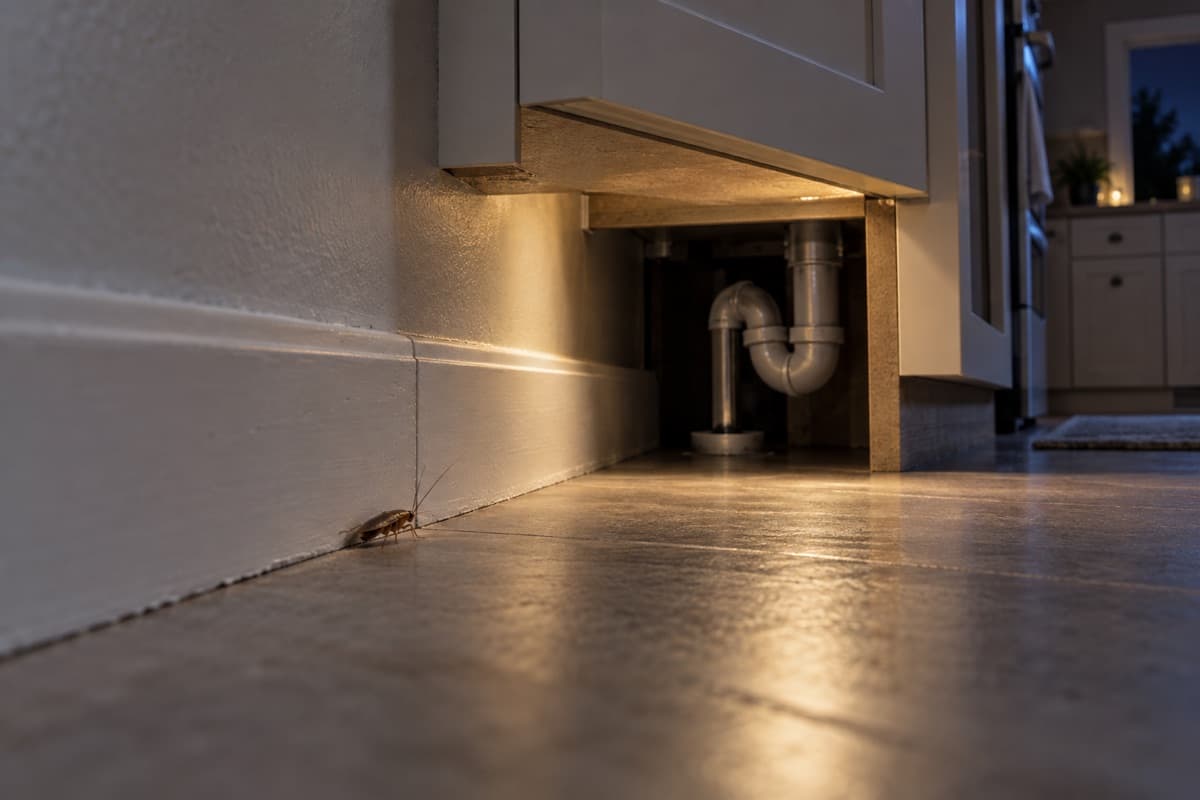
- Close the other routes. Gaps around plumbing penetrations, the toe-kick voids under cabinets, and the seams where cabinet runs meet the wall matter as much as outlets. So do vents — roaches coming out of vents is usually the same wall-void story.
- Cut the water. EPA's guidance for housing managers is to "fix leaking pipes and faucets as soon as possible," noting that even a bucket under a slow leak "provides a watering trough for rats, mice and cockroaches."
- Remove food and clutter from adjacent rooms, particularly cardboard, which is both harborage and food.
- Keep baiting on a schedule. Rutgers' benchmark is repeating applications every two to four weeks until no cockroaches are found over a four-week period.
The full sequence, room by room, is in how to get rid of roaches.
When To Call An Electrician, And When To Call A Pest Pro
Call a licensed electrician if: an outlet is scorched, discolored, warm, loose, or buzzing; a breaker trips repeatedly; plugs fall out; the opening around a box is badly oversized and you are not comfortable sealing it; or you find aluminum branch wiring, which NFPA notes CPSC recommends be replaced or repaired by a qualified electrician.
Call a pest management professional if: you see roaches during the day, find them in more than one room, share walls with an infested unit, are still catching nymphs after four to six weeks of correct baiting, or want wall voids dusted. Void treatment around electrical equipment is a licensed-applicator job.
Frequently Asked Questions
Can I spray insecticide into an outlet if I turn the breaker off first?
No. The circuit being off does not make a receptacle box a labeled application site, and liquid residue remains inside the box after you restore power. The Advion label's prohibition on use "in or on electrical equipment where a possibility of shock hazard exists" is not conditional on the breaker position, and deviating from a label is a FIFRA violation.
Is boric acid or diatomaceous earth safe to puff into an outlet?
No. Desiccant and boric-acid dust labels that permit wall-void treatment reach the void by removing the switch plate, not by dusting the box. CimeXa's label states it directly: don't apply dust directly in electrical boxes.
Why do I see roaches at outlets but nowhere else?
Usually because the outlet is the only opening into the void you can see. The population is in the cavity, the cabinet run, or the plumbing chase. Put sticky traps near the floor in the same room and you will typically find the rest of the story.
Should I use a bug bomb since the roaches are in the walls?
No. Foggers do not penetrate wall voids, they can scatter a population into adjacent rooms or units, and UC IPM describes them as often ineffective and potentially hazardous.
Roaches keep coming back after I seal everything. What now?
Sealing limits movement but does not remove a population already in the cavity, and does nothing about a source next door. Sustained baiting plus monitoring is what reduces numbers. If traps keep filling after a month of correct baiting, bring in a professional and, in multi-unit housing, get property management to treat adjacent units on the same schedule.
Sources
- EPA-accepted label, Advion Cockroach Gel Bait (EPA Reg. No. 100-1484) — the electrical shock-hazard prohibition, the federal misuse statement, crack-and-crevice placement, and spot rates.
- EPA: Introduction to Pesticide Labels — pesticide labels are legally enforceable and carry the federal misuse statement.
- Rockwell Labs CimeXa Insecticide Dust label — wall void access via switch plate covers, and the prohibition on dusting inside electrical boxes.
- DOE Building America Solution Center: Air Seal Electric Outlets and Switches — breaker-off procedure, voltage verification, caulk and low-expanding foam at the box, foam gaskets, and curing before reassembly.
- IRC E3906.6 / NEC 314.21, Noncombustible Surfaces (UpCodes) — no gaps greater than 1/8 inch around the edge of a box with a flush-type cover.
- NEC 406.12 / IRC E4002.14, Tamper-Resistant Receptacles (UpCodes) — where listed tamper-resistant receptacles are required, and what they are for.
- NFPA: Home Fires Caused by Electrical Distribution and Lighting Equipment (Campbell, 2022) — 32,620 fires, 430 deaths, 1,070 injuries and $1.3 billion per year in 2015–2019; wiring at 68%; concealed-space origin; the CPSC aluminum wiring recommendation.
- University of Florida IFAS ENY-989: Assessment-Based Pest Management of German Cockroaches — electrical junction boxes as heat-associated harborage, daytime sightings as a population signal, escutcheon plates, monitoring, and repellents defeating bait.
- UC IPM Pest Notes: Cockroaches — 1/16-inch crevice use, wall voids as harborage, dust use in voids, and the case against total-release foggers.
- Rutgers NJAES FS1322: German Cockroach — HEPA vacuuming, bait quantities, and the four-week elimination benchmark.
- W. Ebeling, *Urban Entomology*, Chapter 6 (UC Riverside) — 1.6 mm crevice access, aggregation in 4.8 mm gaps, and the aggregation pheromone in feces.
- EPA: Pest Control Resources for Housing Managers — leak repair and vacuuming as first-line IPM.