Ortho's own EPA-approved label answers this, and the answer depends on which roach you have. Sprayed directly on an insect, the product is a contact killer that "starts killing in seconds." As a dried residue, the label for EPA Reg. No. 239-2717 qualifies its performance claims this way: American cockroaches (palmetto bugs, waterbugs) die "within minutes of exposure" on treated non-porous surfaces, while German cockroaches only appear in the qualifiers for "2 hour continuous exposure" and "24 hour continuous exposure." Independent testing is harsher still. In a 2024 study in the *Journal of Economic Entomology* that included this exact product, dried residues killed fewer than 20 percent of field-collected German cockroaches given a realistic 30-minute exposure, and needed 24 to 120 hours of forced continuous contact to reach 100 percent mortality even in the lab.
The earlier version of this article said Ortho Home Defense "starts killing roaches within hours" and reaches "full effectiveness" in 24 hours, then described a barrier that "continues to work for up to 12 months." None of that was sourced, and two parts of it are misleading. The label's 12-month claim applies only to indoor, non-porous, undisturbed surfaces, and it is a claim about how long residue stays active, not how fast it kills anything. More importantly, the old version never mentioned the pyrethroid resistance that makes the timing question mostly academic for the species people actually find in their kitchens.
Which Product You Actually Have
"Ortho Home Defense" is a product family, not a formulation, and the chemistry differs across it. Check your bottle before applying anything.
- Ortho Home Defense Insect Killer for Indoor & Perimeter2 and Home Defense Max Insect Killer for Indoor & Perimeter2 (ready-to-use liquid, trigger or Comfort Wand) are sold under EPA Reg. No. 239-2717, registered as Ortho Home Defense Indoor and Outdoor Insect Killer 3. Active ingredients: bifenthrin 0.0500% and zeta-cypermethrin 0.0125%. Both are pyrethroids.
- Ortho Home Defense Ant, Roach & Spider Killer2 is a separate aerosol under EPA Reg. No. 1021-2559-239, with a different mix: cypermethrin 0.030%, pyrethrins 0.011%, prallethrin 0.011%, plus quaternary ammonium compounds. It is built for direct-spray knockdown, not a 12-month barrier.
- Ortho also sells bait stations and gels under the Home Defense name. Those are a completely different control strategy and, for German cockroaches, a far better one.
Everything below refers to the liquid Indoor & Perimeter product unless stated otherwise, because that is the one people mean when they ask this question.
Reading the Label's Kill-Time Claims Precisely
Pesticide marketing claims are reviewed by EPA along with the rest of the label, and the asterisks are where the real information lives. The 239-2717 label lists four qualifying statements that attach to its "kills for up to 12 months" claims:
- Qualifier 1: applies to "Ants, Roaches, & Spiders indoors on non porous surfaces." No time-to-kill stated.
- Qualifier 2: "American Cockroach/Palmetto Bug/Waterbug, Carpenter Ant, Pharaoh Ant, Striped Tail Scorpion, Black Widow Spider, Brown Recluse Spider indoors on treated non porous surfaces within minutes of exposure." German cockroach is absent from this list.
- Qualifier 3: the same list plus German Cockroach, "indoors on treated non porous surfaces after 2 hour continuous exposure."
- Qualifier 4: the same list plus German Cockroach and centipedes, "after 24 hour continuous exposure."
That is the actual answer, written by the registrant and accepted by EPA. A German cockroach has to sit on treated, non-porous, undisturbed residue for two to twenty-four hours without leaving. The label's separate "visible activity against bugs within minutes" claim does cover German and Oriental cockroaches, but visible activity means twitching, staggering, and flushing out of harborage. It does not mean death, and a roach that staggers away into a wall void and recovers has not been controlled.
Three conditions in those qualifiers deserve attention:
- Non-porous. Painted drywall, unsealed wood, concrete, and grout absorb the residue. The 2024 study found products performed significantly worse on painted drywall than on ceramic tile or stainless steel, even against susceptible roaches.
- Continuous. Roaches do not linger on open baseboards. They cross them.
- Undisturbed. The label's own aftercare note says "for long-lasting residual control leave spray undisturbed." Mopping, wiping counters, and normal kitchen cleaning remove the residue you paid for.
What the Independent Testing Found
Johnalyn Gordon and colleagues at the University of Kentucky and Auburn tested four consumer residual insecticides, including Ortho Home Defense Insect Killer, against a susceptible laboratory strain and three field-collected German cockroach populations. The results, published in the Journal of Economic Entomology in 2024:
- Direct spray, 24 hours later: 98 to 100 percent mortality in the susceptible strain. In the field strains, anywhere from 3.9 to 100 percent, depending on product and population.
- Thirty minutes on dried residue: under 20 percent mortality in field populations, across every product and surface combination tested.
- Continuous forced exposure on ceramic tile: 24 to 120 hours to reach 100 percent mortality.
The authors' conclusion was blunt: without residual efficacy, "these products add little to no value," and consumers should use bait products or professional pest control instead.
This is consistent with a 2019 study of German cockroaches from Raleigh apartments, which measured cypermethrin resistance ratios averaging 202-fold and ranging from 59- to 347-fold above a susceptible strain, and found that more than 62 percent of sentinel cockroaches survived a total-release fogger treatment. Pyrethroid resistance in German cockroaches is not a regional quirk. It is the baseline assumption.
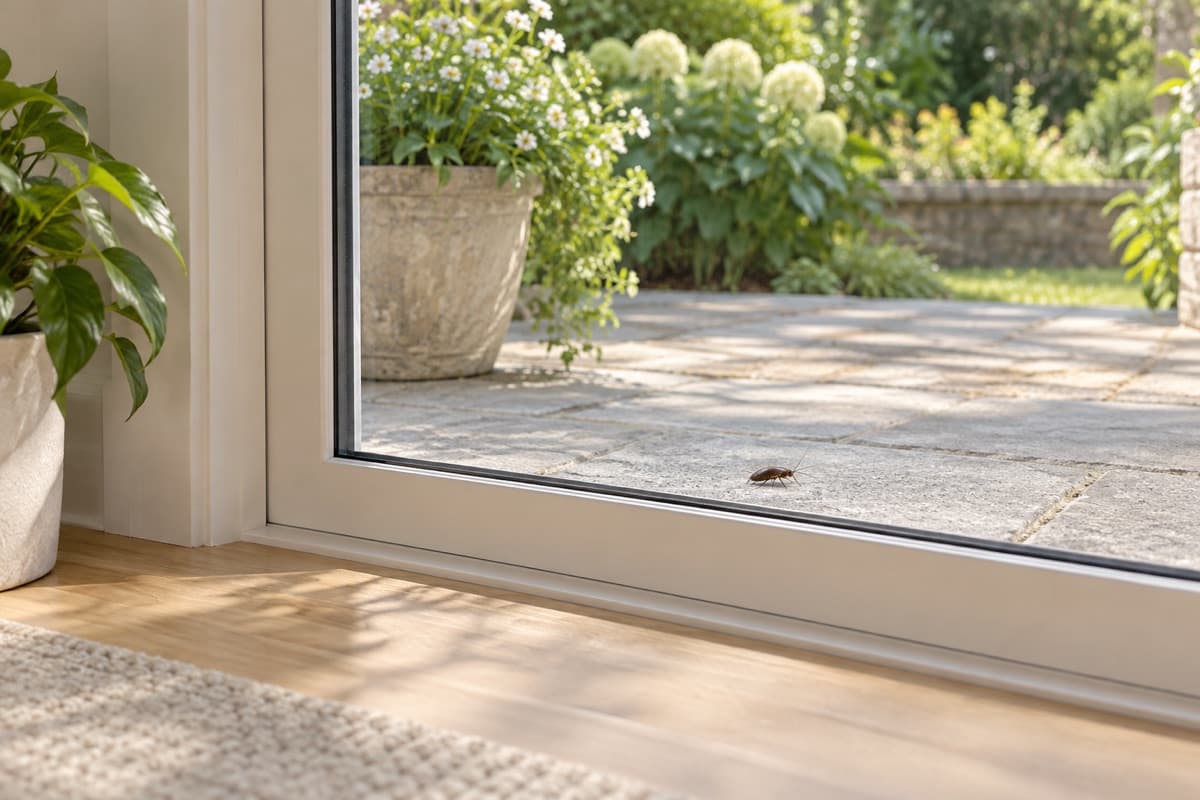
American cockroaches, Oriental cockroaches, and the outdoor species that wander in from mulch beds are a different story. They are larger, they are generally not under the same selection pressure as apartment-dwelling German cockroaches, and a perimeter band can genuinely reduce how many get inside. If your roaches are big, slow, and show up one at a time near a door or drain, a perimeter treatment is a reasonable tool. If they are small, fast, tan, and clustered in the kitchen and bathroom, you have German cockroaches and spraying is the wrong lever.
What To Do Instead, In Order
Timing questions usually come from the wrong starting point. The useful question is not how fast the spray works but whether spraying is the right move at all.
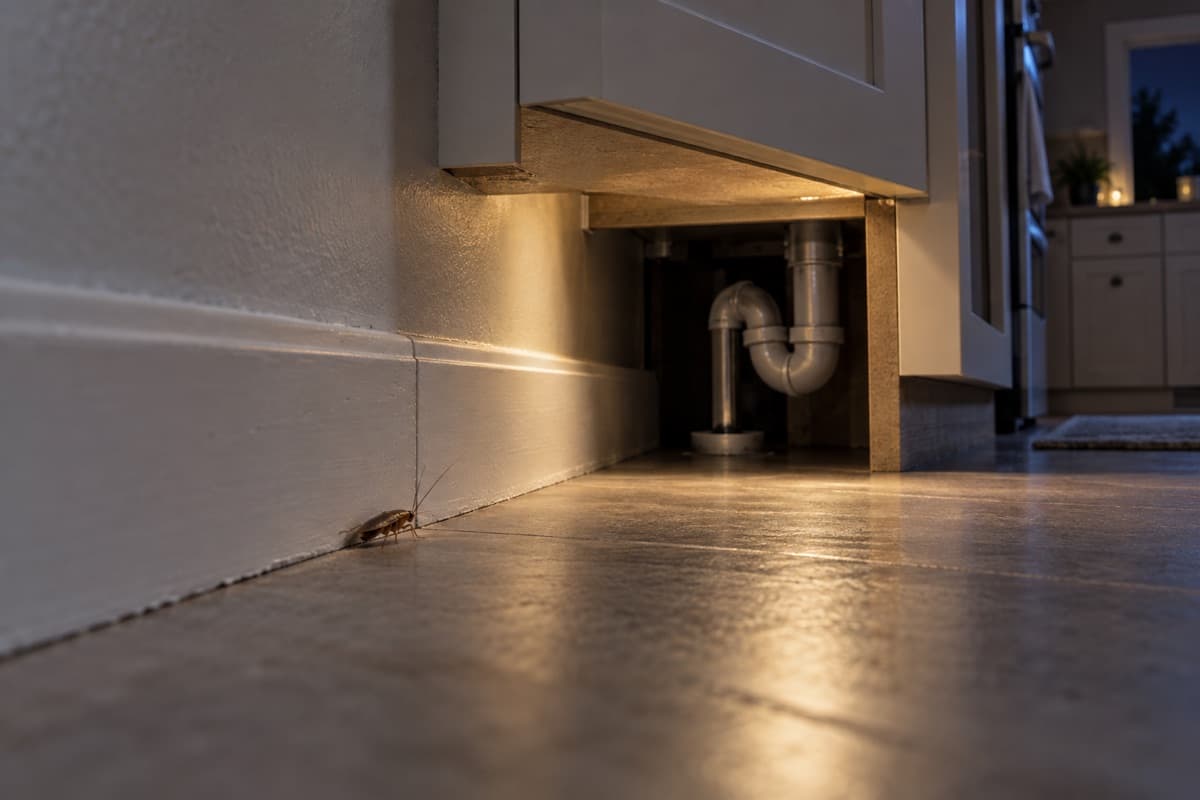
- Identify the species and find the harborage. Sticky monitors placed in corners under the sink, behind the refrigerator, and inside the bottom of upper cabinets will tell you which rooms are involved within a few nights. Our walkthrough on tracking down where roaches are coming from covers placement and how to read the catch.
- Bait first, in small placements, close to harborage. Gel bait exploits behavior that sprays cannot reach. UF/IFAS notes that first-stage nymphs never leave the harborage to forage and feed by eating the droppings and secretions of adults, which means bait carried back by an adult reaches insects you will never see. Expect a visible drop in a week or two rather than overnight; realistic bait timelines are covered here.
- Do not spray where you baited. UF/IFAS is explicit that "using a product with repellent properties in an area where bait may be applied will render the bait ineffective because the treatment will contaminate the bait, making it repellent." Pyrethroids are repellent. A perimeter spray around a bait placement can collapse the whole program.
- Cut food, water, and harborage. Fix the drip under the sink, empty the toe-kick of crumbs, get the cardboard out. UC IPM: "Good sanitation and exclusion are important for effective control; pesticides alone will not solve cockroach problems."
- Use the liquid outdoors, at the perimeter, if you have outdoor-origin roaches. That is where bifenthrin still earns its place, and it is the use the label's outdoor band treatment is designed for.
If you want the full sequence rather than the single-product version, our step-by-step plan for getting rid of roaches puts these in order with what to expect at each stage.
What Not To Do
- Do not treat the 12-month claim as a schedule. It describes residue longevity on undisturbed non-porous indoor surfaces. Anything you wipe, mop, or walk on is not covered by it.
- Do not broadcast it. The outdoor directions limit applications to spot or crack-and-crevice treatments, with spot treatments capped at two square feet, plus a permitted perimeter band of seven feet or less from the foundation and a one-inch band around exterior entry points. Indoors the label calls for a four-inch band, sprayed "until slightly wet without soaking," from about 12 inches away. More product is not more control; it is more residue in your home.
- Do not reach for a fogger when the spray disappoints. Foggers fail on German cockroaches for the same resistance reason and scatter pesticide across surfaces you touch. We go through the evidence in how many roach foggers you need, and the answer is almost always none.
- Do not let it reach drains or water. The label says "do not allow the product to enter any drain during or after application," and not to spray into pools, ponds, streams, or lakes. NPIC's bifenthrin fact sheet explains why: bifenthrin is highly toxic to fish and small aquatic organisms and very highly toxic to bees.
- Do not spray in or on electrical equipment. That is a physical-hazard statement on the label, not a suggestion.
- Do not keep re-treating the same baseboards. Repeated pyrethroid exposure is exactly what selected for the resistance in the first place.
Using It Safely If You Do Use It
The label's re-entry language is short and specific: "People and Pets may re-enter treated area after spray has dried." That is the standard, not an arbitrary hour.
Before you apply indoors, cover or remove exposed food including pet food, and cover food-processing surfaces and utensils. Afterward, wash all food-processing surfaces and utensils with soap and water before reuse. Outdoors, allow at least four hours of drying before expected rainfall.
Bifenthrin's typical human effect from skin contact is "tingling, itching, burning, or numbness at the site of contact," which NPIC notes usually resolves within 48 hours. In pets, signs of overexposure can include vomiting or diarrhea, reduced activity, and ear twitching, with tremors and incoordination at higher exposures. Call Poison Control at 1-800-222-1222 or NPIC at 1-800-858-7378 if someone in the house has a reaction. If reducing pesticide exposure around animals is your main constraint, our risk-based look at pet-safe roach control compares the options honestly, including the ones that are not really safer.
DIY or Call a Pro
Handle it yourself when the roaches are large outdoor species arriving occasionally, when you can see and reach the entry points, and when a perimeter band plus sealing gaps plausibly solves it.
Call a professional when you are seeing small tan roaches during the day, when nymphs of several sizes turn up on monitors, when the problem spans a shared wall or a multi-unit building, or when you have been treating for more than a month without the monitor counts dropping. Day-active German cockroaches indicate a population large enough that harborage is full. That is a job for a bait rotation and follow-up visits, not another bottle of spray.
Frequently Asked Questions
Does Ortho Home Defense kill roaches on contact?
Yes, when sprayed directly onto the insect. The label carries "kills by contact" and "starts killing in seconds" claims for direct application. That is a different question from whether the dried residue kills roaches that walk across it later, which is where the product struggles.
Why did I see roaches after I sprayed?
Two reasons, and they look identical. Pyrethroids are irritants, so a fresh application flushes roaches out of harborage and into the open, which makes the problem look worse for a day or two. Separately, if the population is pyrethroid-resistant, the ones you see may simply be unaffected. If counts are still climbing after two weeks, assume the second.
How long does the residue last indoors?
The label claims up to 12 months on indoor non-porous surfaces if the spray is left undisturbed. Realistically, it is much shorter on anything you clean, on porous surfaces like painted drywall and unsealed wood, and in sunlight. Treat the 12-month figure as a best case under laboratory-like conditions.
Is Ortho Home Defense better or worse than Talstar for roaches?
They are close relatives. Talstar's active ingredient is also bifenthrin, at a higher concentration in a professional concentrate, so the same resistance problem applies to both against German cockroaches. We cover the timing specifics in our guide to how long Talstar takes to kill roaches.
Can I spray it and put out bait too?
Not in the same places. Repellent residues contaminate bait and drive roaches away from it, which is the fastest way to turn a working bait program into a failed one. If you use both, keep the spray to the exterior perimeter and the bait to interior harborage, with no overlap.
Is it safe around kids and pets?
The label's requirement is that people and pets stay off treated areas until the spray has dried, plus covering food and washing food-contact surfaces before reuse. That is the legal standard and it is worth following exactly. "Safe when used as directed" is not the same as inert, and the honest way to reduce exposure is to use less product in fewer places, which is another argument for targeted bait over broadcast spraying.
Does it kill roach eggs?
No. The label's egg-killing claims are limited to beet armyworms, two-spotted spider mites, and Asian lady beetles. Cockroach oothecae are protected capsules, and nothing in this product is labeled to kill them, which is why a treatment that looks successful can be followed by a second wave when eggs hatch.
Sources
- EPA pesticide product label, Ortho Home Defense Indoor and Outdoor Insect Killer 3, EPA Reg. No. 239-2717 (amended February 19, 2021) — active ingredients and percentages, the four 12-month qualifying statements naming German cockroach only at 2 and 24 hours of continuous exposure, "starts killing in seconds," indoor and outdoor application directions, spot-treatment size limits, re-entry after drying, drain and electrical restrictions, and the egg-kill claim list.
- Gordon, Eva, Gaire, Appel, and DeVries, "Common consumer residual insecticides lack efficacy against insecticide-susceptible and resistant populations of the German cockroach," *Journal of Economic Entomology* 117(5), 2024 — the study that tested this exact product; direct-spray versus residual mortality, the under-20-percent figure at 30 minutes, the 24-to-120-hour continuous exposure range, and worse performance on painted drywall.
- DeVries et al., "Pervasive Resistance to Pyrethroids in German Cockroaches Related to Lack of Efficacy of Total Release Foggers," *Journal of Economic Entomology* (2019) — cypermethrin resistance ratios of 59- to 347-fold in apartment populations and 62 percent sentinel survival after fogger treatment.
- UC Statewide IPM Program: Cockroaches — that insecticide sprays do not provide long-term control, that baits outperform sprays, that resistance is widespread, and that pesticides alone will not solve cockroach problems.
- UF/IFAS Extension: Assessment-Based Pest Management of German Cockroaches (ENY-989/IN1190) — why repellent sprays contaminate and ruin bait, coprophagy in first-stage nymphs, monitoring with sticky traps, and resistance developing within a generation.
- NPIC Bifenthrin General Fact Sheet — mode of action, skin-contact symptoms and their duration, signs of pet overexposure, and toxicity to fish and bees.
- Entomology Today coverage of the 2024 study — plain-language summary and the researchers' recommendation to use baits or professional IPM.
</content> </invoke>