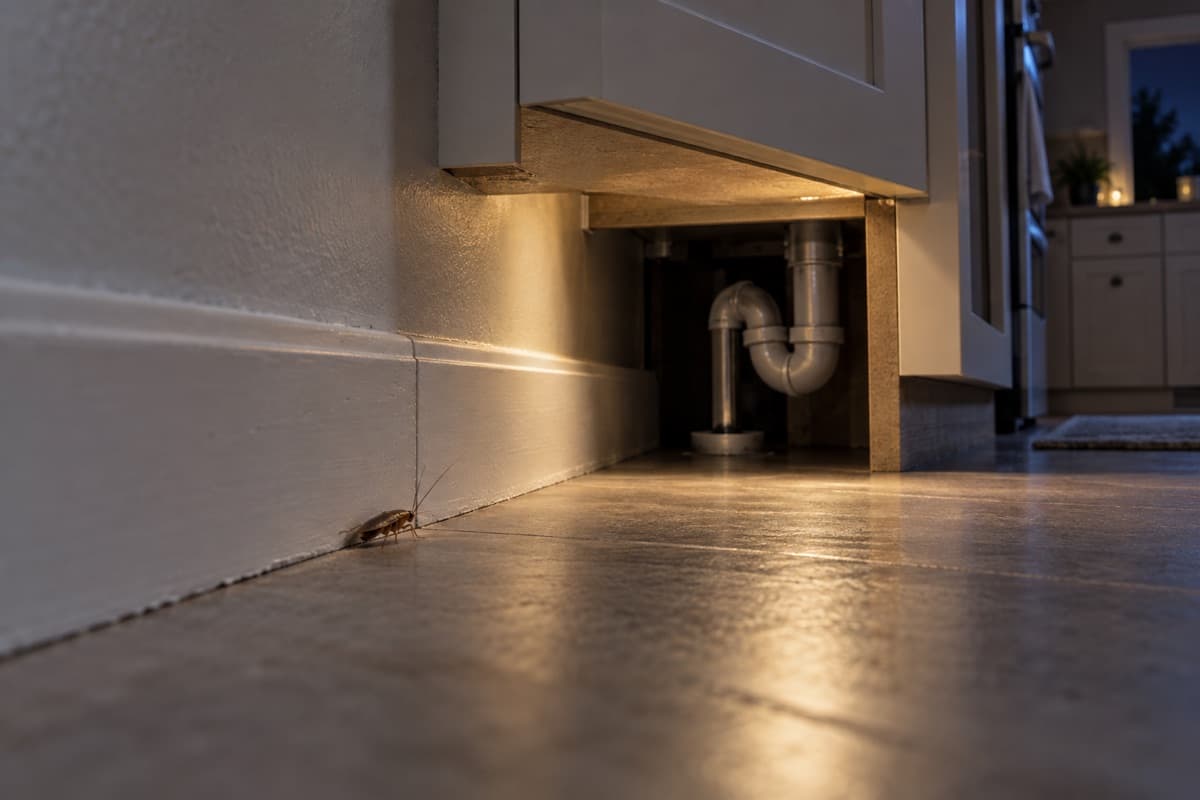
Cockroaches carry a long list of human pathogens on their bodies and in their guts, including Salmonella, E. coli, Staphylococcus aureus, Pseudomonas aeruginosa, Shigella, Candida, Aspergillus, and intestinal parasites. A 2025 systematic review of 43 studies of hospital-collected cockroaches found bacteria in 79 percent of the studies and antibiotic-resistant strains in most of the ones that tested for resistance. What the evidence does not show is a documented chain of transmission from a roach in a home to a specific illness in a person. Those same authors state that "a definitive cause-and-effect relationship between cockroach exposure and patient infections remains to be established." The household health effect that is well documented is allergic: cockroach allergen is a leading asthma trigger, and a randomized trial published in the *Journal of Allergy and Clinical Immunology* showed that killing the roaches measurably improved children's asthma.
The earlier version of this article repeated the widely circulated figure that roaches carry "33 kinds of bacteria, six types of parasitic worms, and seven other human pathogens." That number comes from the National Pest Management Association's consumer site, a trade group, and is not attributed to a study there or anywhere we could find. We have dropped it. The underlying point survives without it, and the real research numbers are both verifiable and more useful.
What Roaches Actually Carry
Cockroaches feed on garbage, sewage, drains, pet waste, and decaying material, then walk across counters and food. Whatever is in the first place ends up on their legs, in their gut, and in their droppings. The literature on what gets recovered from them is large and consistent.
The 2025 review in Microorganisms, covering 43 studies of cockroaches trapped inside hospitals between 2000 and 2024, found:
- Bacteria reported in 79 percent of the studies. The most frequent were Escherichia coli (22 studies), Pseudomonas aeruginosa (11), and Staphylococcus aureus and Enterobacter cloacae (10 each).
- Fungi in 16.2 percent of studies, including Candida and Aspergillus species.
- Helminths, meaning parasitic worms, in 11.6 percent.
- Protozoa in 9.3 percent, and viruses in 6.9 percent.
A 2026 review in *Insects* pulling together healthcare, household, and agricultural studies reports the same organisms plus Acinetobacter baumannii, enterococci, Salmonella, and Shigella. It also cites a global meta-analysis finding that roughly 84 percent of cockroaches collected from human dwellings carried fungi.
Laboratory work shows the carriage can be more than a smear on the outside. A 2023 study in *Ecology and Evolution* found that German cockroaches fed Salmonella Typhimurium shed the bacterium in their feces "from 1 to 20 days after ingestion," at concentrations above 2,000 bacteria per insect per 24 hours, and passed it to other roaches through coprophagy even when no other food or water was available.
For local context, UC IPM's cockroach guidance notes German cockroaches are believed capable of carrying Staphylococcus, Streptococcus, hepatitis virus, and coliform bacteria, and that American cockroaches can pick up Salmonella and Shigella from sewers and pet waste.
Why "Carries" Is Not the Same as "Transmits"
This is the part most articles skip, and it changes how worried you should be.
Every one of those studies establishes mechanical carriage: the organism was found on or in a cockroach. That is a real finding. It is not the same as showing that a person got sick because a cockroach put the organism there. To demonstrate transmission you would need to match the strain on the insect to the strain in the patient, rule out the many other routes into a kitchen, and do it prospectively. That work is rare.
The Insects review is blunt about the gap: "strain-level genomic linkage between cockroach and clinical isolates remains sporadic," and for the drug-resistant yeasts they discuss, "direct transmission to patients has not yet been formally demonstrated." Their overall read is that "most evidence to date supports a predominantly mechanical role for cockroaches."
So the honest framing is this. Roaches are a plausible and biologically capable vehicle for foodborne and enteric organisms, and they are treated seriously in hospitals and food facilities for that reason. In an ordinary home, you should assume contaminated surfaces and act accordingly, but you should not assume that a stomach bug in your household came from the roaches. Gastroenteritis has many causes, and attributing one to an insect you happened to see is a guess.
If you want the broader risk picture beyond infection, our guide to how dangerous roaches actually are covers bites, contamination, and the things people worry about that turn out not to matter.
The Best-Documented Risk Is Allergy and Asthma
Here the evidence is much stronger, and it is the reason public health agencies care about cockroaches in housing at all.
Cockroach droppings, shed skins, saliva, and body fragments break down into house dust. EPA states plainly that "droppings or body parts of cockroaches and other pests can trigger asthma", because proteins in roach feces and saliva provoke allergic reactions. UC IPM goes further, noting that indoor cockroach infestations "have been identified as risk factors for development of asthma in children," not merely as an aggravator of existing asthma.
Three findings anchor this:
- Exposure is common. The National Survey of Lead and Allergens in Housing, which sampled 831 US homes in 1998 and 1999, found detectable cockroach allergen in at least one location in an estimated 63 percent of US homes. Levels were far higher in high-rise apartments, urban areas, pre-1940 buildings, and households earning under $20,000.
- The combination of allergy plus exposure is what hurts. The 1997 National Cooperative Inner-City Asthma Study in the *New England Journal of Medicine* followed 476 asthmatic children aged four to nine across eight US cities. Of them, 36.8 percent were allergic to cockroach allergen and 50.2 percent had high bedroom allergen levels. Children who were both allergic and highly exposed averaged 0.37 asthma hospitalizations a year versus 0.11 for the others, and 2.56 unscheduled medical visits versus 1.43. The same pattern did not appear for dust mite or cat allergen.
- Removing the roaches helps. In the Tulane and NC State randomized trial, 102 children aged 5 to 17 with moderate to severe asthma were followed for 12 months. Homes that got strategically placed insecticidal bait, and nothing else, held significantly fewer cockroaches. Children in the control homes had more symptoms, more unscheduled healthcare use, and were far more likely to have reduced lung function (odds ratio 5.74 for FEV1 under 80 percent predicted). NC State's summary of the work notes the intervention was cheap, low-toxicity, and lasted the full year.
That last study is the most practically useful thing in this article. It says the single highest-value action for a household with asthma and roaches is competent baiting.
The Newer Concern: Antibiotic Resistance
Roaches in hospitals and clinics do not just carry bacteria, they carry resistant ones. The Microorganisms review found that 34 of 43 studies tested for resistance, with E. coli isolates resistant in 51.2 percent of the studies reporting it. Both reviews document extended-spectrum beta-lactamase genes, carbapenemase genes, and mcr-1 colistin-resistance genes in cockroach-associated bacteria.
This matters less for a single apartment than for institutions, but it is a legitimate reason that hospitals, care facilities, and food businesses treat any roach sighting as a control failure rather than a nuisance.
What To Do Now
If you have roaches and you are worried about illness, work in this order.
- Treat every exposed surface and dish as contaminated. Wash with hot soapy water. Dishes, utensils, cutting boards, and countertops. This is ordinary kitchen hygiene, not decontamination.
- Throw out food in compromised packaging. Opened cardboard boxes and paper bags in an infested cabinet are not salvageable. Sealed cans, jars, and factory-sealed plastic are fine after washing the outside.
- Move remaining dry goods into hard containers with gasketed or screw-top lids. Roaches chew through cardboard and thin film.
- Clean up droppings properly. Dry-sweeping or dusting scatters allergen into the air. Our guide to cleaning roach droppings covers wetting the surface first, gloves, and what to do about porous materials.
- Start baiting. Gel bait placed in cracks and along harborage edges is what actually reduced asthma morbidity in the trial above. Using Advion gel correctly matters more than which brand you pick, since most failures are placement failures.
- Wash hands before eating and after cleaning. Mundane, and it is the step that interrupts the fecal-oral route any pest could contribute to.
For the full sequence, including inspection, sanitation, and follow-up timing, see our step-by-step plan for getting rid of roaches.
Symptoms: What To Watch For, and What Not To Assume
There is no such thing as a distinctive "roach-borne illness" presentation. If a roach did contribute to an infection, it would look like the infection, not like the insect.
CDC describes Salmonella infection as watery diarrhea that may contain blood or mucus, plus stomach cramps, starting 6 hours to 6 days after exposure and usually resolving in 4 to 7 days. CDC advises contacting a doctor for diarrhea or vomiting lasting more than two days, bloody stool, fever above 102°F, or signs of dehydration. Infants, adults over 65, and people with weakened immune systems are at higher risk of severe illness.
Allergic symptoms are different and more chronic: coughing, wheezing, chest tightness, nighttime waking, nasal congestion, and itchy eyes that persist in the home and ease elsewhere. If a child's asthma is poorly controlled and the home has roaches, that connection is worth raising with their clinician, who can test for cockroach sensitization.
What you should not do is diagnose backwards from the pest. Tell a clinician what your symptoms are and that there are roaches in the home; let them decide whether it is relevant.
What Not To Do
- Do not set off foggers. Total release foggers do not reach the cracks where roaches live, they can drive the population deeper into a structure, and EPA warns that the aerosol propellants are typically flammable and that improper use can cause fire or explosion. We go through the arithmetic in how many roach foggers you need, and the answer is almost always none.
- Do not rely on disinfectant sprays as pest control. Wiping a counter kills what is on the counter. It does nothing about the population behind the dishwasher that recontaminates it that night.
- Do not pay for a lab test on a roach. Knowing which bacteria your specific roach is carrying will not change the treatment or the cleanup.
- Do not assume one roach means contamination everywhere. A single American cockroach that wandered in from a drain is a different situation from a German cockroach population breeding in the kitchen. Confirm which you have before escalating.
- Do not panic about a swallowed roach. Stomach acid handles most of what a roach carries, and the realistic risk is low. Our note on accidentally eating a roach covers when it is worth a call to a doctor.
Prevention That Lowers Exposure
Pathogen risk and allergen risk both scale with population size, so the prevention list is the same list.
- Remove water. Fix dripping traps and leaky supply lines. Roaches tolerate hunger far better than thirst.
- Deny food residue. Grease films behind and under appliances, pet food left out overnight, and unrinsed recycling are the usual sustainers.
- Seal harborage. Caulk gaps behind backsplashes, around pipe penetrations, and along cabinet edges. UC IPM's approach is exclusion plus sanitation plus bait, not spraying.
- Vacuum rather than sweep, ideally with a HEPA filter, which UC IPM recommends specifically to reduce allergen exposure while removing droppings and shed skins.
- Launder and wet-wipe in bedrooms. Allergen concentrates in dust where people sleep, which is exactly what the 1997 study measured.
- Keep monitoring. Sticky traps in a few fixed locations tell you whether a population is growing or collapsing, which is more reliable than counting sightings.
DIY or Call a Pro?
Handle it yourself when the infestation is small, confined to one room, and you can find and reach the harborage. Gel bait plus sanitation resolves a lot of kitchen-scale German cockroach problems, and the asthma trial shows bait alone can be enough to change health outcomes.
Call a professional when any of these apply:
- Someone in the home has asthma, a respiratory condition, or a compromised immune system, and the infestation is not shrinking within a few weeks.
- You are in a multi-unit building, where roaches move between apartments and unit-by-unit treatment fails. This usually needs building-wide management.
- You see roaches in daylight, in multiple rooms, or find droppings in more than one area, which indicates a large population.
- The infestation is in a food business, daycare, or care facility, where the resistance findings above make it a regulatory and clinical issue, not just a nuisance.
- You have baited correctly for four to six weeks with no decline, which often means bait aversion or a population you have not located.
Frequently Asked Questions
Can you get sick just from a roach walking on your food?
It is possible and it is worth avoiding, but it is not a proven route in home settings. A roach can deposit bacteria mechanically, and infected roaches shed Salmonella in their feces for up to 20 days after exposure. Whether enough organisms transfer to cause illness depends on the pathogen, the dose, and your immune status. Throw out the food, wash the surface, and do not lose sleep over a single contact.
Do roaches carry rabies, HIV, or hepatitis?
Not rabies, which is a mammalian virus spread by bites from infected mammals. Not HIV, which does not survive or replicate in insects. Hepatitis virus appears on UC IPM's list of organisms German cockroaches are believed capable of carrying mechanically, but carriage is not the same as transmission, and there is no evidence of household hepatitis transmission by cockroaches.
Which cockroach species is the biggest health risk?
The German cockroach, because it lives indoors year-round, breeds fast, and stays in kitchens and bathrooms where people prepare food. It is also the species behind most cockroach allergen in homes. American and Oriental cockroaches spend more time in sewers, drains, and crawl spaces, which means dirtier contact but far less time on your counters.
Do roach bites spread disease?
Cockroach bites are rare and typically happen only in heavy infestations where food is scarce. There is no established evidence of disease transmission through a cockroach bite. Treat one as a minor wound: wash it, keep it clean, and watch for signs of secondary bacterial infection.
Will killing the roaches fix asthma symptoms right away?
Not instantly. Cockroach allergen persists in dust after the population is gone, so cleaning has to continue alongside control. In the 12-month randomized trial, the asthma benefit showed up over months, not days. Bait first, then keep vacuuming and washing bedding and soft surfaces.
Are roach droppings dangerous to breathe?
The allergen risk is real and well documented; that dust is what drives the asthma findings. The infection risk from inhaling dried droppings is not established. Either way, the handling advice is the same: wet the surface, wear gloves and a mask, and vacuum with a HEPA filter rather than dry-sweeping.
Should I get my home tested for cockroach allergen?
Generally no. Home allergen testing is used in research, not in routine care, and a positive result would not change what you do. If asthma is the concern, allergy testing on the person is the useful test, because morbidity in the research tracked the combination of being sensitized and being exposed.
Sources
- Pathogens of Medical Importance Identified in Hospital-Collected Cockroaches: A Systematic Review, *Microorganisms* (2025) — 43 studies, pathogen categories and percentages, resistance findings, and the statement that cause and effect has not been established.
- Cockroaches as Vectors of Pathogens and Antimicrobial Resistance, *Insects* (2026) — organism list across settings, resistance genes, and the assessment that the role is predominantly mechanical.
- Mond and Pietri, *Ecology and Evolution* (2023) — Salmonella Typhimurium persistence in German cockroaches, fecal shedding for 1 to 20 days, and horizontal spread by coprophagy.
- Rosenstreich et al., *New England Journal of Medicine* (1997) — the inner-city asthma study: sensitization rates, bedroom allergen levels, and hospitalization and visit rates for allergic, highly exposed children.
- Rabito et al., *Journal of Allergy and Clinical Immunology* (2017) — 12-month randomized trial showing insecticidal bait alone reduced cockroach counts and improved asthma outcomes.
- NC State College of Agriculture and Life Sciences: Simple Cockroach Control Method Lowers Respiratory Health Risks — plain-language summary of that trial and its cost and toxicity profile.
- Cohn et al., National Survey of Lead and Allergens in Housing, *Environmental Health Perspectives* (2005) — detectable cockroach allergen in an estimated 63 percent of US homes, and the housing characteristics associated with high levels.
- UC Statewide IPM Program: Cockroaches — organisms each species can carry, cockroach infestation as an asthma risk factor in children, HEPA vacuuming, and why foggers and sprays are the wrong tool.
- EPA: Asthma Triggers, Gain Control — droppings and body parts as asthma triggers, and the sanitation and exclusion steps EPA recommends before pesticides.
- EPA: Safety Precautions for Total Release Foggers — flammable propellants and the hazards of improper fogger use.
- CDC: Symptoms of Salmonella Infection — symptom picture, 6-hour to 6-day onset, 4- to 7-day duration, and when to call a doctor.
- National Pest Management Association: Cockroach Allergens Linked to Diseases Like Salmonella — the origin of the widely repeated "33 kinds of bacteria" figure, cited here only to show where it comes from.