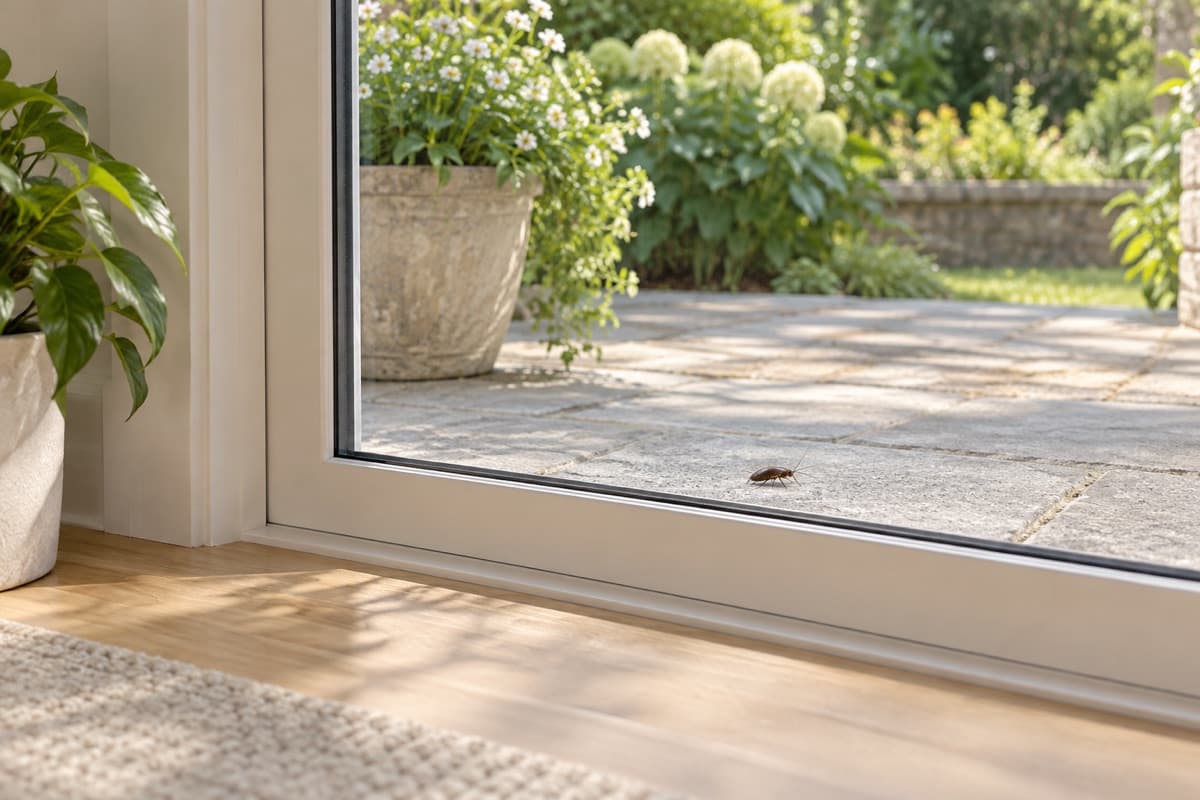
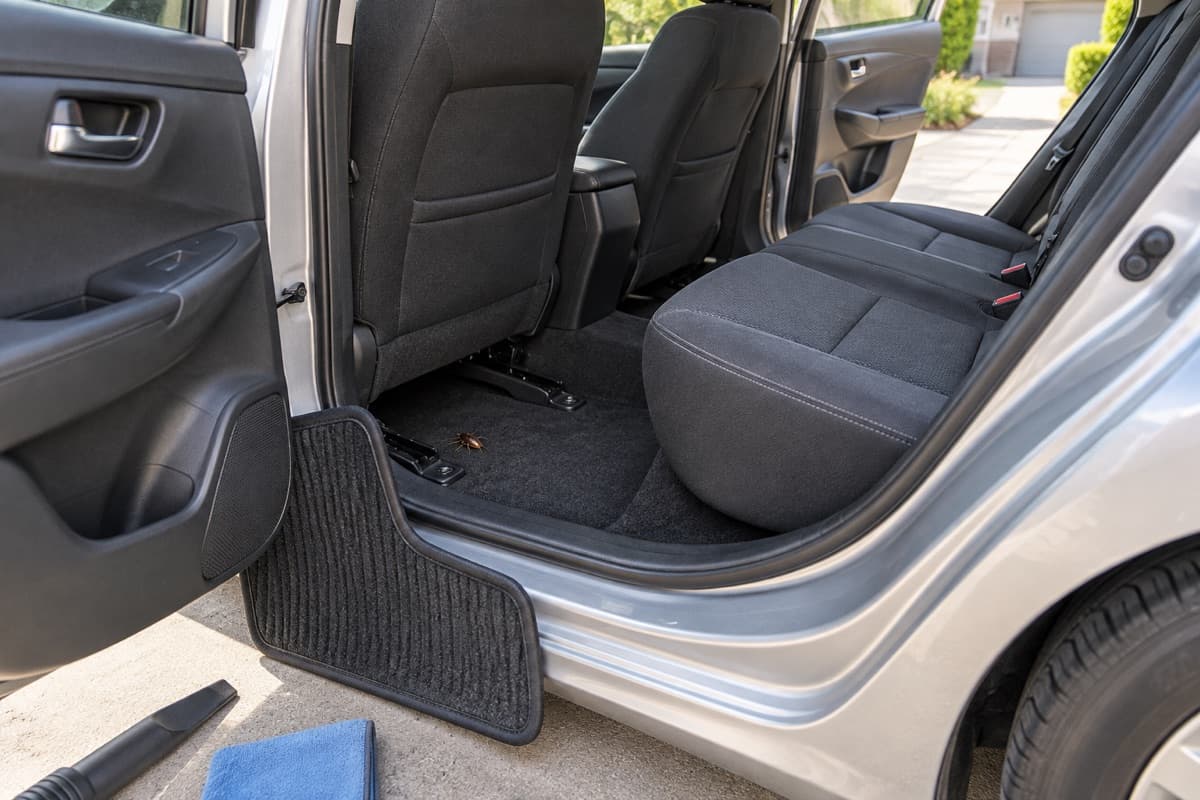
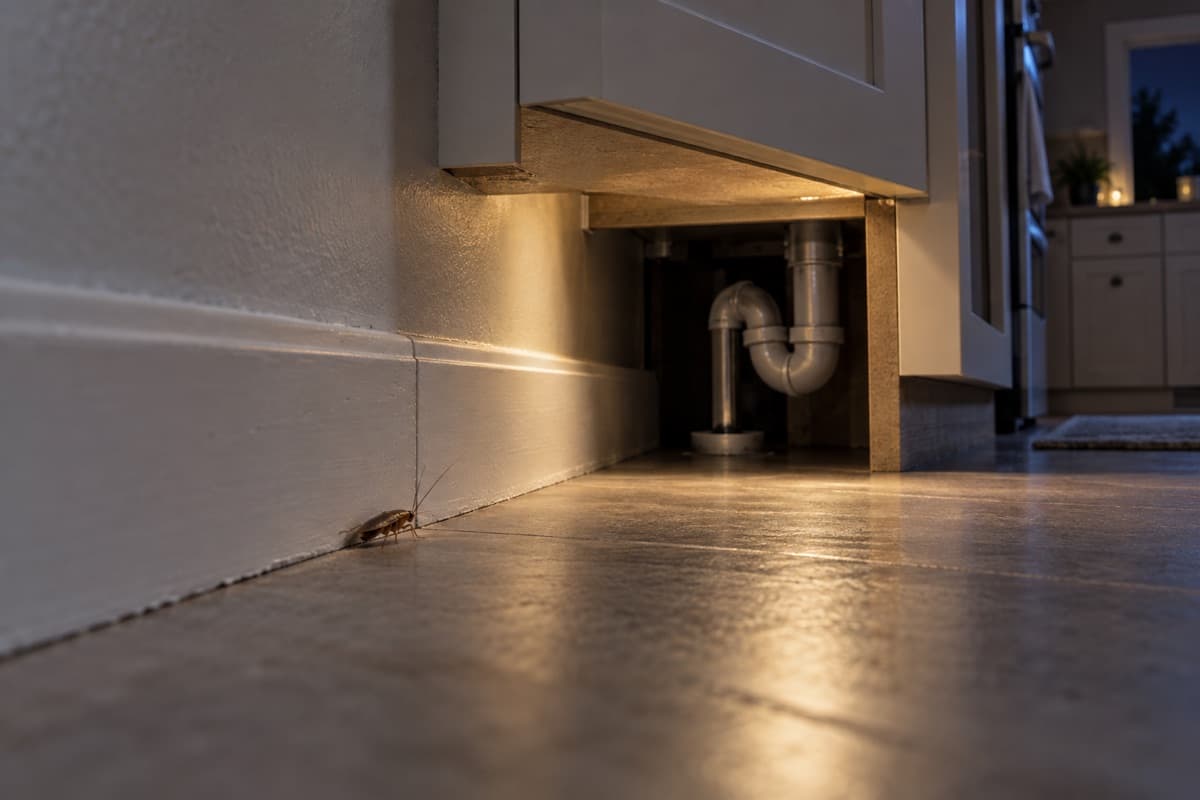
You cannot reliably summon a cockroach with food. Roaches press their bodies into tight crevices because of positive thigmotaxis — a hardwired preference for contact on all sides — and adult German cockroaches will occupy cracks as narrow as one-sixteenth of an inch. What actually brings them into view are the three methods professionals use: a flashlight inspection after dark, because German cockroaches are most active at night and daytime sightings indicate a severe infestation; sticky monitor traps placed at the junctions of floors and walls and close to sites where cockroaches are suspected, which often catch roaches within the first 24 hours; and a flushing agent injected into voids. Extension guidance recommends a nonchemical flusher such as canned compressed air, with a vacuum ready as roaches emerge, and warns against insecticide flushing agents because they contaminate bait placements. Food lures are the weakest option available, because the roach already has food.
The previous version of this article recommended mixing borax into homemade food bait, moistening bait with beer, and using low-frequency sound devices. All three have been removed. Mixing a pesticide into a homemade bait is not a labeled use; EPA states that pesticide labels are legally enforceable and that using a product in a manner inconsistent with its labeling violates federal law. And the FTC has sent warning letters to more than 60 manufacturers and retailers of ultrasonic pest-control devices, noting in earlier complaints that ultrasound devices do not control insects.
Why Roaches Hide, and Why That Matters
German cockroaches are not hiding from you specifically. They are doing what their body plan is built for. Penn State Extension notes that their relatively wide, flat bodies enable them to move in and out of cracks and narrow openings with ease, and that they seek out dark sites offering warmth and humidity. Combine that with a strong preference for surface contact and an aggregation response to pheromones in their own feces, and the result is a population packed into crevices you would never think to open.
Two more facts shape any search. Adults generally stay within about 10 feet of their food source, and young nymphs venture only about 2 feet from their hiding places. So a single roach sighting is a location clue, not a stray event. And when the eXtension German cockroach guide says daytime sightings indicate a severe infestation, that is because roaches forced out during daylight hours are usually competing for limited food inside a crowded harborage.
That is why "luring one out" is the wrong goal. Finding where the group lives is the right one. Where the roach nest actually is — and why there isn't one covers that distinction in more detail.
The Night Flashlight Inspection
This is the highest-yield thing a homeowner can do, and it costs nothing.
- Wait until at least an hour after full dark, with the lights in the room off and the house quiet.
- Walk in with a bright flashlight and a small inspection mirror. Extension guidance specifically names a flashlight and mirror as inspection tools.
- Go straight to heat and water. Behind and underneath the refrigerator, the range and the dishwasher. Inside the motor compartment of the fridge. Around the water heater. Under the sink where the supply lines enter the cabinet. Around electrical junction boxes.
- Open and look inside cabinet corners, hinge recesses, and the gap between the cabinet box and the wall. Pull out the bottom drawer entirely and look into the cavity behind it.
- Use your nose. Established infestations have a distinctive odor from feces and pheromones, and experienced technicians often smell a problem before they see it.
- Look for droppings, not just roaches. German cockroach droppings look like ground pepper or coffee grounds, and heavy accumulations stain surfaces. Droppings concentrated in one spot mean the harborage is right there.
Move deliberately rather than quickly. You are surveying, not hunting. If you find a concentration, mark it — that is a bait placement site.
Sticky Monitors: The Actual Professional Technique
If night inspection is the flashlight, monitors are the security camera. They work while you sleep and they produce numbers rather than impressions.
- Use plain cardboard sticky monitors, which are perforated so you can fold or tear them to fit a space.
- Place them along structural lines — flush against walls, into corners, where the floor meets the cabinet toe kick, behind and beside heat-producing appliances. UC IPM specifies the junctions of floors and walls. Extension guidance warns that monitors placed incorrectly will trap only a fraction of the cockroaches they otherwise could.
- Keep them dry. Replace any monitor that is full, wet, or dusted over.
- Date and number every one and sketch a map. This is what turns a trap into a measurement.
- Read what you catch, not just how many. A mix of adults, nymphs and females with egg cases means an established infestation. One or two adults alone suggests a new introduction. A few very small nymphs means you should focus your inspection within 5 to 10 feet of that monitor.
Penn State suggests a survey using sticky traps at ten or more strategic locations for about a week to determine the extent of an infestation, on the grounds that visual inspection alone will not reveal all harborage areas. That is a reasonable home protocol too. How long roach traps take to work sets expectations for the first few nights.
Flushing: What Professionals Do and What You Should Do
A flushing agent is a product injected into a void to irritate roaches into leaving it, so the technician can see how many there are and where they live. The Illinois Department of Public Health lists a flushing agent, typically an aerosol containing pyrethrins, among standard cockroach inspection tools alongside a flashlight, mirror, and probing tools.
Homeowners generally should not use an insecticide flusher, for two concrete reasons.
It ruins your baiting program. Extension guidance says plainly to avoid the use of insecticide flushing agents because they will contaminate bait placements. UF/IFAS states the underlying rule more broadly: never spray a liquid insecticide where baits have been applied, because it will repel cockroaches from the bait.
It scatters the infestation. Penn State Extension warns that residual sprays and aerosol foggers inside a structure are of little value and may disperse the cockroaches, making control difficult and lengthy. UC IPM makes the same point about aerosols repelling and dispersing cockroaches to other areas of a building.
The safe substitute is mechanical. Extension guidance recommends a nonchemical flushing agent such as a can of compressed air sold for cleaning electronics, directed through the straw tip into cracks and crevices you suspect, with a vacuum in your other hand to collect roaches as they emerge. A HEPA vacuum is preferable, since cockroach droppings and body parts are recognized asthma triggers. Empty the canister into a sealed bag and put it outside.
If You Genuinely Just Need To Find One Roach
Sometimes the goal really is narrow — you saw one, you want to know whether there are more, or you want to catch a specimen for identification. In that case:
- Put three to six sticky monitors down tonight at floor-wall junctions in the kitchen and bathroom. Check them in the morning.
- Do the flashlight walk an hour after dark.
- Remove competing food first. Wipe up crumbs, do the dishes, lift pet bowls, take the bin out. A monitor competes poorly with a floor full of food. This is also the honest kernel inside the old folk advice about food lures: it is not that bait attracts roaches strongly, it is that everything else stops attracting them.
- Skip the improvised jar traps and homemade lures. A jar trap tells you very little compared with a two-dollar sticky card you can read at a glance.
- Identify what you caught. German cockroaches live and breed entirely indoors; large outdoor species are usually entering from elsewhere, and the treatment differs. Confirming whether you actually have roaches walks through the signs that settle it.
If monitors come back with mixed life stages, stop trying to see roaches and start treating. If they come back empty for a week in well-chosen spots, you probably do not have an established indoor population.
What Not To Do
- Do not mix pesticides into homemade food bait. Combining borax or boric acid with peanut butter, sugar or beer is not a use pattern that appears on a label, and label directions are enforceable under federal law. The details of what a borate label does and does not allow are in what you can mix with boric acid.
- Do not rely on sound or electromagnetic repellers. The FTC has taken repeated enforcement action against unsubstantiated claims for these devices.
- Do not set off a fogger to drive roaches out. Foggers do not reach harborage, they scatter roaches into new areas, and EPA warns that fogger propellants are typically flammable and improper use may cause a fire or explosion.
- Do not spray into outlets or appliances. UF/IFAS says never spray around or into electrical outlets, and the Advion Cockroach Gel Bait label prohibits use in or on electrical equipment where a shock hazard exists.
- Do not trust food-based home remedies. Extension guidance states there is no scientific evidence supporting vinegar, essential oils or DIY boric acid concoctions for German cockroach control.
- Do not leave a light on to "draw them out." Roaches avoid light. A lit room suppresses the activity you are trying to observe.
When To Call a Professional
- You can smell roaches but cannot find them. That usually means harborage inside a wall or appliance cavity.
- Monitors fill overnight. A heavy established infestation needs a structured baiting and rotation program, not a search.
- You live in an apartment or share a wall. Single-unit efforts rarely hold when the source is elsewhere in the building. Tracing where roaches are coming from covers what you can establish yourself before escalating.
- Someone in the household has asthma. Allergen removal is its own task, separate from killing roaches.
- You need void access. Technicians can safely open and treat spaces behind panels, under equipment and inside voids that a homeowner should not.
Frequently Asked Questions
What food attracts roaches out of hiding fastest?
No food reliably does, because a roach in an infested home is already near food. Removing competing food sources matters far more than choosing a lure. If you want a food-based tool, use a commercial gel bait placed per its label rather than an improvised lure — it is formulated with phagostimulants and designed to be eaten in a crevice, not on an open floor.
Does light make roaches come out?
The opposite. German cockroaches are nocturnal and avoid light, which is why inspection is done in the dark with a directed flashlight beam rather than with the room lights on.
Will roaches come out if I stop cleaning?
No — the reverse. Abundant loose food lets roaches feed briefly and retreat, reducing both their foraging range and their interest in monitors or bait. Tight sanitation is what pushes them into the tools you have set.
Why do I only see roaches at night?
Because that is their active period. Extension guidance treats daytime sightings as a sign of a severe infestation, typically driven by crowding and food competition inside the harborage.
Is it worth trying to catch roaches by hand?
Only for identification. Vacuuming is faster and safer, and a HEPA vacuum also removes the droppings and shed skins that trigger asthma. Extension guidance recommends HEPA vacuuming heavy infestations before treatment for exactly this reason.
Can I use a pyrethrin aerosol to flush them out myself?
It is legal if you follow the label, but it is usually counterproductive. It contaminates bait placements, it can scatter roaches into untreated parts of the home, and pyrethroid resistance in German cockroaches is well documented. Compressed air plus a vacuum gets you the same information without those costs.
How long should I leave a sticky monitor down?
At least a week for an initial survey, then keep them in place through treatment. They are how you know whether the population is rising, falling or flat — and extension guidance is to keep baiting until monitors show zero, with no nymphs and no egg cases.
Sources
- UC IPM: Cockroaches — adult German cockroaches occupying cracks 1/16 inch wide, sticky traps at floor-wall junctions, catches within the first 24 hours, and aerosols dispersing cockroaches.
- eXtension Pests in the Home: German Cockroach Pest Control — nocturnal activity and daytime sightings, flashlight and mirror inspection, odor, droppings, monitor placement, compressed air as a nonchemical flusher, the warning against insecticide flushers, HEPA vacuuming, and home remedies lacking evidence.
- Penn State Extension: German Cockroaches — flat body form and crevice movement, the ten-or-more sticky trap survey, and residual sprays and foggers dispersing cockroaches.
- UF/IFAS ENY-989: Assessment-Based Pest Management of German Cockroaches — reading monitor catches by life stage and the 5-to-10-foot inspection radius.
- UF/IFAS ENY-214: Cockroaches and Their Management — never spraying liquid insecticide where bait is placed, and never spraying into electrical outlets.
- Illinois Department of Public Health: Cockroaches — the inspection toolkit including pyrethrin flushing agents, harborage locations, and adult and nymph travel distances from harborage.
- Federal Trade Commission: FTC Warns Manufacturers and Retailers of Ultrasonic Pest-Control Devices — more than 60 warning letters and the requirement for scientific support of efficacy claims.
- EPA-accepted label, Advion Cockroach Gel Bait (EPA Reg. No. 100-1484) — the prohibition on use in or on electrical equipment where a shock hazard exists.
- EPA: Introduction to Pesticide Labels — pesticide labels are legally enforceable.
- EPA: Safety Precautions for Total Release Foggers — fogger flammability and reentry guidance.
- EPA: Asthma Triggers, Gain Control — cockroach droppings and body parts as asthma triggers.