There is no reliable number of hours or days after which mold "dies" from drying, because drying is not primarily a killing mechanism. Growth stops when the moisture leaves, and the colony becomes metabolically inactive — a state that a 2023 PLOS Biology primer describes as spores being dormant, metabolically (nearly) inactive, and able to stay viable even after 17 years of storage. More importantly, viability is the wrong thing to track. OSHA's guidance states that simply killing mold is not enough, because the chemicals and proteins which can cause a reaction in humans are present even in dead mold, and the EPA says the same: dead mold may still cause allergic reactions in some people, so it is not enough to simply kill the mold, it must also be removed. Dry it to stop the growth. Remove it because drying does not undo it.
The previous version of this article claimed mold "typically dies within 24-48 hours without moisture." That figure was borrowed from the wrong rule. The 24-to-48-hour window in EPA guidance is the deadline for drying water-damaged materials to prevent mold growth from starting — it is not a death clock for mold that has already grown. That claim has been dropped.
What Dormancy Actually Means
A fungal colony has two parts that behave differently when the water goes away.
- The hyphae, the network growing into and across the material, stop extending. Depending on the species, the substrate, and how completely it dried, some of that biomass dies and some persists.
- The spores are built for exactly this. Fungal spores are stress-resistant cell types that survive heat, UV, and drying; their cytoplasm becomes so concentrated with protective solutes that it has been described as a "glassy state" in which proteins are preserved but inactive. That is dormancy: not death, but suspension. Rewet the material and germination resumes.
So the honest answer to "how long until it dies" is that the visible growth stops within a day or two of genuine drying, portions of the colony degrade over weeks to months, and viable spores can persist far longer than any homeowner timeline. Nobody should be planning around the difference.
Why Dead Mold Still Matters
This is the part that makes "does it die?" the wrong question. The allergic response is to fungal proteins and other cell components, and those survive the organism.
- OSHA is unambiguous. Porous materials with mold growth may have to be discarded because mold can infiltrate the material, and "as a general rule, simply killing the mold, for example, with biocide is not enough. The mold must be removed."
- The remediation standard agrees. The industry's ANSI-accredited mold standard treats physical removal of mold contamination as the primary means of remediation, and notes that killing mold "only eliminates its ability to grow" while leaving allergic and toxigenic reactions to dead mold on the table.
- Animal data support it. In a study of Aspergillus fumigatus exposure published in BioMed Research International, live conidia provoked a stronger response overall, but in mice already sensitized to fungal antigens, killed conidia still recruited neutrophils and induced goblet cell metaplasia — an asthma-type airway response to non-viable spores.
- Fragments count too, not just intact spores. Work published in Medical Mycology using immunostaining found that roughly 25% of airborne hyphal fragments expressed detectable allergen, and that airborne hyphae were often present in higher concentrations than the conidia of individual allergenic genera. A dried, crumbling colony sheds these.
Practically: a wall you dried out and left alone is still a reservoir. Disturbing it later — sanding, demolition, a vacuum without a HEPA filter — puts that material into the air.
What Drying Does Accomplish
Drying is still the first and most important step. It just is not the last one.
- It stops the colony from expanding. The EPA's basic statement is that mold spores will not grow if moisture is not present.
- It prevents new growth elsewhere. Wet materials dried within 24 to 48 hours will in most cases not become moldy.
- It makes removal safer and cleaner. Wet material tears, smears, and re-contaminates. Dry material cuts and bags.
- It protects the structure. USDA Forest Products Laboratory guidance notes that fully air-dried wood normally sits at a moisture content not exceeding 20%, which provides a reasonable margin of safety against fungal damage, and that wood will not decay if kept air dry — though the same source notes humid air alone, while insufficient for decay, will still permit development of some mold fungi. Stopping decay and stopping mold are not the same threshold.
If you want the other half of this timeline — how quickly growth starts once something gets wet — see how fast mold grows in walls.
How To Verify It Is Actually Dry
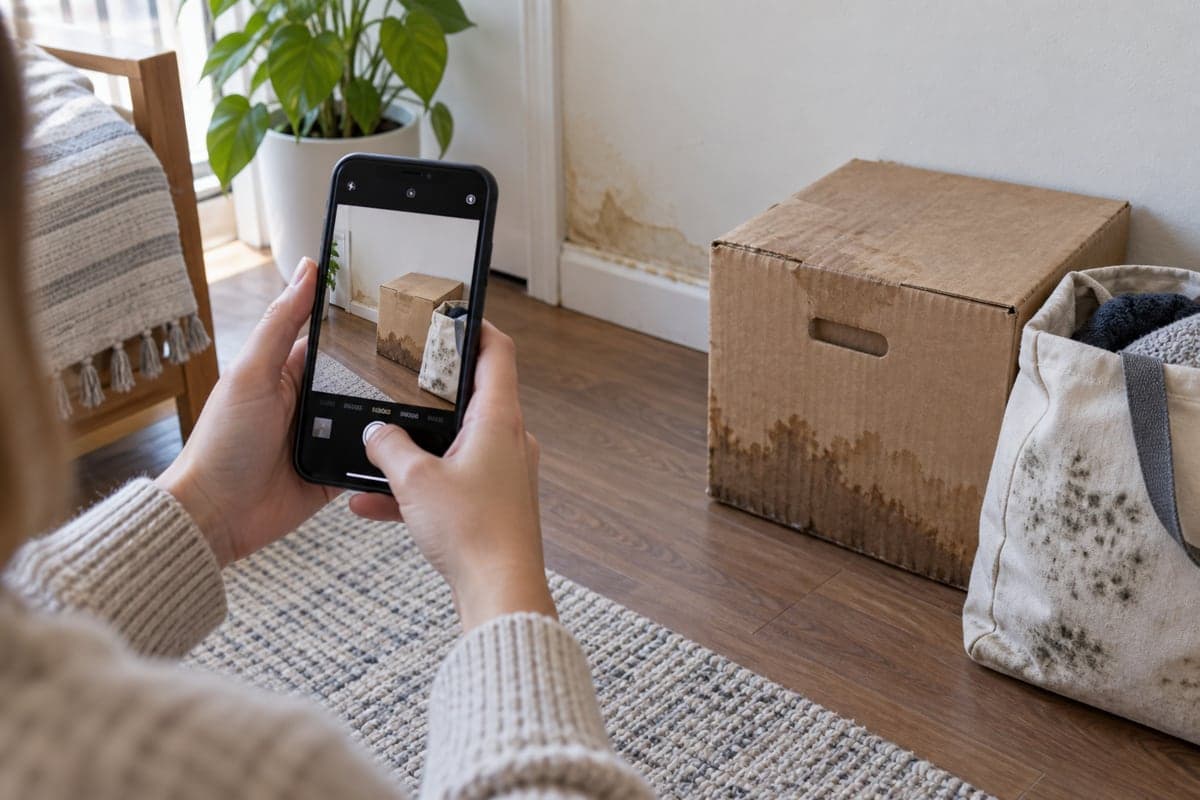
"Looks dry" and "feels dry" are surface observations. Materials dry from the outside in, so the face of a piece of drywall can be dry to the touch while the paper backing and the cavity behind it are not.
- Use a moisture meter. The EPA's mold course notes that investigators use moisture meters to find wet areas and to monitor the process of drying these materials; OSHA adds that they work on carpet, wallboard, wood, brick and concrete, using either an inserted pin probe or a surface-contact pad.
- Compare against an unaffected reference. Meters read differently on different materials, so the useful measurement is not an absolute number but the same material in a part of the building that never got wet. Restoration practice under the water-damage standard sets drying targets this way rather than against a universal figure.
- Measure repeatedly, in the same spots. A single reading is a snapshot. Readings that stop falling over consecutive days are what tells you drying has finished — or stalled.
- Watch room humidity too. Keep indoor relative humidity below 60%, ideally between 30 and 50 percent; the CDC's version is to keep it no higher than 50% all day long. If the room air stays humid, materials will not give up their moisture.
- Check hidden reservoirs. Insulation, subfloor, the back of cabinets, and wall cavities dry far more slowly than the finished surfaces in front of them.
What Has To Come Out
Once the material is dry, the decision is about porosity and how deeply the growth penetrated.
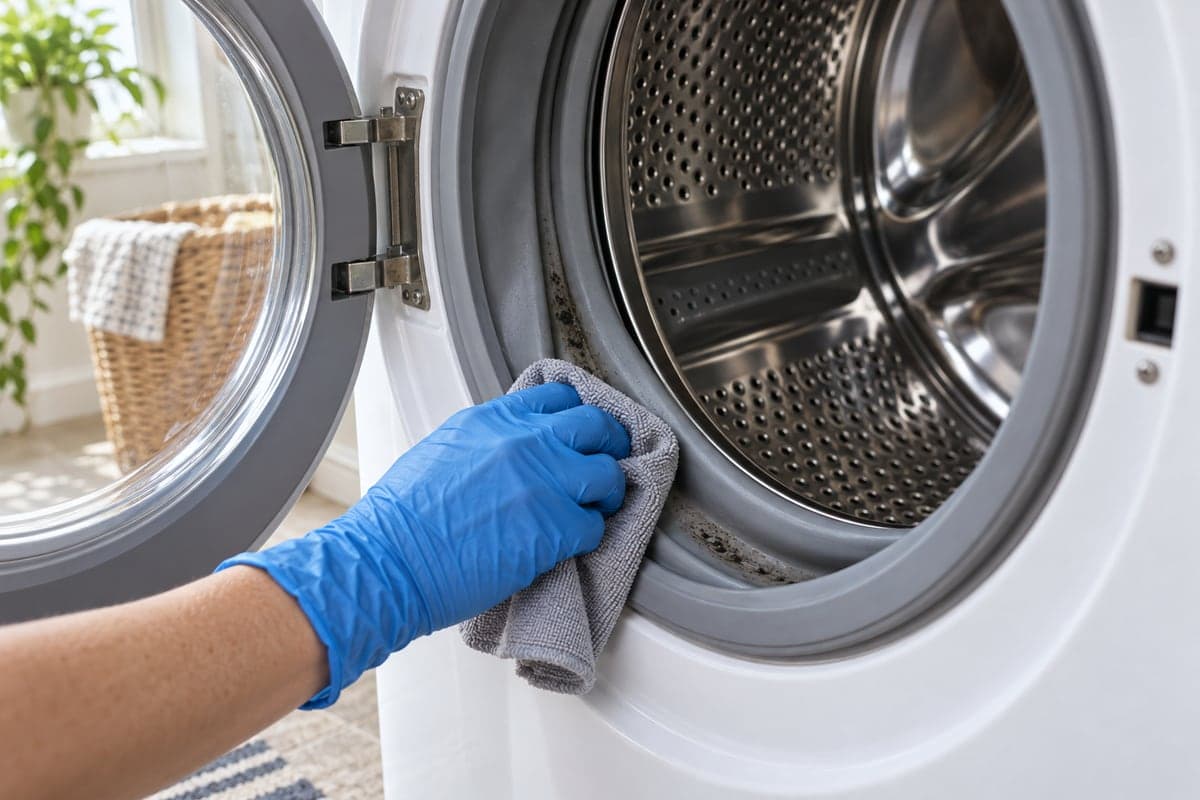
Usually cleanable in place — nonporous and semi-porous hard surfaces: glazed tile, glass, metal, plastic, sealed countertops, finished wood trim with surface-only growth. The EPA's method is to scrub mold off hard surfaces with detergent and water, and dry completely.
Usually discarded — absorbent and porous materials that stayed wet and grew mold: ceiling tile, carpet and pad, insulation, and drywall with more than superficial growth. The EPA states these may have to be thrown away, and OSHA's reasoning is that mold can infiltrate porous substances and fill crevices, making complete removal difficult or impossible.
Never do this: do not paint or caulk over it. The EPA is explicit — clean up the mold and dry the surfaces before painting, or the coating will peel. Encapsulating dried growth hides it without removing the allergenic material.
Scale matters for who does the work. The EPA's threshold is that if the moldy area is less than about 10 square feet — roughly a three-by-three-foot patch — most people can handle it themselves. If you are unsure where the line between cleaning, removal, and full remediation sits, the difference between remediation, removal, and abatement sorts out the terms.
What Not To Rely On
- Do not treat "I killed it" as finished. Every authority above says the same thing in different words: killing is not removal. The remediation standard discourages biocides outright as ineffective for the purpose.
- Do not assume a spray fixed a porous material. Vinegar, hydrogen peroxide, and bleach act on surfaces they can reach. Bleach in particular does not penetrate porous material and does nothing about moisture. If you are going to use one, how long vinegar takes to kill mold covers the realistic limits.
- Respect the chemistry. The CDC's limit for bleach on hard surfaces is no more than one cup of household laundry bleach per gallon of water, and never mix bleach with ammonia or other cleaners — it produces a poisonous gas. OSHA also notes it is a violation of federal EPA law to use a biocide in any manner inconsistent with its label directions, which makes off-label use a legal problem as well as a safety one.
- Do not count on a lab result to tell you whether it is dead. Culture-based sampling only counts what grows; spore-trap counts do not distinguish a harmless background from a hidden reservoir, and neither is judged against any federal standard. How accurate air mold tests are explains what the numbers can and cannot support.
- Do not skip the moisture source. Rewetting is the entire reason dormancy matters. If the leak, the condensation, or the humidity is still there, the timeline resets.
When To Bring In a Professional
- The affected area is larger than roughly 10 square feet, or it keeps growing as you open things up.
- Materials will not dry, or readings plateau well above the unaffected reference.
- The water was sewage or floodwater.
- Mold is in HVAC ductwork or the air handler, where running the system can distribute it.
- You can smell it but cannot find it, which usually means a wall, floor, or ceiling cavity.
- Anyone in the household has asthma, a mold allergy, chronic lung disease, or a weakened immune system — the groups the CDC identifies as higher risk.
Hiring an assessor who does not also sell the remediation avoids an obvious conflict. For what the work itself involves, how long mold remediation takes gives a realistic timeline.
Frequently Asked Questions
So mold never dies without water?
Parts of it do. Hyphae die back and some spores lose viability over time. But there is no dependable interval after which a dried colony is biologically gone, and even if there were, non-viable material still carries the proteins that cause allergic reactions. Removal is the standard because viability was never the deciding factor.
Can dried-out mold start growing again?
Yes, if the material gets wet again. Dormant spores are built to wait for water. This is why cleanup that stops at drying so often "comes back" — nothing came back; growth resumed.
Is dried mold dangerous to touch or breathe?
It is more of an inhalation concern than a contact one, and disturbance is what matters. Dry, friable growth releases spores and fragments readily when scrubbed, sanded, or demolished. Use gloves, goggles without vent holes, and an N95 or better when disturbing it, and ventilate the area.
Can I just run a dehumidifier and leave the mold alone?
A dehumidifier is a good tool for drying materials and holding humidity down afterward. It is not a remediation method. It stops growth; it removes nothing.
Does heat, ozone, or a UV lamp finish the job instead?
Those are all killing approaches, and killing is the step that does not substitute for removal. They also do nothing about the moisture that caused the problem. Treat any "kill" technology as, at best, a supplement to physical removal — never a replacement.
How dry does wood need to be?
As a rule of thumb, Forest Products Laboratory guidance treats a moisture content not exceeding 20% as a reasonable margin of safety against fungal damage in wood. In practice, compare readings against identical wood elsewhere in the building that never got wet, and keep drying until the wet and dry readings converge and hold.
Do I need to test after drying?
Usually not. The CDC does not recommend mold testing, and the EPA's position is that sampling is unnecessary where visible growth is present. Visual inspection plus moisture readings answer the practical question better than a spore count does — a point that also comes up in how common mold really is in homes.
Sources
- EPA: A Brief Guide to Mold, Moisture and Your Home — dead mold still causing allergic reactions and needing removal, spores not growing without moisture, the 24–48 hour drying window, and humidity targets.
- EPA: Mold Cleanup in Your Home — the 10-square-foot threshold, detergent-and-water cleaning of hard surfaces, disposal of porous materials, and not painting or caulking moldy surfaces.
- EPA Mold Course, Chapter 3 — use of moisture meters to locate wet areas and monitor drying progress.
- OSHA SHIB 03-10-10: A Brief Guide to Mold in the Workplace — killing mold not being sufficient because proteins persist in dead mold, porous materials needing disposal, moisture meters, and federal biocide label law.
- CDC: About Mold — the bleach dilution limit, the never-mix-with-ammonia warning, the 50% humidity ceiling, at-risk groups, and the position against routine testing.
- Seekles, *PLOS Biology* (2023): The breaking of fungal spore dormancy — spores as metabolically near-inactive, the "glassy state," and viability after 17 years of storage.
- Pandey, Hoselton and Schuh, *BioMed Research International* (2013) — killed Aspergillus fumigatus conidia still provoking neutrophil recruitment and goblet cell metaplasia in sensitized mice.
- Green et al., *Medical Mycology* (2006): Airborne fungal fragments and allergenicity — about 25% of hyphal fragments expressing detectable allergen, and airborne hyphae often exceeding conidia in concentration.
- Society of Cleaning and Restoration Technicians on ANSI/IICRC S520 — physical removal as the primary means of remediation, and why killing mold does not resolve exposure.
- USDA Forest Products Laboratory, Wood Handbook GTR-282, Chapter 14 — the 20% wood moisture content margin of safety, and humid air permitting mold growth without supporting decay.